
Mapa mental
GLOBALISATION AND MIGRATION
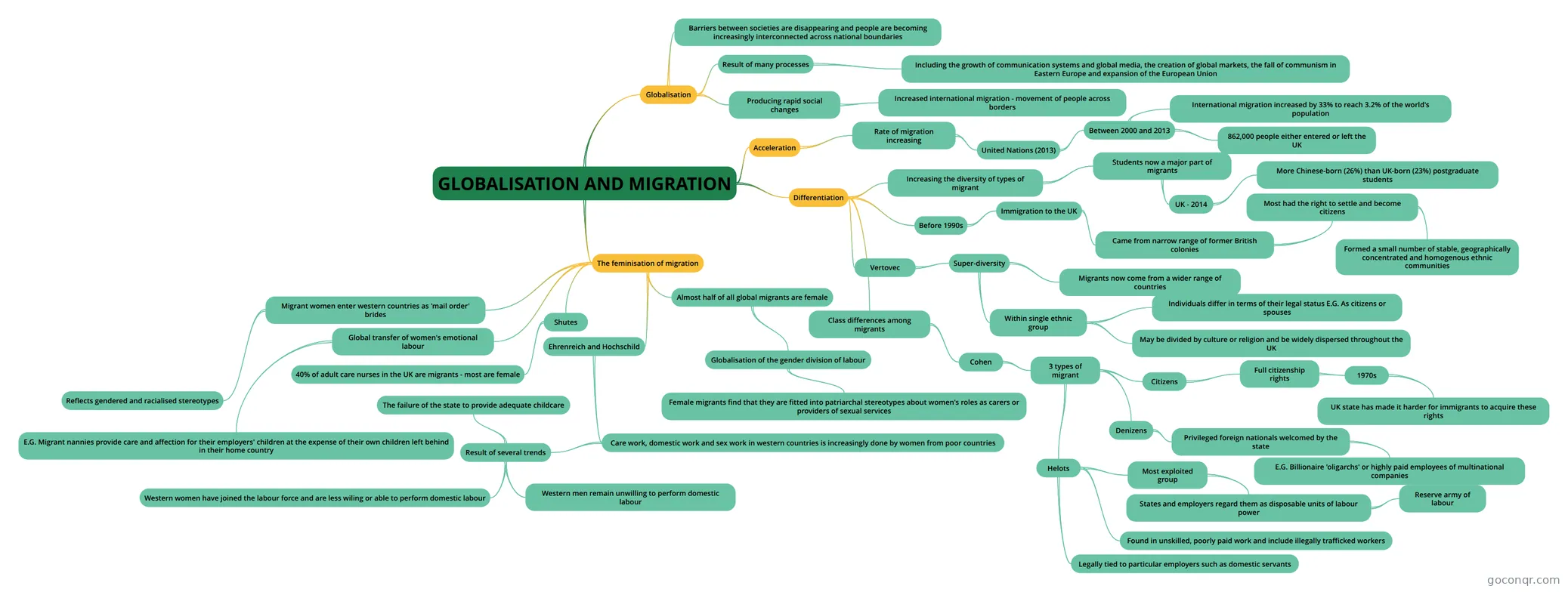
Mind map: Globalisation and migration
Conteúdo do mapa
GLOBALISATION AND MIGRATION
Globalisation
- Barriers between societies are disappearing and people are becoming increasingly interconnected across national boundaries
- Result of many processes
- Including the growth of communication systems and global media, the creation of global markets, the fall of communism in Eastern Europe and expansion of the European Union
- Producing rapid social changes
- Increased international migration - movement of people across borders
Acceleration
- Rate of migration increasing
- United Nations (2013)
- Between 2000 and 2013
- International migration increased by 33% to reach 3.2% of the world's population
- 862,000 people either entered or left the UK
- Between 2000 and 2013
- United Nations (2013)
- Rate of migration increasing
Differentiation
- Increasing the diversity of types of migrant
- Students now a major part of migrants
- UK - 2014
- More Chinese-born (26%) than UK-born (23%) postgraduate students
- UK - 2014
- Students now a major part of migrants
- Before 1990s
- Immigration to the UK
- Came from narrow range of former British colonies
- Most had the right to settle and become citizens
- Formed a small number of stable, geographically concentrated and homogenous ethnic communities
- Most had the right to settle and become citizens
- Came from narrow range of former British colonies
- Immigration to the UK
- Vertovec
- Super-diversity
- Migrants now come from a wider range of countries
- Within single ethnic group
- Individuals differ in terms of their legal status E.G. As citizens or spouses
- May be divided by culture or religion and be widely dispersed throughout the UK
- Super-diversity
- Class differences among migrants
- Cohen
- 3 types of migrant
- Citizens
- Full citizenship rights
- 1970s
- UK state has made it harder for immigrants to acquire these rights
- 1970s
- Full citizenship rights
- Denizens
- Privileged foreign nationals welcomed by the state
- E.G. Billionaire 'oligarchs' or highly paid employees of multinational companies
- Privileged foreign nationals welcomed by the state
- Helots
- Most exploited group
- States and employers regard them as disposable units of labour power
- Reserve army of labour
- States and employers regard them as disposable units of labour power
- Found in unskilled, poorly paid work and include illegally trafficked workers
- Legally tied to particular employers such as domestic servants
- Most exploited group
- Citizens
- 3 types of migrant
- Cohen
- Increasing the diversity of types of migrant
The feminisation of migration
- Almost half of all global migrants are female
- Globalisation of the gender division of labour
- Female migrants find that they are fitted into patriarchal stereotypes about women's roles as carers or providers of sexual services
- Globalisation of the gender division of labour
- Ehrenreich and Hochschild
- Care work, domestic work and sex work in western countries is increasingly done by women from poor countries
- Result of several trends
- The failure of the state to provide adequate childcare
- Western men remain unwilling to perform domestic labour
- Western women have joined the labour force and are less wiling or able to perform domestic labour
- Result of several trends
- Care work, domestic work and sex work in western countries is increasingly done by women from poor countries
- Shutes
- 40% of adult care nurses in the UK are migrants - most are female
- Global transfer of women's emotional labour
- E.G. Migrant nannies provide care and affection for their employers' children at the expense of their own children left behind in their home country
- Migrant women enter western countries as 'mail order' brides
- Reflects gendered and racialised stereotypes
- Almost half of all global migrants are female
Informações
- Descrição
- A level Sociology (DEMOGRAPHY) Mapa Mental sobre GLOBALISATION AND MIGRATION, criado por Inayah Motin em 01-09-2017.
- Criado por
- Inayah Motin
- Visualizações
- 3
- Avaliação
Mais sobre Globalisation and migration