
Mapa mental
Hormone system
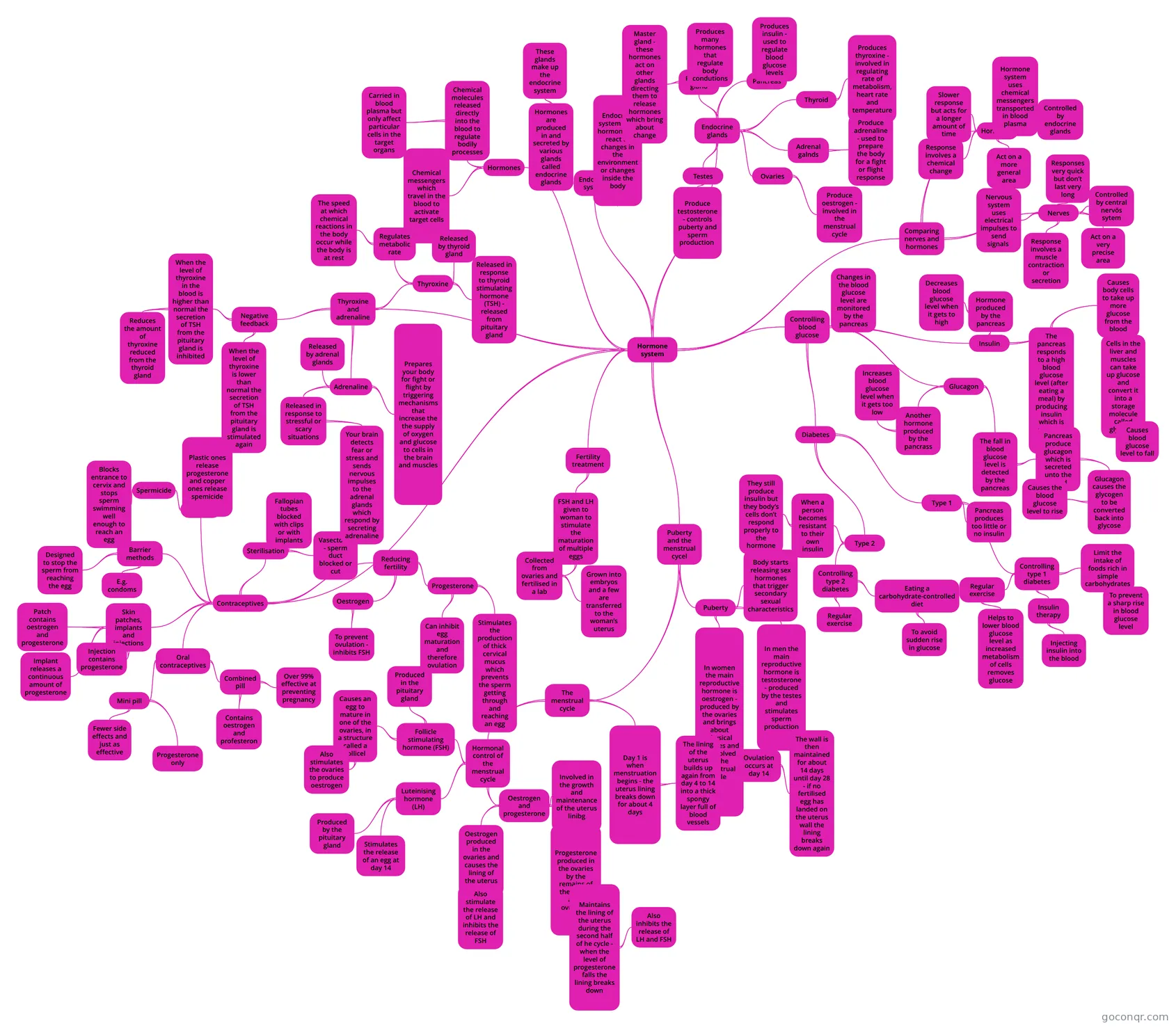
Mind map: hormone system
Conteúdo do mapa
Hormone system
Hormones
- Chemical molecules released directly into the blood to regulate bodily processes
- Carried in blood plasma but only affect particular cells in the target organs
- Chemical messengers which travel in the blood to activate target cells
- Chemical molecules released directly into the blood to regulate bodily processes
Endocrine system
- Hormones are produced in and secreted by various glands called endocrine glands
- These glands make up the endocrine system
- Endocrine system uses hormones to react to changes in the environment or changes inside the body
- Hormones are produced in and secreted by various glands called endocrine glands
Endocrine glands
- Pituitary gland
- Produces many hormones that regulate body condutions
- Master gland - these hormones act on other glands directing them to release hormones which bring about change
- Pancreas
- Produces insulin - used to regulate blood glucose levels
- Thyroid
- Produces thyroxine - involved in regulating rate of metabolism, heart rate and temperature
- Adrenal galnds
- Produce adrenaline - used to prepare the body for a fight or flight response
- Ovaries
- Produce oestrogen - involved in the menstrual cycle
- Testes
- Produce testosterone - controls puberty and sperm production
- Pituitary gland
Comparing nerves and hormones
- Hormones
- Hormone system uses chemical messengers transported in blood plasma
- Slower response but acts for a longer amount of time
- Controlled by endocrine glands
- Act on a more general area
- Response involves a chemical change
- Nerves
- Nervous system uses electrical impulses to send signals
- Responses very quick but don’t last very long
- Controlled by central nervös sytem
- Act on a very precise area
- Response involves a muscle contraction or secretion
- Hormones
Controlling blood glucose
- Changes in the blood glucose level are monitored by the pancreas
- Insulin
- Hormone produced by the pancreas
- Decreases blood glucose level when it gets to high
- The pancreas responds to a high blood glucose level (after eating a meal) by producing insulin which is secreted into the blood
- Causes body cells to take up more glucose from the blood
- Cells in the liver and muscles can take up glucose and convert it into a storage molecule called glycogen
- Causes blood glucose level to fall
- Cells in the liver and muscles can take up glucose and convert it into a storage molecule called glycogen
- Causes body cells to take up more glucose from the blood
- Hormone produced by the pancreas
- Glucagon
- Another hormone produced by the pancrass
- Increases blood glucose level when it gets too low
- The fall in blood glucose level is detected by the pancreas
- Pancreas produce glucagon which is secreted unto the blood
- Glucagon causes the glycogen to be converted back into glycose
- Causes the blood glucose level to rise
- Glucagon causes the glycogen to be converted back into glycose
- Pancreas produce glucagon which is secreted unto the blood
- Another hormone produced by the pancrass
- Diabetes
- Type 1
- Pancreas produces too little or no insulin
- Controlling type 1 diabetes
- Insulin therapy
- Injecting insulin into the blood
- Amount depends on person’s diet and how active they are
- Injecting insulin into the blood
- Limit the intake of foods rich in simple carbohydrates
- To prevent a sharp rise in blood glucose level
- Regular exercise
- Helps to lower blood glucose level as increased metabolism of cells removes glucose
- Insulin therapy
- Type 2
- When a person becomes resistant to their own insulin
- They still produce insulin but they body’s cells don’t respond properly to the hormone
- Controlling type 2 diabetes
- Eating a carbohydrate-controlled diet
- To avoid sudden rise in glucose
- Regular exercise
- Eating a carbohydrate-controlled diet
- When a person becomes resistant to their own insulin
- Type 1
Puberty and the menstrual cycel
- Puberty
- Body starts releasing sex hormones that trigger secondary sexual characteristics
- In men the main reproductive hormone is testosterone - produced by the testes and stimulates sperm production
- In women the main reproductive hormone is oestrogen - produced by the ovaries and brings about physical changes and is involved in the menstrual cycle
- The menstrual cycle
- Day 1 is when menstruation begins - the uterus lining breaks down for about 4 days
- The lining of the uterus builds up again from day 4 to 14 into a thick spongy layer full of blood vessels
- Ovulation occurs at day 14
- The wall is then maintained for about 14 days until day 28 - if no fertilised egg has landed on the uterus wall the lining breaks down again
- Ovulation occurs at day 14
- The lining of the uterus builds up again from day 4 to 14 into a thick spongy layer full of blood vessels
- Hormonal control of the menstrual cycle
- Follicle stimulating hormone (FSH)
- Causes an egg to mature in one of the ovaries, in a structure called a follicel
- Also stimulates the ovaries to produce oestrogen
- Produced in the pituitary gland
- Causes an egg to mature in one of the ovaries, in a structure called a follicel
- Luteinising hormone (LH)
- Stimulates the release of an egg at day 14
- Produced by the pituitary gland
- Oestrogen and progesterone
- Involved in the growth and maintenance of the uterus linibg
- Oestrogen produced in the ovaries and causes the lining of the uterus to grow
- Also stimulate the release of LH and inhibits the release of FSH
- Progesterone produced in the ovaries by the remains of the follicle after ovulation
- Maintains the lining of the uterus during the second half of he cycle - when the level of progesterone falls the lining breaks down
- Also inhibits the release of LH and FSH
- Maintains the lining of the uterus during the second half of he cycle - when the level of progesterone falls the lining breaks down
- Follicle stimulating hormone (FSH)
- Day 1 is when menstruation begins - the uterus lining breaks down for about 4 days
- Puberty
Contraceptives
- Reducing fertility
- Oestrogen
- To prevent ovulation - inhibits FSH
- Progesterone
- Stimulates the production of thick cervical mucus which prevents the sperm getting through and reaching an egg
- Can inhibit egg maturation and therefore ovulation
- Oestrogen
- Oral contraceptives
- Combined pill
- Over 99% effective at preventing pregnancy
- Contains oestrogen and profesteron
- Mini pill
- Progesterone only
- Fewer side effects and just as effective
- Combined pill
- Skin patches, implants and injections
- Patch contains oestrogen and progesterone
- Implant releases a continuous amount of progesterone
- Injection contains progesterone
- Barrier methods
- Designed to stop the sperm from reaching the egg
- E.g. condoms
- IUD
- Spermicide
- Blocks entrance to cervix and stops sperm swimming well enough to reach an egg
- Plastic ones release progesterone and copper ones release spemicide
- Spermicide
- Sterilisation
- Fallopian tubes blocked with clips or with implants
- Vasectomy - sperm duct blocked or cut
- Reducing fertility
Fertility treatment
- FSH and LH given to woman to stimulate the maturation of multiple eggs
- Collected from ovaries and fertilised in a lab
- Grown into embryos and a few are transferred to the woman’s uterus
- Collected from ovaries and fertilised in a lab
- FSH and LH given to woman to stimulate the maturation of multiple eggs
Thyroxine and adrenaline
- Thyroxine
- Released by thyroid gland
- Regulates metabolic rate
- The speed at which chemical reactions in the body occur while the body is at rest
- Released in response to thyroid stimulating hormone (TSH) - released from pituitary gland
- Negative feedback
- When the level of thyroxine in the blood is higher than normal the secretion of TSH from the pituitary gland is inhibited
- Reduces the amount of thyroxine reduced from the thyroid gland
- When the level of thyroxine is lower than normal the secretion of TSH from the pituitary gland is stimulated again
- When the level of thyroxine in the blood is higher than normal the secretion of TSH from the pituitary gland is inhibited
- Adrenaline
- Released by adrenal glands
- Released in response to stressful or scary situations
- Your brain detects fear or stress and sends nervous impulses to the adrenal glands which respond by secreting adrenaline
- Prepares your body for fight or flight by triggering mechanisms that increase the the supply of oxygen and glucose to cells in the brain and muscles
- Thyroxine
Informações
- Descrição
- Yr 10 mocks (Biology) Mapa Mental sobre Hormone system, criado por Emily H em 19-11-2017.
- Criado por
- Emily H
- Visualizações
- 0
- Avaliação