
Mapa mental
Pneumothorax
Conteúdo do mapa
Pneumothorax
Pathophysiology: Restrictive respiratory disorders: impairs the ability of chest wall to move
- Spontaneous: when the air sacs on top of lungs rupture
- Closed: Pleural cavity pressure is less than atmospheric pressure
- Open Pneumothorax: pleural cavity pressure is equal to the atmospheric pressure
- Tension pneumothorax: pleural cavity pressure is greater than atmospheric pressure
Pathophysiology: Restrictive respiratory disorder: impairs the ability of chest wall to move, air in the lungs
- Spontaneous: occurs due to the rupture of small blebs (air filled sacs located on surface of lungs)
- Tension: will desat right away and blood pressure will go down
- Open: pleural cavity is equal to the atmospheric pressure
- closed: pleural cavity pressure is less than the atmospheric pressure
- Signs and Symptoms: Sudden respiratory distress, pain, no lung sounds on side of pneumo, decreased heart sounds if increased pressure, tracheal deviation toward un affected side, anxiety, pallor, cyanosis, hypotension, cough
- Management: Oxygen therapy
- Invasive: Chest Tube: usually attached to drainage system
- Nursing care: can be inserted in ED or OR. Position patient with arm raised above head on affected side to expose midaxillary area, elevate head 30-60 degree angle to lower diaphragm and reduce injury risk. Dressings: change according to protocol, remove dressing and assess for inflammation or infection.
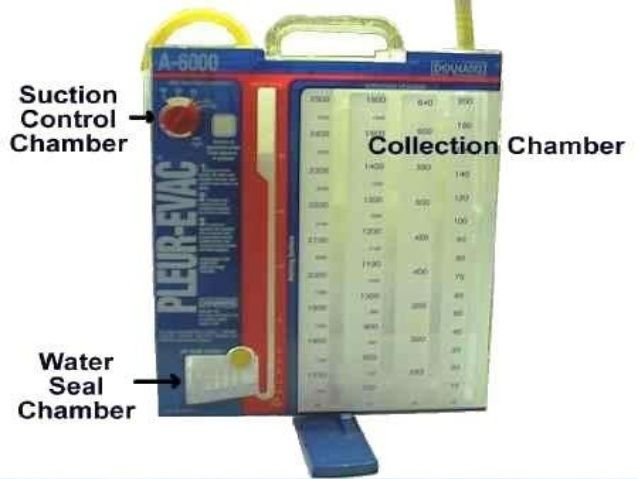
- Drainage system: used to collect fluid, air, or blood from thoracic cavity
- First compartment: collection chamber. Receives fluid and air from pleural or mediastinal space. Drained fluid stays in this chamber while expelled air vents to the second compartment
- Second Compartment: water seal chamber: contains 2 cm of water, which acts as a one-way valve. Incoming air enters from collection chamber and bubbles up through the water. Water prevents backflow of air into patient. Intermittent bubbling during exhalation, coughing, or sneezing may occur. Bubbling ceases when air leak resolves and lung becomes more fully expanded. Normal fluctuation is tidaling- water moves up and down in concert with respiration- cessation of tidaling may signify occlusion of chest tube
- Third compartment: suction control chamber. Applies suction to chest drainage system. Uses a column of water to control the amount of suction from the wall regulator
- Non-invasive: CPAP: pressure on expiration and inspiration, prevents alveolar collapse, decreases work of breathing. BiPAP: can change pressure on expiration and inspiration (if you need to expire for longer time, asthma, COPD)
- Nursing care: indicated for patients with hypercapneic respiratory failure, COPD, respiratory acidosis. Assess LOC, VS, O2 sat, chest movement, RR, nutrition, comfort, humidification,
- Benefits: reduced work of breathing, improved gas exchange, decreased need for ICU admission for intubation, shorter stays, decreased infection rates, fewer deaths
- Complicaitons: gastric distention, vomiting, risk of aspiration, nasal congestion, nasal and oral drying, eye irritation, pneumothorax, skin breakdown on the face, claustrophobia
- Invasive: Chest Tube: usually attached to drainage system
- Management: Oxygen therapy