
Mapa mental
Families and Households - Couples
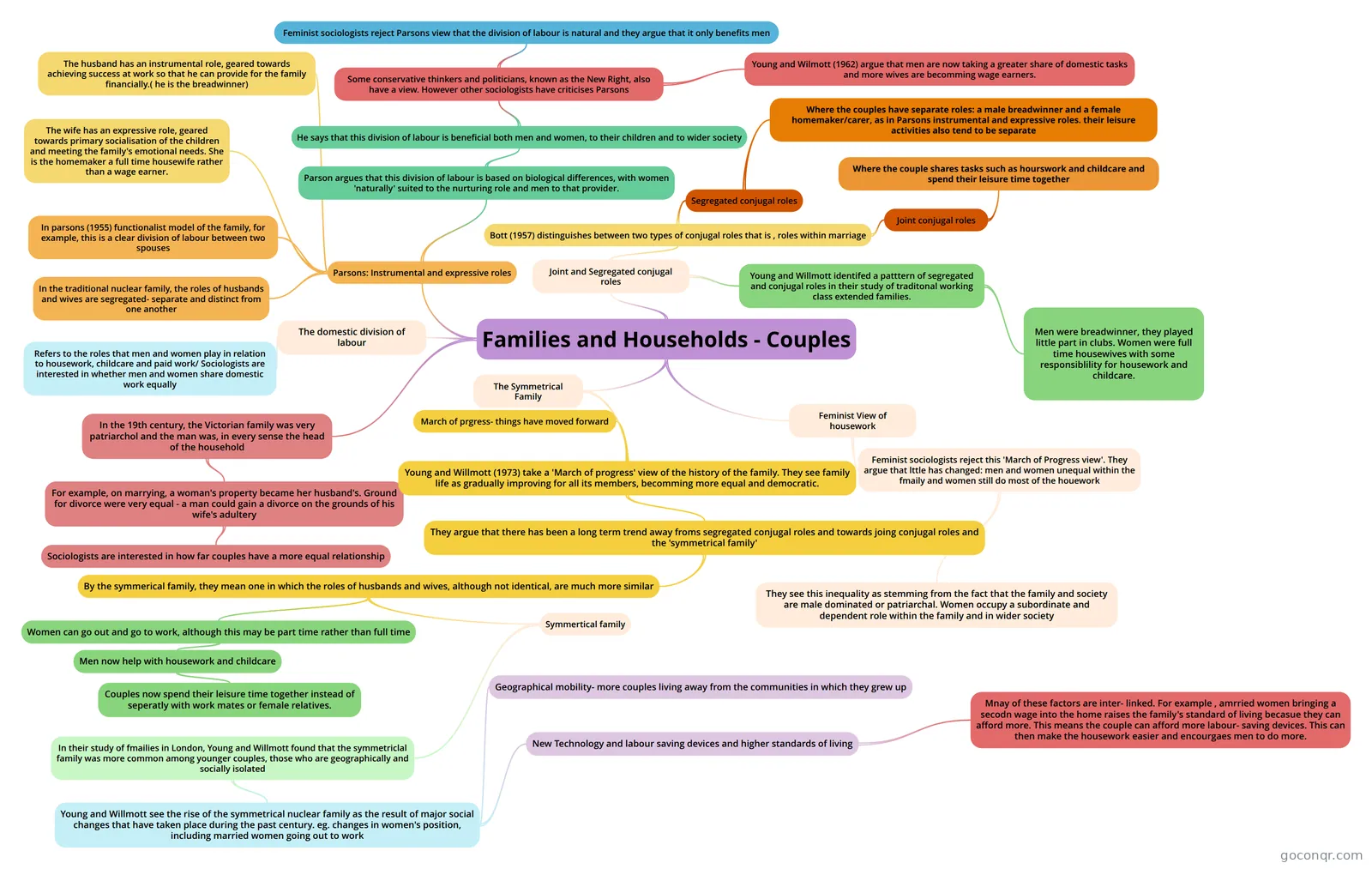
Mind map: Families and households - couples
Conteúdo do mapa
Families and Households - Couples
In the 19th century, the Victorian family was very patriarchol and the man was, in every sense the head of the household
- For example, on marrying, a woman's property became her husband's. Ground for divorce were very equal - a man could gain a divorce on the grounds of his wife's adultery
- Sociologists are interested in how far couples have a more equal relationship
- For example, on marrying, a woman's property became her husband's. Ground for divorce were very equal - a man could gain a divorce on the grounds of his wife's adultery
The domestic division of labour
- Refers to the roles that men and women play in relation to housework, childcare and paid work/ Sociologists are interested in whether men and women share domestic work equally
Parsons: Instrumental and expressive roles
- In the traditional nuclear family, the roles of husbands and wives are segregated- separate and distinct from one another
- In parsons (1955) functionalist model of the family, for example, this is a clear division of labour between two spouses
- The husband has an instrumental role, geared towards achieving success at work so that he can provide for the family financially.( he is the breadwinner)
- The wife has an expressive role, geared towards primary socialisation of the children and meeting the family's emotional needs. She is the homemaker a full time housewife rather than a wage earner.
- Parson argues that this division of labour is based on biological differences, with women 'naturally' suited to the nurturing role and men to that provider.
- He says that this division of labour is beneficial both men and women, to their children and to wider society
- Some conservative thinkers and politicians, known as the New Right, also have a view. However other sociologists have criticises Parsons
- Feminist sociologists reject Parsons view that the division of labour is natural and they argue that it only benefits men
- Young and Wilmott (1962) argue that men are now taking a greater share of domestic tasks and more wives are becomming wage earners.
- Some conservative thinkers and politicians, known as the New Right, also have a view. However other sociologists have criticises Parsons
- He says that this division of labour is beneficial both men and women, to their children and to wider society
Joint and Segregated conjugal roles
- Bott (1957) distinguishes between two types of conjugal roles that is , roles within marriage
- Segregated conjugal roles
- Where the couples have separate roles: a male breadwinner and a female homemaker/carer, as in Parsons instrumental and expressive roles. their leisure activities also tend to be separate
- Joint conjugal roles
- Where the couple shares tasks such as hourswork and childcare and spend their leisure time together
- Segregated conjugal roles
- Young and Willmott identifed a patttern of segregated and conjugal roles in their study of traditonal working class extended families.
- Men were breadwinner, they played little part in clubs. Women were full time housewives with some responsiblility for housework and childcare.
- Bott (1957) distinguishes between two types of conjugal roles that is , roles within marriage
The Symmetrical Family
- Young and Willmott (1973) take a 'March of progress' view of the history of the family. They see family life as gradually improving for all its members, becomming more equal and democratic.
- March of prgress- things have moved forward
- They argue that there has been a long term trend away froms segregated conjugal roles and towards joing conjugal roles and the 'symmetrical family'
- By the symmerical family, they mean one in which the roles of husbands and wives, although not identical, are much more similar
- Women can go out and go to work, although this may be part time rather than full time
- Men now help with housework and childcare
- Couples now spend their leisure time together instead of seperatly with work mates or female relatives.
- Men now help with housework and childcare
- Symmertical family
- In their study of fmailies in London, Young and Willmott found that the symmetriclal family was more common among younger couples, those who are geographically and socially isolated
- Young and Willmott see the rise of the symmetrical nuclear family as the result of major social changes that have taken place during the past century. eg. changes in women's position, including married women going out to work
- Geographical mobility- more couples living away from the communities in which they grew up
- New Technology and labour saving devices and higher standards of living
- Mnay of these factors are inter- linked. For example , amrried women bringing a secodn wage into the home raises the family's standard of living becasue they can afford more. This means the couple can afford more labour- saving devices. This can then make the housework easier and encourgaes men to do more.
- Young and Willmott see the rise of the symmetrical nuclear family as the result of major social changes that have taken place during the past century. eg. changes in women's position, including married women going out to work
- In their study of fmailies in London, Young and Willmott found that the symmetriclal family was more common among younger couples, those who are geographically and socially isolated
- Women can go out and go to work, although this may be part time rather than full time
- By the symmerical family, they mean one in which the roles of husbands and wives, although not identical, are much more similar
- Young and Willmott (1973) take a 'March of progress' view of the history of the family. They see family life as gradually improving for all its members, becomming more equal and democratic.
Feminist View of housework
- Feminist sociologists reject this 'March of Progress view'. They argue that lttle has changed: men and women unequal within the fmaily and women still do most of the houework
- They see this inequality as stemming from the fact that the family and society are male dominated or patriarchal. Women occupy a subordinate and dependent role within the family and in wider society
- Feminist sociologists reject this 'March of Progress view'. They argue that lttle has changed: men and women unequal within the fmaily and women still do most of the houework
Informações
- Descrição
- AS level Sociology Mapa Mental sobre Families and Households - Couples, criado por Laiba Sheeraz em 28-02-2018.
- Criado por
- Laiba Sheeraz
- Visualizações
- 9
- Avaliação