
Mapa mental
Cell Signalling
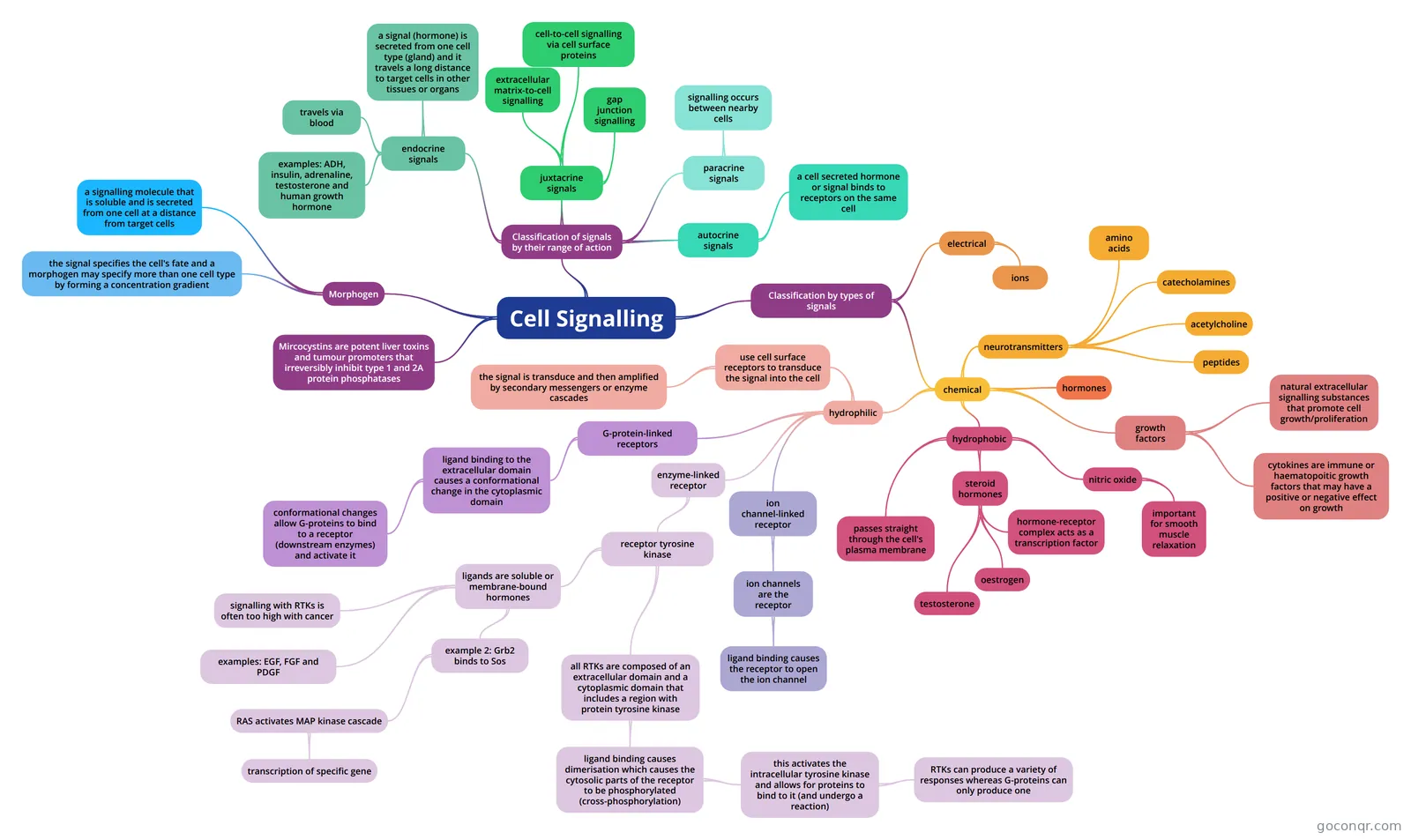
Mind map: Cell signalling
Conteúdo do mapa
Cell Signalling
Classification of signals by their range of action
- endocrine signals
- a signal (hormone) is secreted from one cell type (gland) and it travels a long distance to target cells in other tissues or organs
- travels via blood
- examples: ADH, insulin, adrenaline, testosterone and human growth hormone
- juxtacrine signals
- cell-to-cell signalling via cell surface proteins
- extracellular matrix-to-cell signalling
- gap junction signalling
- paracrine signals
- signalling occurs between nearby cells
- autocrine signals
- a cell secreted hormone or signal binds to receptors on the same cell
- endocrine signals
Classification by types of signals
- electrical
- ions
- chemical
- neurotransmitters
- amino acids
- catecholamines
- acetylcholine
- acetylcholinesterase enzyme and reuptake transporters switch off the acetylcholine signal myasthenia gravis is muscle weakness and is when autoimmune antibodies attack ACh receptors at neuromuscular junctions so there isn't appropriate muscle innervation
- peptides
- hormones
- growth factors
- natural extracellular signalling substances that promote cell growth/proliferation
- cytokines are immune or haematopoitic growth factors that may have a positive or negative effect on growth
- hydrophilic
- use cell surface receptors to transduce the signal into the cell
- the signal is transduce and then amplified by secondary messengers or enzyme cascades
- ion channel-linked receptor
- Example: GABA-A receptor GABA is the main inhibitory neurotransmitter in the CNS. It is a ligand-gated chloride ion channel of post-synaptic nerve cells. GABA-A is the site of action for a lot of drugs
- ion channels are the receptor
- ligand binding causes the receptor to open the ion channel
- enzyme-linked receptor
- receptor tyrosine kinase
- ligands are soluble or membrane-bound hormones
- examples: EGF, FGF and PDGF
- example 2: Grb2 binds to Sos
- RAS activates MAP kinase cascade
- transcription of specific gene
- RAS activates MAP kinase cascade
- signalling with RTKs is often too high with cancer
- all RTKs are composed of an extracellular domain and a cytoplasmic domain that includes a region with protein tyrosine kinase
- ligand binding causes dimerisation which causes the cytosolic parts of the receptor to be phosphorylated (cross-phosphorylation)
- this activates the intracellular tyrosine kinase and allows for proteins to bind to it (and undergo a reaction)
- RTKs can produce a variety of responses whereas G-proteins can only produce one
- this activates the intracellular tyrosine kinase and allows for proteins to bind to it (and undergo a reaction)
- ligand binding causes dimerisation which causes the cytosolic parts of the receptor to be phosphorylated (cross-phosphorylation)
- ligands are soluble or membrane-bound hormones
- receptor tyrosine kinase
- G-protein-linked receptors
- also called serpentine or seven-span receptors as their protein structure crosses the plasma membrane 7 times alpha, beta and gamma subunit inactive form of protein is GDP bound ligand binding causes GTP to bind to the protein instead of GDP and this allows the alpha subunit to dissociate from the beta and gamma subunits the alpha, beta and gamma subunits go on to have different effects 3 main G-alpha effectors are adenylyl cyclase (can make cyclic AMP), phospholipase C (can cause calcium release from smooth ER) and RhoGEFs beta and gamma subunits are often ion channels GTP is hydrolysed to GDP by RGS protein adrenergic receptors are G-protein coupled receptors
- ligand binding to the extracellular domain causes a conformational change in the cytoplasmic domain
- conformational changes allow G-proteins to bind to a receptor (downstream enzymes) and activate it
- use cell surface receptors to transduce the signal into the cell
- hydrophobic
- steroid hormones
- oestrogen
- testosterone
- hormone-receptor complex acts as a transcription factor
- passes straight through the cell's plasma membrane
- nitric oxide
- important for smooth muscle relaxation
- steroid hormones
- neurotransmitters
- electrical
Morphogen
- a signalling molecule that is soluble and is secreted from one cell at a distance from target cells
- the signal specifies the cell's fate and a morphogen may specify more than one cell type by forming a concentration gradient
Mircocystins are potent liver toxins and tumour promoters that irreversibly inhibit type 1 and 2A protein phosphatases
Informações
- Descrição
- Year 1 Mapa Mental sobre Cell Signalling, criado por Rana Al-Khayat em 29-03-2018.
- Criado por
- Rana Al-Khayat
- Visualizações
- 0
- Avaliação