
Mapa mental
Business ethics
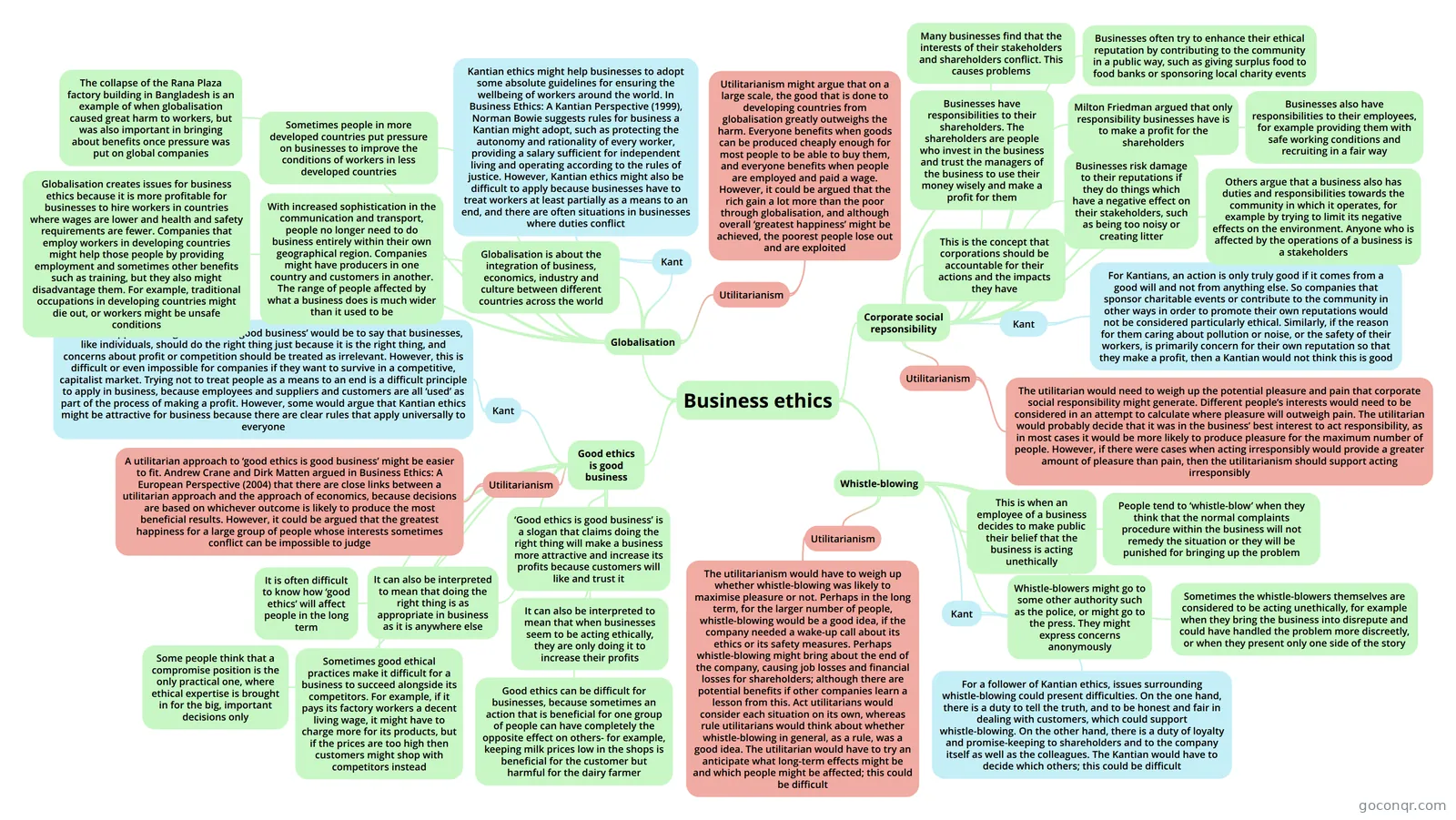
Mind map: Business ethics
Conteúdo do mapa
Business ethics
Corporate social repsonsibility
- Kant
- For Kantians, an action is only truly good if it comes from a good will and not from anything else. So companies that sponsor charitable events or contribute to the community in other ways in order to promote their own reputations would not be considered particularly ethical. Similarly, if the reason for them caring about pollution or noise, or the safety of their workers, is primarily concern for their own reputation so that they make a profit, then a Kantian would not think this is good
- Utilitarianism
- The utilitarian would need to weigh up the potential pleasure and pain that corporate social responsibility might generate. Different people’s interests would need to be considered in an attempt to calculate where pleasure will outweigh pain. The utilitarian would probably decide that it was in the business’ best interest to act responsibility, as in most cases it would be more likely to produce pleasure for the maximum number of people. However, if there were cases when acting irresponsibly would provide a greater amount of pleasure than pain, then the utilitarianism should support acting irresponsibly
- This is the concept that corporations should be accountable for their actions and the impacts they have
- Businesses have responsibilities to their shareholders. The shareholders are people who invest in the business and trust the managers of the business to use their money wisely and make a profit for them
- Businesses also have responsibilities to their employees, for example providing them with safe working conditions and recruiting in a fair way
- Milton Friedman argued that only responsibility businesses have is to make a profit for the shareholders
- Others argue that a business also has duties and responsibilities towards the community in which it operates, for example by trying to limit its negative effects on the environment. Anyone who is affected by the operations of a business is a stakeholders
- Businesses risk damage to their reputations if they do things which have a negative effect on their stakeholders, such as being too noisy or creating litter
- Many businesses find that the interests of their stakeholders and shareholders conflict. This causes problems
- Businesses often try to enhance their ethical reputation by contributing to the community in a public way, such as giving surplus food to food banks or sponsoring local charity events
- Kant
Good ethics is good business
- Kant
- A Kantian approach to ‘good ethics is good business’ would be to say that businesses, like individuals, should do the right thing just because it is the right thing, and concerns about profit or competition should be treated as irrelevant. However, this is difficult or even impossible for companies if they want to survive in a competitive, capitalist market. Trying not to treat people as a means to an end is a difficult principle to apply in business, because employees and suppliers and customers are all ‘used’ as part of the process of making a profit. However, some would argue that Kantian ethics might be attractive for business because there are clear rules that apply universally to everyone
- Utilitarianism
- A utilitarian approach to ‘good ethics is good business’ might be easier to fit. Andrew Crane and Dirk Matten argued in Business Ethics: A European Perspective (2004) that there are close links between a utilitarian approach and the approach of economics, because decisions are based on whichever outcome is likely to produce the most beneficial results. However, it could be argued that the greatest happiness for a large group of people whose interests sometimes conflict can be impossible to judge
- ‘Good ethics is good business’ is a slogan that claims doing the right thing will make a business more attractive and increase its profits because customers will like and trust it
- It can also be interpreted to mean that doing the right thing is as appropriate in business as it is anywhere else
- It can also be interpreted to mean that when businesses seem to be acting ethically, they are only doing it to increase their profits
- Good ethics can be difficult for businesses, because sometimes an action that is beneficial for one group of people can have completely the opposite effect on others- for example, keeping milk prices low in the shops is beneficial for the customer but harmful for the dairy farmer
- Sometimes good ethical practices make it difficult for a business to succeed alongside its competitors. For example, if it pays its factory workers a decent living wage, it might have to charge more for its products, but if the prices are too high then customers might shop with competitors instead
- It is often difficult to know how ‘good ethics’ will affect people in the long term
- Some people think that a compromise position is the only practical one, where ethical expertise is brought in for the big, important decisions only
- Kant
Whistle-blowing
- Kant
- For a follower of Kantian ethics, issues surrounding whistle-blowing could present difficulties. On the one hand, there is a duty to tell the truth, and to be honest and fair in dealing with customers, which could support whistle-blowing. On the other hand, there is a duty of loyalty and promise-keeping to shareholders and to the company itself as well as the colleagues. The Kantian would have to decide which others; this could be difficult
- Utilitarianism
- The utilitarianism would have to weigh up whether whistle-blowing was likely to maximise pleasure or not. Perhaps in the long term, for the larger number of people, whistle-blowing would be a good idea, if the company needed a wake-up call about its ethics or its safety measures. Perhaps whistle-blowing might bring about the end of the company, causing job losses and financial losses for shareholders; although there are potential benefits if other companies learn a lesson from this. Act utilitarians would consider each situation on its own, whereas rule utilitarians would think about whether whistle-blowing in general, as a rule, was a good idea. The utilitarian would have to try an anticipate what long-term effects might be and which people might be affected; this could be difficult
- This is when an employee of a business decides to make public their belief that the business is acting unethically
- People tend to ‘whistle-blow’ when they think that the normal complaints procedure within the business will not remedy the situation or they will be punished for bringing up the problem
- Whistle-blowers might go to some other authority such as the police, or might go to the press. They might express concerns anonymously
- Sometimes the whistle-blowers themselves are considered to be acting unethically, for example when they bring the business into disrepute and could have handled the problem more discreetly, or when they present only one side of the story
- Kant
Globalisation
- Kant
- Kantian ethics might help businesses to adopt some absolute guidelines for ensuring the wellbeing of workers around the world. In Business Ethics: A Kantian Perspective (1999), Norman Bowie suggests rules for business a Kantian might adopt, such as protecting the autonomy and rationality of every worker, providing a salary sufficient for independent living and operating according to the rules of justice. However, Kantian ethics might also be difficult to apply because businesses have to treat workers at least partially as a means to an end, and there are often situations in businesses where duties conflict
- Utilitarianism
- Utilitarianism might argue that on a large scale, the good that is done to developing countries from globalisation greatly outweighs the harm. Everyone benefits when goods can be produced cheaply enough for most people to be able to buy them, and everyone benefits when people are employed and paid a wage. However, it could be argued that the rich gain a lot more than the poor through globalisation, and although overall ‘greatest happiness’ might be achieved, the poorest people lose out and are exploited
- Globalisation is about the integration of business, economics, industry and culture between different countries across the world
- With increased sophistication in the communication and transport, people no longer need to do business entirely within their own geographical region. Companies might have producers in one country and customers in another. The range of people affected by what a business does is much wider than it used to be
- Globalisation creates issues for business ethics because it is more profitable for businesses to hire workers in countries where wages are lower and health and safety requirements are fewer. Companies that employ workers in developing countries might help those people by providing employment and sometimes other benefits such as training, but they also might disadvantage them. For example, traditional occupations in developing countries might die out, or workers might be unsafe conditions
- Sometimes people in more developed countries put pressure on businesses to improve the conditions of workers in less developed countries
- The collapse of the Rana Plaza factory building in Bangladesh is an example of when globalisation caused great harm to workers, but was also important in bringing about benefits once pressure was put on global companies
- Kant
Informações
- Descrição
- AS level Philosophy ethics and theology (Ethics) Mapa Mental sobre Business ethics, criado por Lily Duffy em 15-04-2018.
- Criado por
- Lily Duffy
- Visualizações
- 0
- Avaliação
Mais sobre Business and Professional Ethics