
Mapa mental
EFFECTIVENESS
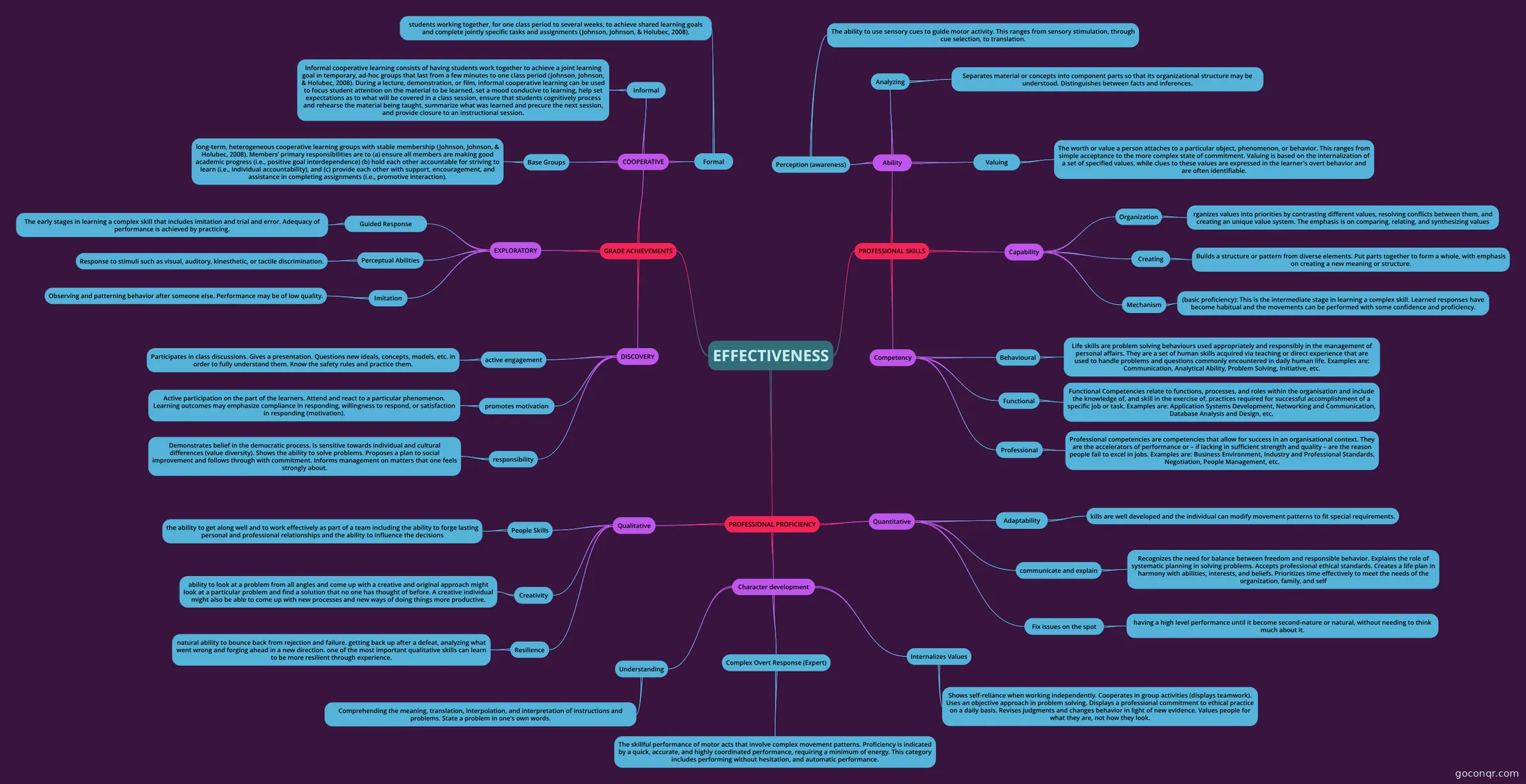
Mind map: Effectiveness
Conteúdo do mapa
EFFECTIVENESS
GRADE ACHIEVEMENTS
- COOPERATIVE
- Formal
- students working together, for one class period to several weeks, to achieve shared learning goals and complete jointly specific tasks and assignments (Johnson, Johnson, & Holubec, 2008).
- Informal
- Informal cooperative learning consists of having students work together to achieve a joint learning goal in temporary, ad-hoc groups that last from a few minutes to one class period (Johnson, Johnson, & Holubec, 2008). During a lecture, demonstration, or film, informal cooperative learning can be used to focus student attention on the material to be learned, set a mood conducive to learning, help set expectations as to what will be covered in a class session, ensure that students cognitively process and rehearse the material being taught, summarize what was learned and precure the next session, and provide closure to an instructional session.
- Base Groups
- long-term, heterogeneous cooperative learning groups with stable membership (Johnson, Johnson, & Holubec, 2008). Members’ primary responsibilities are to (a) ensure all members are making good academic progress (i.e., positive goal interdependence) (b) hold each other accountable for striving to learn (i.e., individual accountability), and (c) provide each other with support, encouragement, and assistance in completing assignments (i.e., promotive interaction).
- Formal
- EXPLORATORY
- Guided Response
- The early stages in learning a complex skill that includes imitation and trial and error. Adequacy of performance is achieved by practicing.
- Imitation
- Observing and patterning behavior after someone else. Performance may be of low quality.
- Perceptual Abilities
- Response to stimuli such as visual, auditory, kinesthetic, or tactile discrimination.
- Guided Response
- DISCOVERY
- promotes motivation
- Active participation on the part of the learners. Attend and react to a particular phenomenon. Learning outcomes may emphasize compliance in responding, willingness to respond, or satisfaction in responding (motivation).
- responsibility
- Demonstrates belief in the democratic process. Is sensitive towards individual and cultural differences (value diversity). Shows the ability to solve problems. Proposes a plan to social improvement and follows through with commitment. Informs management on matters that one feels strongly about.
- active engagement
- Participates in class discussions. Gives a presentation. Questions new ideals, concepts, models, etc. in order to fully understand them. Know the safety rules and practice them.
- promotes motivation
- COOPERATIVE
PROFESSIONAL PROFICIENCY
- Qualitative
- Resilience
- natural ability to bounce back from rejection and failure. getting back up after a defeat, analyzing what went wrong and forging ahead in a new direction. one of the most important qualitative skills can learn to be more resilient through experience.
- People Skills
- the ability to get along well and to work effectively as part of a team including the ability to forge lasting personal and professional relationships and the ability to influence the decisions
- Creativity
- ability to look at a problem from all angles and come up with a creative and original approach might look at a particular problem and find a solution that no one has thought of before. A creative individual might also be able to come up with new processes and new ways of doing things more productive.
- Resilience
- Character development
- Complex Overt Response (Expert)
- The skillful performance of motor acts that involve complex movement patterns. Proficiency is indicated by a quick, accurate, and highly coordinated performance, requiring a minimum of energy. This category includes performing without hesitation, and automatic performance.
- Understanding
- Comprehending the meaning, translation, interpolation, and interpretation of instructions and problems. State a problem in one's own words.
- Internalizes Values
- Shows self-reliance when working independently. Cooperates in group activities (displays teamwork). Uses an objective approach in problem solving. Displays a professional commitment to ethical practice on a daily basis. Revises judgments and changes behavior in light of new evidence. Values people for what they are, not how they look.
- Complex Overt Response (Expert)
- Quantitative
- Fix issues on the spot
- having a high level performance until it become second-nature or natural, without needing to think much about it.
- Adaptability
- kills are well developed and the individual can modify movement patterns to fit special requirements.
- communicate and explain
- Recognizes the need for balance between freedom and responsible behavior. Explains the role of systematic planning in solving problems. Accepts professional ethical standards. Creates a life plan in harmony with abilities, interests, and beliefs. Prioritizes time effectively to meet the needs of the organization, family, and self
- Fix issues on the spot
- Qualitative
PROFESSIONAL SKILLS
- Ability
- Perception (awareness)
- The ability to use sensory cues to guide motor activity. This ranges from sensory stimulation, through cue selection, to translation.
- Analyzing
- Separates material or concepts into component parts so that its organizational structure may be understood. Distinguishes between facts and inferences.
- Valuing
- The worth or value a person attaches to a particular object, phenomenon, or behavior. This ranges from simple acceptance to the more complex state of commitment. Valuing is based on the internalization of a set of specified values, while clues to these values are expressed in the learner's overt behavior and are often identifiable.
- Perception (awareness)
- Capability
- Organization
- rganizes values into priorities by contrasting different values, resolving conflicts between them, and creating an unique value system. The emphasis is on comparing, relating, and synthesizing values
- Creating
- Builds a structure or pattern from diverse elements. Put parts together to form a whole, with emphasis on creating a new meaning or structure.
- Mechanism
- (basic proficiency): This is the intermediate stage in learning a complex skill. Learned responses have become habitual and the movements can be performed with some confidence and proficiency.
- Organization
- Competency
- Behavioural
- Life skills are problem solving behaviours used appropriately and responsibly in the management of personal affairs. They are a set of human skills acquired via teaching or direct experience that are used to handle problems and questions commonly encountered in daily human life. Examples are: Communication, Analytical Ability, Problem Solving, Initiative, etc.
- Functional
- Functional Competencies relate to functions, processes, and roles within the organisation and include the knowledge of, and skill in the exercise of, practices required for successful accomplishment of a specific job or task. Examples are: Application Systems Development, Networking and Communication, Database Analysis and Design, etc.
- Professional
- Professional competencies are competencies that allow for success in an organisational context. They are the accelerators of performance or – if lacking in sufficient strength and quality – are the reason people fail to excel in jobs. Examples are: Business Environment, Industry and Professional Standards, Negotiation, People Management, etc.
- Behavioural
- Ability
Informações
- Descrição
- English Mapa Mental sobre EFFECTIVENESS, criado por Shzn Tj em 25-04-2018.
- Criado por
- Shzn Tj
- Visualizações
- 7
- Avaliação