
Mapa mental
Topic 1: Atomic Structure and the Periodic Table
Conteúdo do mapa
Topic 1: Atomic Structure and the Periodic Table
Atoms
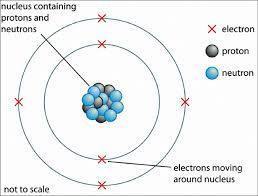
- The nucleus contains protons and neutrons
- Protons have a relative mass of 1 and a charge of +1
- Neutrons have a relative mass of 1 and a charge of 0
- Electrons are found around the nucleus, arranged in shells
- Electrons have a relative mass of 0 and charge of -1
- The number of protons is EQUAL to the number of electrons
- Atoms are neutral as charges cancel each other out
- The atomic number of an element tells you the number of protons (& therefore electrons)
- The mass number tells you the number of protons + the number of neutrons in the nucleus
- Number of neutrons = mass number - atomic number
- The mass number tells you the number of protons + the number of neutrons in the nucleus
- The nucleus contains protons and neutrons
Elements
- An element is a substance made of atoms that all have the same number of protons
- Contains only one type of atom
- An element is a substance made of atoms that all have the same number of protons
Isotopes
- Isotopes are different forms of the same element
- They all have the same number of PROTONS
- The number of NEUTRONS chnages
- The relative atomic mass is an AVERAGE mass of the isotopes that make up an element
- Relative atomic mass (Ar) = Sum of (isotope abundance x isotope mass number) ------------------------------------- Sum of abundance of all isotopes
- Isotopes are different forms of the same element
Compounds
- Atoms join together to make COMPOUNDS
- Hard to seperate
- Compounds are two or more elements chemically bonded together
- Atoms join together to make COMPOUNDS
Chromatography
- 1: draw a line in PENCIL
- 2: add a spot of ink on to the line and place in solvent
- Make sure the solvent isn't touching the ink
- 3: let the solvent travel up the paper, carrying the ink with it
- 4: each dye will separate as they move at different rates
- 5: when the solvent is nearly at the top, take the paper out and leave to dry
Filtration & Crystallisation
- Filtration separates insoluble solids from liquids
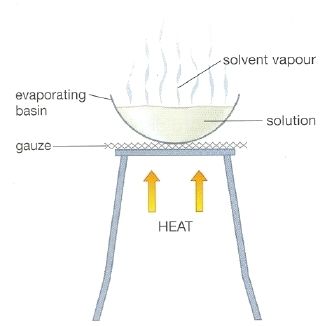
- 1: pour solution into evaporating dish
- 2: heat the solution until most of the solvent has evaporated
- 3: Remove heat and leave to cool and form crystals
- 4: dry crystals using filter paper
Distillation
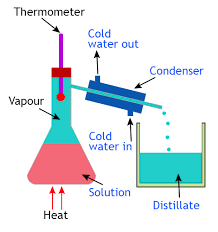
- 1: heat solution
- 2: as the temperature rises, the component with the lowest boiling point will evaporate
- 3: the vapour is cooled and condenses and is collected in a separate beaker
History of the atom
- The Plum Pudding Model showed that an atom was a ball of positive charge with negatively charged electrons scattered throughout it
- Rutherford showed the plum pudding model was inaccurate by carrying out the alpha particle scattering experiment
- fired positively charged alpha particles at a sheet of gold expecting the particles to pass straight through
- Most particles went straight through but some were deflected
- fired positively charged alpha particles at a sheet of gold expecting the particles to pass straight through
- Rutherford showed the plum pudding model was inaccurate by carrying out the alpha particle scattering experiment
- The nuclear model shows that an atom has a positively charged nucleus at the center with a 'cloud' of electrons around it
- Most of the atom is empty space
- Alpha particles would pass straight through the empty space unless fired at the nucleus when it would be deflected backwards
- Bohr's nuclear model showed electrons were arranged in shells which were a fixed distance away from the nucleus which contains protons and neutrons
- The Plum Pudding Model showed that an atom was a ball of positive charge with negatively charged electrons scattered throughout it
Electronic structure
- Electrons are arranged in shells (energy levels)
- !st: 2 electrons 2nd: 8 electrons 3rd: 8 electrons
- Atoms react to have a full outer shell
- Electrons are arranged in shells (energy levels)
Metals and non metals
- metals are found on the left hand side of the periodic table
- Form positive ions
- strong
- Malleable
- Good conductors
- High melting/ boiling points
- Non metals are found on the right hand side of the periodic table
- Forms negative ions
- Brittle
- Dull looking
- Don't conduct electricity
- metals are found on the left hand side of the periodic table
Periodic table
- Developement
- Arranged in order of atomic mass
- Mendeleev placed elements in groups based on their physical and chemical properties
- He left gaps to allow undiscovered elements with similar properties to be added into the periodic table
- Modern
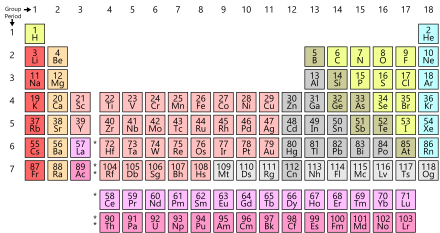
- Arranged in order of increasing atomic number
- Arranged in groups (vertical) and periods (horizontal)
- Group number tells you how many electrons are in the element's outer shell
- Arranged in groups (vertical) and periods (horizontal)
- Arranged in order of increasing atomic number
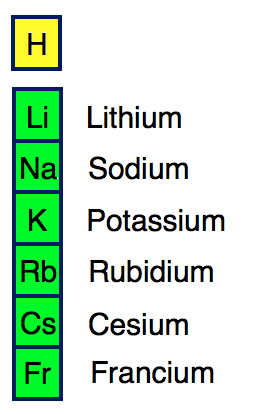
- Group 1 elements: Alkali metals
- Soft
- Reactive
- As you go down the group
- Reactivity increaes
- Melting/ boiling points decrease
- Reactivity increaes
- Forms +1 ions
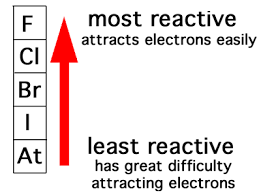
- Group 7 elements: Halogens
- As you go down the group
- Reactivity decreases
- Melting/ boiling point increase
- Reactivity decreases
- All halogens are diatomic molecules
- Fluorine is a poisonous yellow gas
- Chlorine is a poisonous green gas
- Bromine is a dense, poisonous red/ brown liquid
- Iodine is a grey solid or purple vapour
- Form -1 ions
- As you go down the group
- Group 0 elements: Noble gases
- Inert (unreactive) as they have a full outer shell of electrons
- As you go down the group
- Boiling points increase
- Developement
Imagens e arquivos do mapa

Informações
- Descrição
- Year 11 Chemistry Mapa Mental sobre Topic 1: Atomic Structure and the Periodic Table, criado por Lauren Bayard em 08-05-2018.
- Criado por
- Lauren Bayard
- Visualizações
- 0
- Avaliação