
Mapa mental
Literary Devices (1)
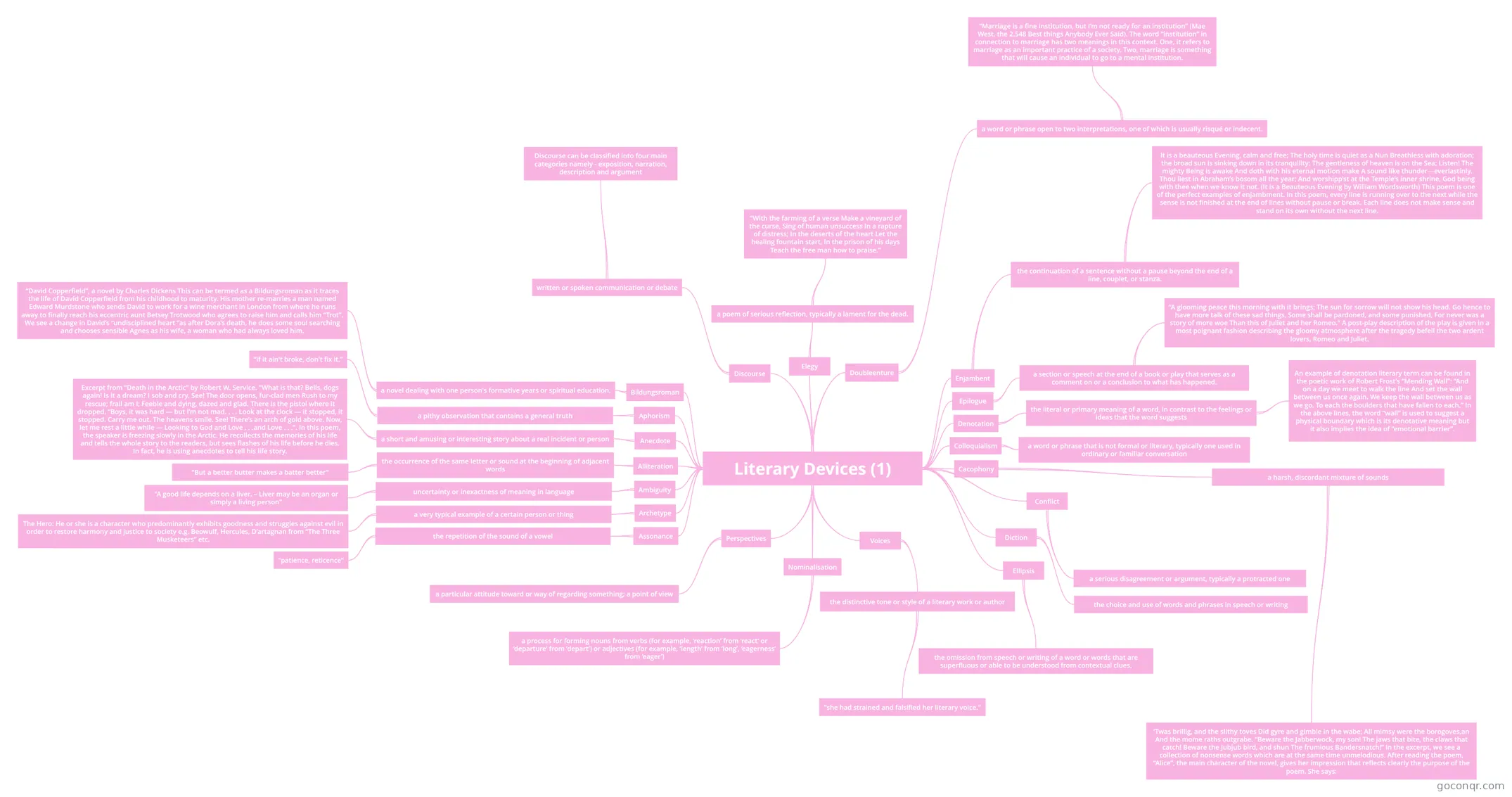
Mind map: Literary devices
Conteúdo do mapa
Literary Devices (1)
Alliteration
- the occurrence of the same letter or sound at the beginning of adjacent words
- "But a better butter makes a batter better"
- the occurrence of the same letter or sound at the beginning of adjacent words
Ambiguity
- uncertainty or inexactness of meaning in language
- "A good life depends on a liver. – Liver may be an organ or simply a living person"
- uncertainty or inexactness of meaning in language
Anecdote
- a short and amusing or interesting story about a real incident or person
- Excerpt from “Death in the Arctic” by Robert W. Service. "What is that? Bells, dogs again! Is it a dream? I sob and cry. See! The door opens, fur-clad men Rush to my rescue; frail am I; Feeble and dying, dazed and glad. There is the pistol where it dropped. “Boys, it was hard — but I’m not mad. . . . Look at the clock — it stopped, it stopped. Carry me out. The heavens smile. See! There’s an arch of gold above. Now, let me rest a little while — Looking to God and Love . . .and Love . . .”. In this poem, the speaker is freezing slowly in the Arctic. He recollects the memories of his life and tells the whole story to the readers, but sees flashes of his life before he dies. In fact, he is using anecdotes to tell his life story.
- a short and amusing or interesting story about a real incident or person
Aphorism
- a pithy observation that contains a general truth
- “if it ain't broke, don't fix it.”
- a pithy observation that contains a general truth
Archetype
- a very typical example of a certain person or thing
- The Hero: He or she is a character who predominantly exhibits goodness and struggles against evil in order to restore harmony and justice to society e.g. Beowulf, Hercules, D’artagnan from “The Three Musketeers” etc.
- a very typical example of a certain person or thing
Assonance
- the repetition of the sound of a vowel
- "patience, reticence"
- the repetition of the sound of a vowel
Bildungsroman
- a novel dealing with one person's formative years or spiritual education.
- “David Copperfield”, a novel by Charles Dickens This can be termed as a Bildungsroman as it traces the life of David Copperfield from his childhood to maturity. His mother re-marries a man named Edward Murdstone who sends David to work for a wine merchant in London from where he runs away to finally reach his eccentric aunt Betsey Trotwood who agrees to raise him and calls him “Trot”. We see a change in David’s “undisciplined heart “as after Dora’s death, he does some soul searching and chooses sensible Agnes as his wife, a woman who had always loved him.
- a novel dealing with one person's formative years or spiritual education.
Cacophony
- a harsh, discordant mixture of sounds
- ‘Twas brillig, and the slithy toves Did gyre and gimble in the wabe; All mimsy were the borogoves,an And the mome raths outgrabe. “Beware the Jabberwock, my son! The jaws that bite, the claws that catch! Beware the Jubjub bird, and shun The frumious Bandersnatch!” In the excerpt, we see a collection of nonsense words which are at the same time unmelodious. After reading the poem, “Alice”, the main character of the novel, gives her impression that reflects clearly the purpose of the poem. She says:
- a harsh, discordant mixture of sounds
Colloquialism
- a word or phrase that is not formal or literary, typically one used in ordinary or familiar conversation
Conflict
- a serious disagreement or argument, typically a protracted one
Denotation
- the literal or primary meaning of a word, in contrast to the feelings or ideas that the word suggests
- An example of denotation literary term can be found in the poetic work of Robert Frost’s “Mending Wall”: “And on a day we meet to walk the line And set the wall between us once again. We keep the wall between us as we go. To each the boulders that have fallen to each.” In the above lines, the word “wall” is used to suggest a physical boundary which is its denotative meaning but it also implies the idea of “emotional barrier”.
- the literal or primary meaning of a word, in contrast to the feelings or ideas that the word suggests
Diction
- the choice and use of words and phrases in speech or writing
Epilogue
- a section or speech at the end of a book or play that serves as a comment on or a conclusion to what has happened.
- “A glooming peace this morning with it brings; The sun for sorrow will not show his head. Go hence to have more talk of these sad things, Some shall be pardoned, and some punished, For never was a story of more woe Than this of Juliet and her Romeo.” A post-play description of the play is given in a most poignant fashion describing the gloomy atmosphere after the tragedy befell the two ardent lovers, Romeo and Juliet.
- a section or speech at the end of a book or play that serves as a comment on or a conclusion to what has happened.
Enjambent
- the continuation of a sentence without a pause beyond the end of a line, couplet, or stanza.
- It is a beauteous Evening, calm and free; The holy time is quiet as a Nun Breathless with adoration; the broad sun Is sinking down in its tranquility; The gentleness of heaven is on the Sea; Listen! The mighty Being is awake And doth with his eternal motion make A sound like thunder―everlastinly. Thou liest in Abraham’s bosom all the year; And worshipp’st at the Temple’s inner shrine, God being with thee when we know it not. (It is a Beauteous Evening by William Wordsworth) This poem is one of the perfect examples of enjambment. In this poem, every line is running over to the next while the sense is not finished at the end of lines without pause or break. Each line does not make sense and stand on its own without the next line.
- the continuation of a sentence without a pause beyond the end of a line, couplet, or stanza.
Ellipsis
- the omission from speech or writing of a word or words that are superfluous or able to be understood from contextual clues.
Elegy
- a poem of serious reflection, typically a lament for the dead.
- “With the farming of a verse Make a vineyard of the curse, Sing of human unsuccess In a rapture of distress; In the deserts of the heart Let the healing fountain start, In the prison of his days Teach the free man how to praise.”
- a poem of serious reflection, typically a lament for the dead.
Doubleenture
- a word or phrase open to two interpretations, one of which is usually risqué or indecent.
- “Marriage is a fine institution, but I’m not ready for an institution” (Mae West, the 2,548 Best things Anybody Ever Said). The word “institution” in connection to marriage has two meanings in this context. One, it refers to marriage as an important practice of a society. Two, marriage is something that will cause an individual to go to a mental institution.
- a word or phrase open to two interpretations, one of which is usually risqué or indecent.
Discourse
- written or spoken communication or debate
- Discourse can be classified into four main categories namely - exposition, narration, description and argument
- written or spoken communication or debate
Nominalisation
- a process for forming nouns from verbs (for example, ‘reaction’ from ‘react’ or ‘departure’ from ‘depart’) or adjectives (for example, ‘length’ from ‘long’, ‘eagerness’ from ‘eager’)
Perspectives
- a particular attitude toward or way of regarding something; a point of view
Voices
- the distinctive tone or style of a literary work or author
- "she had strained and falsified her literary voice."
- the distinctive tone or style of a literary work or author
Informações
- Descrição
- English Mapa Mental sobre Literary Devices (1), criado por caolanmcgovern em 24-11-2014.
- Criado por
- caolanmcgovern
- Visualizações
- 30
- Avaliação