
Mapa mental
Septic Shock
Conteúdo do mapa
Septic Shock
Sepsis is the simultaneous activation of systemic inflammation and coagulation due to microbial invasion
- Septic Shock
- Characterized by maldistribution of blood flow and arterial hypotension (systemic arterial pressure <90mmHg), leading to respiratory, heart and failure of other organs, and death
- Septic Shock
Diagnosis
- Pathophysiology
- Invading microorganisms
- Activation of CNS and endocrine systems
- Hypermetabolic state
- Decreased tissue perfusion
- Cellular oxygen demand
- Release of pro-inflammatory cytokines (TNF, IL-1, etc.)
- Myocardial depression, peripheral vasodilation, increased capillary permeability, microemboli, selective vasoconstriction
- Impaired cellular metabolism
- Maldistribution of circulating blood volume
- Decreased cellular oxygen supply
- Decreased tissue perfusion
- Myocardial depression, peripheral vasodilation, increased capillary permeability, microemboli, selective vasoconstriction
- Endothelial damage
- Increased membrane permeability
- Microemboli
- Activation of CNS and endocrine systems
- Invading microorganisms
- Diagnostic Studies
- Blood
- Low Hgb
- Anemia
- Abnormal glucose levels
- ↑ WBC Count
- Prolonged PT and PTT
- ↑BUN/Cr
- (+) blood cultures
- Low Hgb
- Urine
- ↑ Specific gravity
- ↑ Osmolarity
- Serum Electrolytes
- ↑ Serum Lactate Levels
- ↑ Liver Enzymes (ALT, AST, GGT)
- K+ imbalances
- Na imbalances
- Blood
- Etiology
- Risk Factors
- Poor nutrition
- Major surgery
- Predisposition to infections
- Chronic disease
- Long-term hospital stay
- Immunosuppressed
- Pregnant women
- Infants
- Clients on immunosuppressive agents
- Males
- Older adults
- Risk Factors
- Pathophysiology
Nursing Care
- Assessment
- 1) Initial Stage
- Metabolism changes at cellular level
- Aerobic to anaerobic
- Lactic acid buildup
- Aerobic to anaerobic
- Not clinically apparent
- Metabolism changes at cellular level
- 2) Compensatory Stage
- ↑ pro-inflammatory mediators
- Massive vasodilation (↓SVR)
- SNS:↑HR, ↓BP
- Neurological status
- Restlessness
- Agitation
- 3) Progressive Stage
- ↑↑ vasodilation, with ↑capillary permeability
- Hemodynamic instability
- Hypovolemia
- Hypotension
- V/Q mismatch, l/t hypoperfusion
- Organ failure
- ↑SvO2
- 4) Refractory Stage
- Exacerbated anaerobic metabolism
- ↑Peripheral vasoconstriction
- ↓CO (lactic acidosis)
- Decreased cerebral blood flow
- Cerebral ischemia
- Decreased coronary blood flow
- Myocardial depression
- Exacerbated anaerobic metabolism
- 1) Initial Stage
- Planning
- Adequate tissue perfusion
- Restoring normal or baseline BP
- Recovery of organ function
- Avoiding prolonged states of hypoperfusion
- Implementation
- Acute
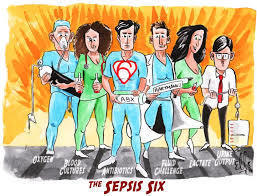
- The Sepsis Six
- 1. Give 02 to keep sats above 94%
- 2. Take blood cultures
- 3. Give antibiotics
- 4. Give a fluid challenge
- 5. Measure lactate
- 6. Measure urine output
- ROS
- Neurological
- Monitor physical and emotional status
- Assess orientation and LOC q1hr
- Cardiological
- Assess VS (BP, HR, CVP) frequently
- ECG monitoring
- Ausculate S3/S4
- Monitor hemodynamic status
- Capillary refill
- Palpate peripheral pulses
- Vascular IV
- Respiratory
- Monitor oxygenation
- Patient airway
- Assess ABGs levels
- LS/VS (RR, depth, rhythm, SaO2 q1hr)
- Chest Radiography
- Mechanical ventilation
- Frequent suctioning
- HOB 30-45°
- GI/GU
- Assess BS q1hr
- Abdominal distention
- NG/stool: check for occult blood
- Renal output >0.5ml/kg/hr
- Assess BUN/Cr levels
- Integumentary
- Assess for...
- T° q1hr
- Pallor
- Cyanosis
- Diaphoresis
- Edema
- Assess for...
- Neurological
- Personal Hygiene
- Prevent skin breakdown and infection
- Frequent oral care
- Assess swallowing and gag reflex
- The Sepsis Six
- Health Promotion
- Prevention
- Prevent Complications
- LMW heparin
- VTE prophylaxis
- Identify patient at risk
- Decrease risk of infections
- Effective hand hygiene
- Aseptic technique during invasive procdures
- Equipment change as per institutional policies
- Prevent Complications
- Adequate rest
- Pain management
- Monitor fluid balance
- Reposition q2hr
- Encourage family members in pt care
- Therapeutic Communication
- Non-verbal
- Prevention
- Acute
- Evaluation
- Systemic Inflammatory Response Syndrome (SIRS)
- Characterized by ↑inflammation/coagulation not always related to infection
- Multiple Organ Dysfunction Syndrome (MODS)
- Systemic Inflammatory Response Syndrome (SIRS)
- Assessment
Complications
- GI bleeding
- Pressure/Stress Ulcer
- Electrolyte Imbalance
- ARDS
- Anemia
- Pneumonia
fucking treatment
Imagens e arquivos do mapa










Informações
- Descrição
- Nursing Mapa Mental sobre Septic Shock, criado por Nazifa Jaigirdar em 08-03-2019.
- Criado por
- Nazifa Jaigirdar
- Visualizações
- 0
- Histórico
-
- Criado por Savvy Modgil · 6 mar 2019
- Copiado por Nazifa Jaigirdar · 8 mar 2019
- Avaliação