
Mapa mental
19 - Cetacea
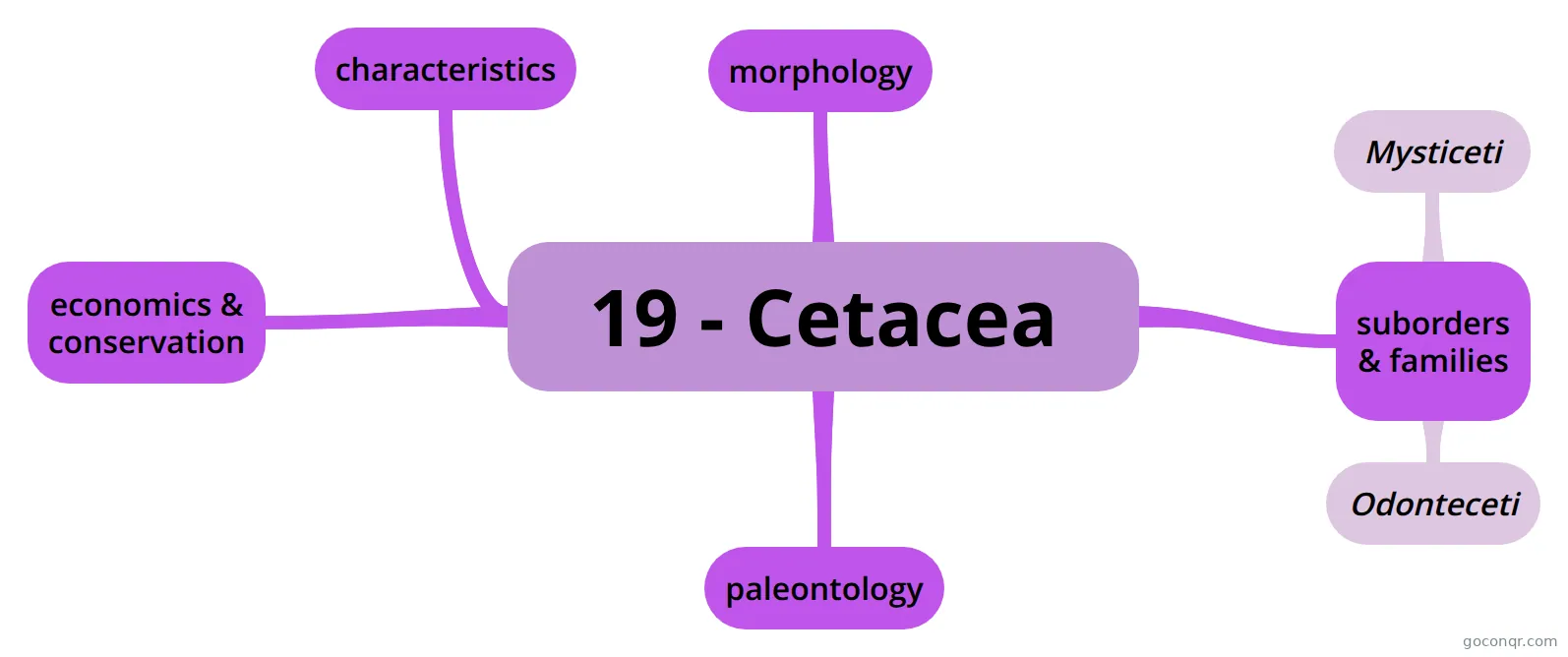
Mind map: Cetacea
Conteúdo do mapa
19 - Cetacea
- 84 species fully adapted to aquatic life
- feed at the MIDDLE or TOP of marine food web
- amazing swimming and diving ability
- ability to echolocate
- considerable intelligence
- complex social behaviors
morphology
- highly TELESCOPED skull structure
- posterior bones of cranium COMPRESSED and OVERLAPPING
- anterior bones elongated and overlap posteriors
- posterior displacement of nares to TOP of skull
- tympanic bones NOT braced against skull (partly insulated from the rest of the cranium by surrounding FAT BODIES)
- THERMOREGULATION
- nearly hairless
- LOW surface area-to-volume ratio
- subcutaneous blubber for insulation and heat retention
- COUNTERCURRENT exchange
- diving adaptations (100-200 meter depths)
- many ribs lack CONNECTION to sternum, collapsible and elastic lungs
- bronchioles BRACED by CARTILAGE RINGS
- gas exchange > terrestrial mammals
- oxygen efficiency: 12% cetacean, 4% terrestrial mammals
- erythrocytes: 2x more
- myoglobin: 2-9x more
- tolerate high lactic acid, CO2
- apnea: 3-70 minutes
- bradycardia, reduced peripheral circulation
- sub-dermal "springs" in tailstock store and release elastic energy for swimming
- drag reduced on body surfaces
- compliant spongy layer in outer skin dampens pressure and turbulence
- LARGER BODY MASS increases speed
- recorded speeds of 36 kph (dolphins) to 55 kph (killer whale)
- also favors THERMOREGULATION
paleontology
- EOCENE cetaceans from coastal Tethys Sea
- transitional forms from terrestrial to aquatic
- hippos considered sister group to ancestral cetaceans
- double-pulley ASTRALAGUS bone in ankle common bond
- PAKICETUS = the earliest known whale in early EOCENE
- RHODOCETUS from MID-EOCENE
- transition to FILTER FEEDING corresponds to opening of circum-Antarctic currents
- explosion in marine plankton productivity
economics & conservation
- whaling dates back thousands of years
- land-based: slower species in coastal waters driven onto land
- by 16th and 17th centuries, Europe and North America begin commercial trade with large ships
- high economic value of MEAT, OIL, BALEEN
- significant declines began
- technology improved efficiency, hastened declines (harpoon guns, steam-driven ships by 1860s)
- floating factory ships, stern slipways by 1925
- right whales so named for ease of hunting, lots of oil and meat so it is economically valuable
- FIRST SPECIES (right whale) to be overexploited, 2 endangered
- GRAY WHALES extirpated from Atlantic in 1700s, eastern Pacific population protected and growing
- Beluga = threatened
- California harbor porpoise, finless porpoise = endangered
- 2006: Chinese river dolphin = first cetacean to go extinct sincce 1950s
- Establishment of International Whaling Commission in 1946
- governs the conduct of whaling throughout the world
- limits numbers, size of whales which may be taken
- COMPLETE PROTECTION of certain species
- designate specified areas as whale sanctuaries
- prescribe seasons and areas for whaling
- prohibit capture of suckling calves and females with calves
- require CATCH reports, other statistical and biological records
- encourages, co-ordinates and funds whale research
- promotes humane killing operations
- moratorium in 1985, but thousands still killed for "research"
- Japan, Russia, Norway, Iceland, Finland
- Institute of Cetacean Research for "Research Goals and Results"
suborders & families
- Mysticeti
- GRAZING near surface: right whales swim through swarms of plankton
- lunge feeding: RORQUALS
- furrows on throat for expansion
- during contraction of pouch, water and food pass through baleen plates
- mandible braced by frontomandibular stay apparatus
- bubble netting = a form of lunge feeding
- sediment feeding: gray whales
- plow head through mud at bottom
- scoop or suck up sediments
- filter out marine organisms
- "moustache/whale"; baleen whales
- TWO external narial openings (blowholes) on top of head
- do NOT echolocate
- distributed worldwide marine
- teeth VESTIGIAL in embryos and ABSENT in adults
- baleen of CORNIFIED EPITHELIUM in place of teeth
- Odonteceti
- DENTITION and ECHOLOCATION
- VARIABLE tooth number, usually HOMODONT
- active pursuit of prey, requres agility and speed
- echolocation sounds likely produced in NASAL sacs
- focused by oil-filled melon in forehead, sent out
- return echoes pass through oil-filled LOWER JAW to bullae, isolated from skull bones by tissue
- "tooth/whale"; toothed whales
- generally smaller than mysticetes
- skyll BILATERALLY asymmetrical
- single external narial opening on top of head (left)
- teeth present, from 2-260 in different species
- use ECHOLOCATION
- nasal sacs and fatty melon
- foraging and orientation
- distributed worldwide marine, some species riverine
- Mysticeti
characteristics
- whales, dolphins, porpoises, narwhal
- besides SIRENIANS, only mammals to be ENTIRELY aquatic (never leaving water)
- some are the LARGEST vertebrates (30m blue whale)
- loudest VOICES of all mammals
- dive deeper, exposed to higher pressures than ANY other mammal
- longest MIGRATIONS of any mammals (18,000km in gray whales)
- Fusiform
- NO external ears
- teats enclosed within slits next to urogenital opening
- testes remain ABDOMINAL
- hindlimbs ABSENT
- vestigal pelvic girdle present but not attached to vertebral column
- forelimbs (flippers) paddle-shaped but limb elements not visible externally (STABILIZERS, not thrust generators)
- digits long, with additional phalanges
- tail (fluke) flattened DORSOVENTRALLY
- caudal undulations provide THRUST through medium
- simple postcranial skeleton
- mostly vertebrae; cervical COMPRESSED chevron bones on anterior caudal vertebrae; high neural spines
- has CLAVICLE
Informações
- Descrição
- Mammalogy (Final Exam) Mapa Mental sobre 19 - Cetacea, criado por nicolepridemore em 27-04-2015.
- Criado por
- nicolepridemore
- Visualizações
- 4
- Avaliação