
Mapa mental
Scarlet Letter Chapter 17
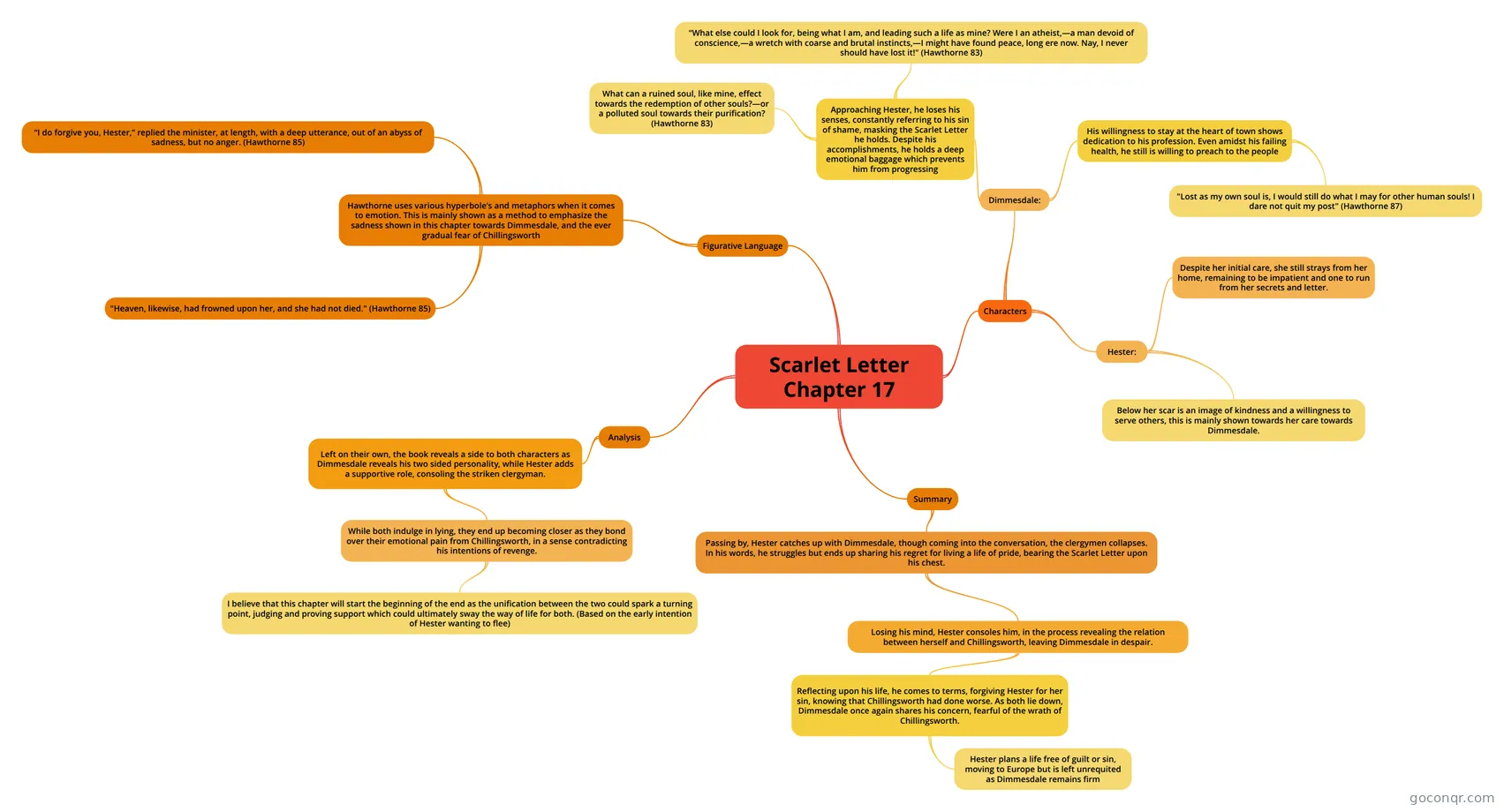
Mind map: The Scarlet Letter chapter 17
Conteúdo do mapa
Scarlet Letter Chapter 17
Summary
- Passing by, Hester catches up with Dimmesdale, though coming into the conversation, the clergymen collapses. In his words, he struggles but ends up sharing his regret for living a life of pride, bearing the Scarlet Letter upon his chest.
- Losing his mind, Hester consoles him, in the process revealing the relation between herself and Chillingsworth, leaving Dimmesdale in despair.
- Reflecting upon his life, he comes to terms, forgiving Hester for her sin, knowing that Chillingsworth had done worse. As both lie down, Dimmesdale once again shares his concern, fearful of the wrath of Chillingsworth.
- Hester plans a life free of guilt or sin, moving to Europe but is left unrequited as Dimmesdale remains firm
- Reflecting upon his life, he comes to terms, forgiving Hester for her sin, knowing that Chillingsworth had done worse. As both lie down, Dimmesdale once again shares his concern, fearful of the wrath of Chillingsworth.
- Losing his mind, Hester consoles him, in the process revealing the relation between herself and Chillingsworth, leaving Dimmesdale in despair.
- Passing by, Hester catches up with Dimmesdale, though coming into the conversation, the clergymen collapses. In his words, he struggles but ends up sharing his regret for living a life of pride, bearing the Scarlet Letter upon his chest.
Characters
- Hester:
- Below her scar is an image of kindness and a willingness to serve others, this is mainly shown towards her care towards Dimmesdale.
- Despite her initial care, she still strays from her home, remaining to be impatient and one to run from her secrets and letter.
- Dimmesdale:
- Approaching Hester, he loses his senses, constantly referring to his sin of shame, masking the Scarlet Letter he holds. Despite his accomplishments, he holds a deep emotional baggage which prevents him from progressing
- “What else could I look for, being what I am, and leading such a life as mine? Were I an atheist,—a man devoid of conscience,—a wretch with coarse and brutal instincts,—I might have found peace, long ere now. Nay, I never should have lost it!" (Hawthorne 83)
- What can a ruined soul, like mine, effect towards the redemption of other souls?—or a polluted soul towards their purification? (Hawthorne 83)
- His willingness to stay at the heart of town shows dedication to his profession. Even amidst his failing health, he still is willing to preach to the people
- "Lost as my own soul is, I would still do what I may for other human souls! I dare not quit my post" (Hawthorne 87)
- Approaching Hester, he loses his senses, constantly referring to his sin of shame, masking the Scarlet Letter he holds. Despite his accomplishments, he holds a deep emotional baggage which prevents him from progressing
- Hester:
Analysis
- Left on their own, the book reveals a side to both characters as Dimmesdale reveals his two sided personality, while Hester adds a supportive role, consoling the striken clergyman.
- While both indulge in lying, they end up becoming closer as they bond over their emotional pain from Chillingsworth, in a sense contradicting his intentions of revenge.
- I believe that this chapter will start the beginning of the end as the unification between the two could spark a turning point, judging and proving support which could ultimately sway the way of life for both. (Based on the early intention of Hester wanting to flee)
- While both indulge in lying, they end up becoming closer as they bond over their emotional pain from Chillingsworth, in a sense contradicting his intentions of revenge.
- Left on their own, the book reveals a side to both characters as Dimmesdale reveals his two sided personality, while Hester adds a supportive role, consoling the striken clergyman.
Figurative Language
- Hawthorne uses various hyperbole's and metaphors when it comes to emotion. This is mainly shown as a method to emphasize the sadness shown in this chapter towards Dimmesdale, and the ever gradual fear of Chillingsworth
- “I do forgive you, Hester,” replied the minister, at length, with a deep utterance, out of an abyss of sadness, but no anger. (Hawthorne 85)
- "Heaven, likewise, had frowned upon her, and she had not died." (Hawthorne 85)
- Hawthorne uses various hyperbole's and metaphors when it comes to emotion. This is mainly shown as a method to emphasize the sadness shown in this chapter towards Dimmesdale, and the ever gradual fear of Chillingsworth
Informações
- Descrição
- 10th grade English Mapa Mental sobre Scarlet Letter Chapter 17, criado por Ahmed Hafeez em 08-03-2021.
- Criado por
- Ahmed Hafeez
- Visualizações
- 0
- Avaliação