
Mapa mental
Waves
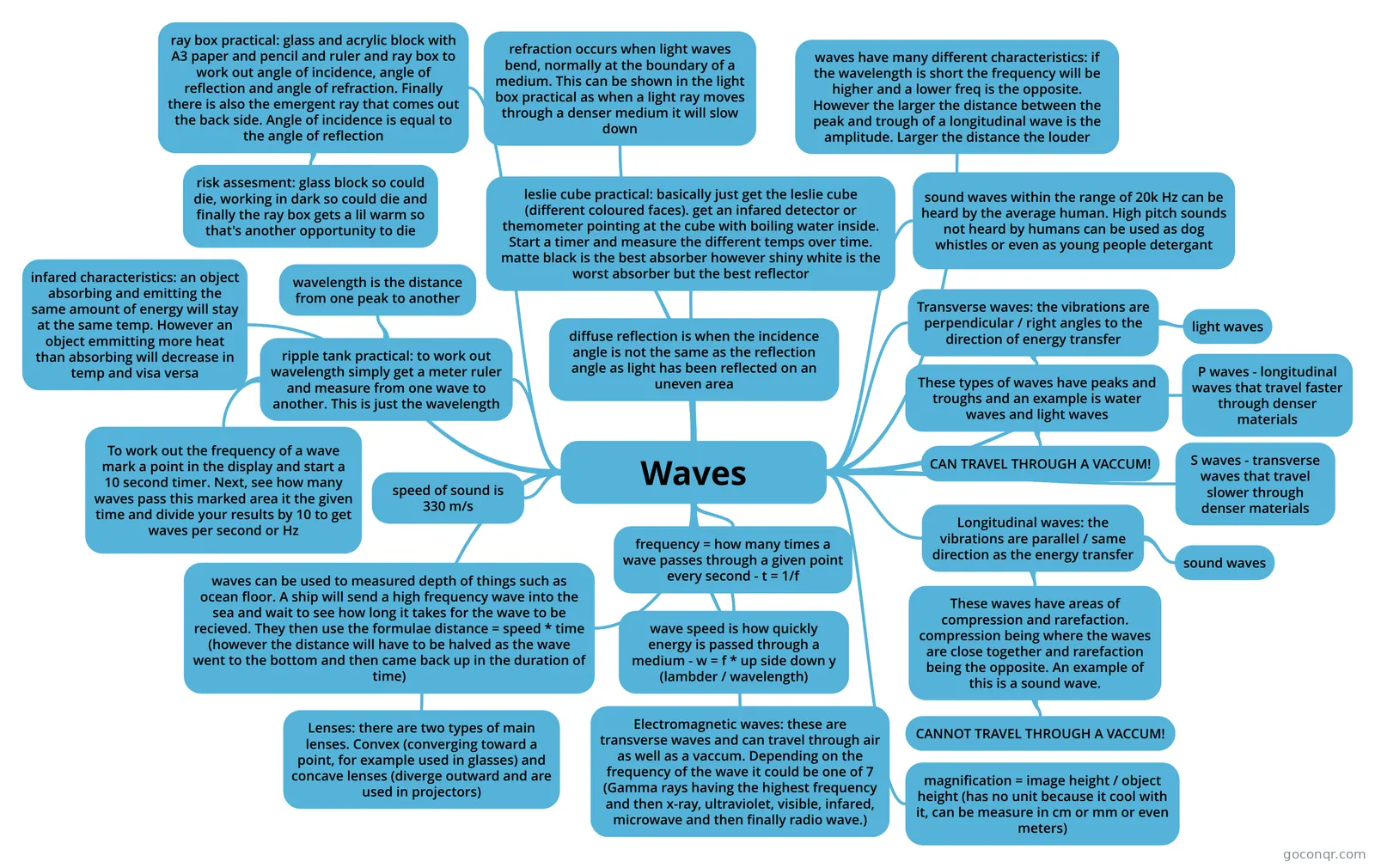
Mind map: waves physics
Conteúdo do mapa
Waves
Transverse waves: the vibrations are perpendicular / right angles to the direction of energy transfer
- These types of waves have peaks and troughs and an example is water waves and light waves
- CAN TRAVEL THROUGH A VACCUM!
- light waves
- These types of waves have peaks and troughs and an example is water waves and light waves
Longitudinal waves: the vibrations are parallel / same direction as the energy transfer
- These waves have areas of compression and rarefaction. compression being where the waves are close together and rarefaction being the opposite. An example of this is a sound wave.
- CANNOT TRAVEL THROUGH A VACCUM!
- sound waves
- These waves have areas of compression and rarefaction. compression being where the waves are close together and rarefaction being the opposite. An example of this is a sound wave.
frequency = how many times a wave passes through a given point every second - t = 1/f
wave speed is how quickly energy is passed through a medium - w = f * up side down y (lambder / wavelength)
speed of sound is 330 m/s
ripple tank practical: to work out wavelength simply get a meter ruler and measure from one wave to another. This is just the wavelength
- To work out the frequency of a wave mark a point in the display and start a 10 second timer. Next, see how many waves pass this marked area it the given time and divide your results by 10 to get waves per second or Hz
- wavelength is the distance from one peak to another
ray box practical: glass and acrylic block with A3 paper and pencil and ruler and ray box to work out angle of incidence, angle of reflection and angle of refraction. Finally there is also the emergent ray that comes out the back side. Angle of incidence is equal to the angle of reflection
- risk assesment: glass block so could die, working in dark so could die and finally the ray box gets a lil warm so that's another opportunity to die
leslie cube practical: basically just get the leslie cube (different coloured faces). get an infared detector or themometer pointing at the cube with boiling water inside. Start a timer and measure the different temps over time. matte black is the best absorber however shiny white is the worst absorber but the best reflector
diffuse reflection is when the incidence angle is not the same as the reflection angle as light has been reflected on an uneven area
refraction occurs when light waves bend, normally at the boundary of a medium. This can be shown in the light box practical as when a light ray moves through a denser medium it will slow down
sound waves within the range of 20k Hz can be heard by the average human. High pitch sounds not heard by humans can be used as dog whistles or even as young people detergant
waves have many different characteristics: if the wavelength is short the frequency will be higher and a lower freq is the opposite. However the larger the distance between the peak and trough of a longitudinal wave is the amplitude. Larger the distance the louder
waves can be used to measured depth of things such as ocean floor. A ship will send a high frequency wave into the sea and wait to see how long it takes for the wave to be recieved. They then use the formulae distance = speed * time (however the distance will have to be halved as the wave went to the bottom and then came back up in the duration of time)
Electromagnetic waves: these are transverse waves and can travel through air as well as a vaccum. Depending on the frequency of the wave it could be one of 7 (Gamma rays having the highest frequency and then x-ray, ultraviolet, visible, infared, microwave and then finally radio wave.)
P waves - longitudinal waves that travel faster through denser materials
S waves - transverse waves that travel slower through denser materials
infared characteristics: an object absorbing and emitting the same amount of energy will stay at the same temp. However an object emmitting more heat than absorbing will decrease in temp and visa versa
Lenses: there are two types of main lenses. Convex (converging toward a point, for example used in glasses) and concave lenses (diverge outward and are used in projectors)
magnification = image height / object height (has no unit because it cool with it, can be measure in cm or mm or even meters)