
Mapa mental
DT L1 Identifying User Needs
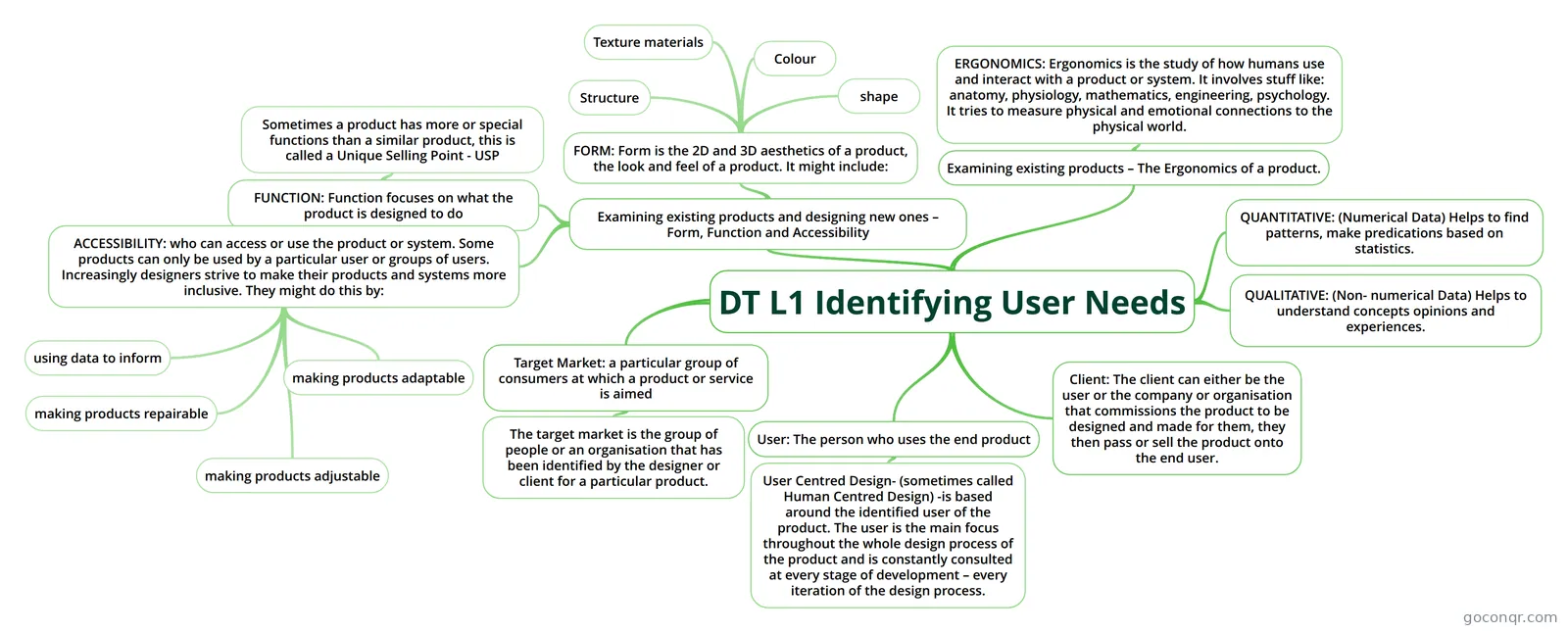
Mind map: DT L1 identifying user needs
Conteúdo do mapa
DT L1 Identifying User Needs
User: The person who uses the end product
- User Centred Design- (sometimes called Human Centred Design) -is based around the identified user of the product. The user is the main focus throughout the whole design process of the product and is constantly consulted at every stage of development – every iteration of the design process.
Client: The client can either be the user or the company or organisation that commissions the product to be designed and made for them, they then pass or sell the product onto the end user.
Target Market: a particular group of consumers at which a product or service is aimed
- The target market is the group of people or an organisation that has been identified by the designer or client for a particular product.
QUALITATIVE: (Non- numerical Data) Helps to understand concepts opinions and experiences.
QUANTITATIVE: (Numerical Data) Helps to find patterns, make predications based on statistics.
Examining existing products – The Ergonomics of a product.
- ERGONOMICS: Ergonomics is the study of how humans use and interact with a product or system. It involves stuff like: anatomy, physiology, mathematics, engineering, psychology. It tries to measure physical and emotional connections to the physical world.
Examining existing products and designing new ones – Form, Function and Accessibility
- FORM: Form is the 2D and 3D aesthetics of a product, the look and feel of a product. It might include:
- shape
- Colour
- Texture materials
- Structure
- FUNCTION: Function focuses on what the product is designed to do
- Sometimes a product has more or special functions than a similar product, this is called a Unique Selling Point - USP
- ACCESSIBILITY: who can access or use the product or system. Some products can only be used by a particular user or groups of users. Increasingly designers strive to make their products and systems more inclusive. They might do this by:
- using data to inform
- making products adaptable
- making products repairable
- making products adjustable
- FORM: Form is the 2D and 3D aesthetics of a product, the look and feel of a product. It might include:
Informações
- Descrição
- D&T L1 Identifying User's Needs EOY exam revision 2020
- Criado por
- Maria Alexandru-Chidesciuc
- Visualizações
- 65
- Tags
- Avaliação