
Mapa mental
DKE Part 1
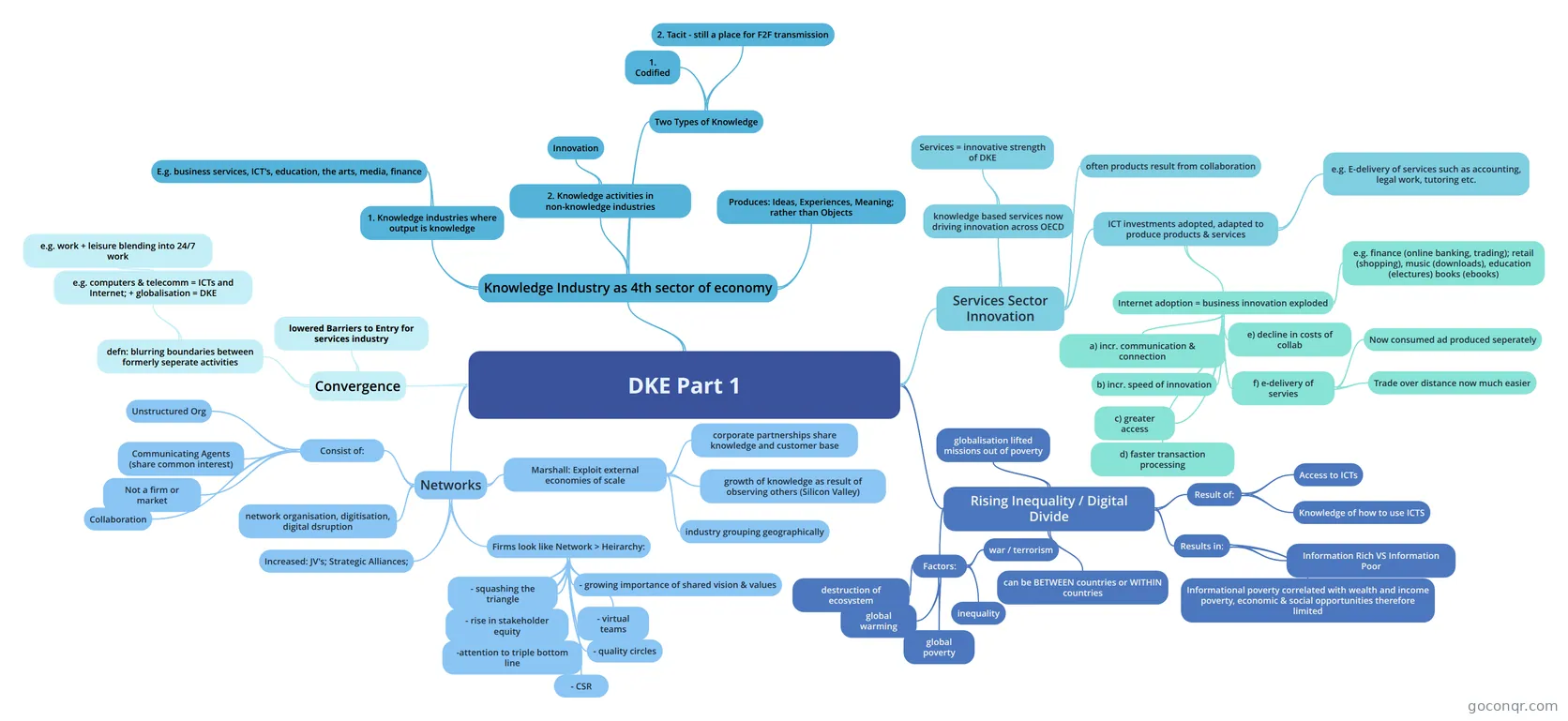
Mind map: DKE part 1 knowledge economy
Conteúdo do mapa
DKE Part 1
Knowledge Industry as 4th sector of economy
- 1. Knowledge industries where output is knowledge
- E.g. business services, ICT's, education, the arts, media, finance
- 2. Knowledge activities in non-knowledge industries
- Innovation
- Produces: Ideas, Experiences, Meaning; rather than Objects
- Two Types of Knowledge
- 1. Codified
- 2. Tacit - still a place for F2F transmission
- 1. Knowledge industries where output is knowledge
Convergence
- defn: blurring boundaries between formerly seperate activities
- e.g. computers & telecomm = ICTs and Internet; + globalisation = DKE
- e.g. work + leisure blending into 24/7 work
- e.g. computers & telecomm = ICTs and Internet; + globalisation = DKE
- lowered Barriers to Entry for services industry
- defn: blurring boundaries between formerly seperate activities
Networks
- network organisation, digitisation, digital dsruption
- Increased: JV's; Strategic Alliances;
- Marshall: Exploit external economies of scale
- industry grouping geographically
- growth of knowledge as result of observing others (Silicon Valley)
- corporate partnerships share knowledge and customer base
- Consist of:
- Communicating Agents (share common interest)
- Unstructured Org
- Not a firm or market
- Collaboration
- Firms look like Network > Heirarchy:
- - squashing the triangle
- - virtual teams
- - quality circles
- -attention to triple bottom line
- - growing importance of shared vision & values
- - rise in stakeholder equity
- - CSR
Services Sector Innovation
- knowledge based services now driving innovation across OECD
- Services = innovative strength of DKE
- ICT investments adopted, adapted to produce products & services
- e.g. E-delivery of services such as accounting, legal work, tutoring etc.
- Internet adoption = business innovation exploded
- a) incr. communication & connection
- b) incr. speed of innovation
- c) greater access
- d) faster transaction processing
- e) decline in costs of collab
- f) e-delivery of servies
- Now consumed ad produced seperately
- Trade over distance now much easier
- e.g. finance (online banking, trading); retail (shopping), music (downloads), education (electures) books (ebooks)
- often products result from collaboration
- knowledge based services now driving innovation across OECD
Rising Inequality / Digital Divide
- Factors:
- destruction of ecosystem
- global warming
- global poverty
- inequality
- war / terrorism
- globalisation lifted missions out of poverty
- Result of:
- Access to ICTs
- Knowledge of how to use ICTS
- can be BETWEEN countries or WITHIN countries
- Results in:
- Information Rich VS Information Poor
- Informational poverty correlated with wealth and income poverty, economic & social opportunities therefore limited
- Factors: