
Mapa mental
Poetry part 1
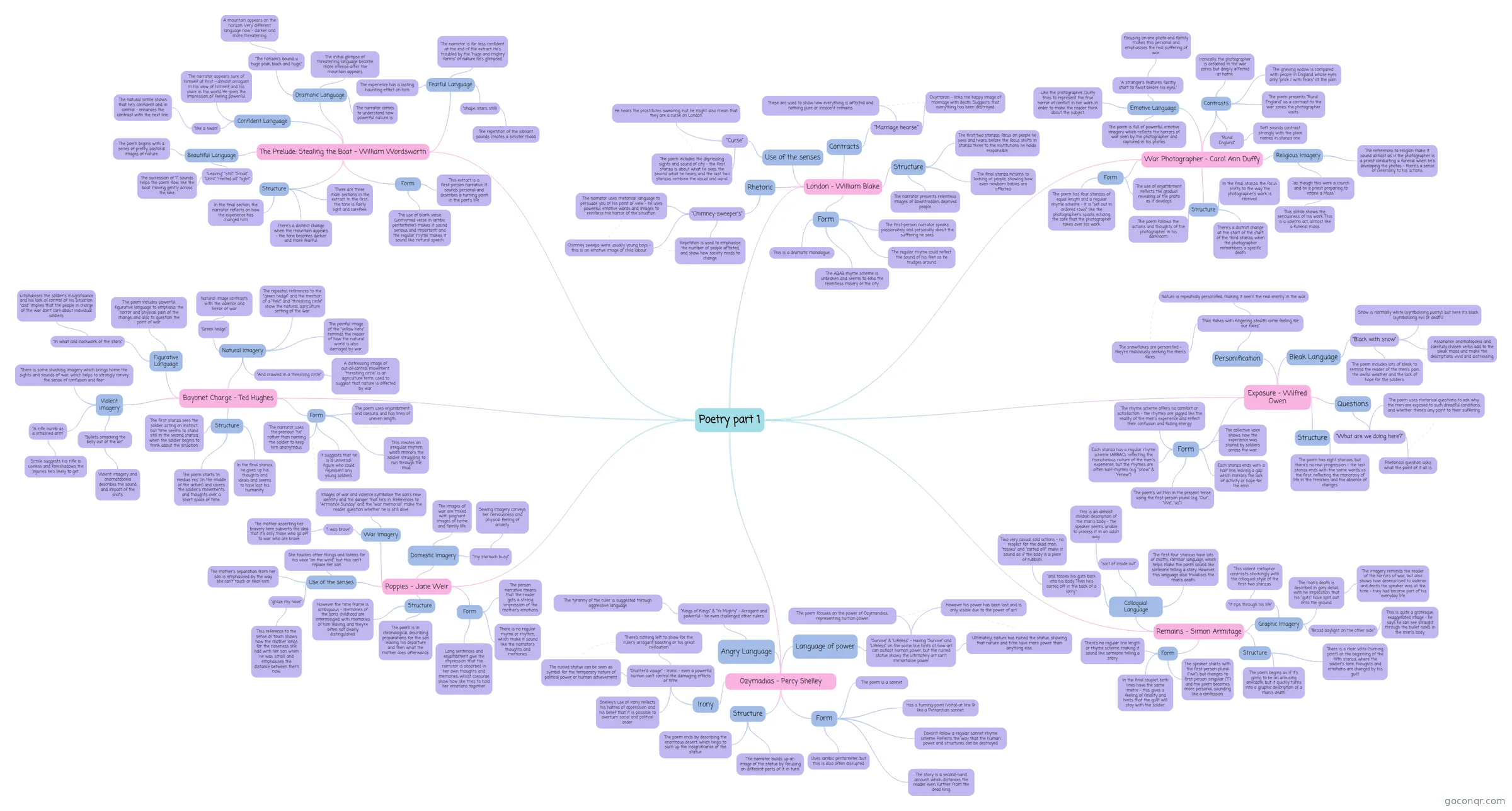
Mind map: Poetry part 1
Conteúdo do mapa
Poetry part 1
Ozymadias - Percy Shelley
- Form
- The poem is a sonnet
- Has a turning-point (volta) at line 9 like a Petrarchan sonnet.
- Doesn't follow a regular sonnet rhyme scheme. Reflects the way that the human power and structures can be destroyed.
- Uses iambic pentameter, but this is also often disrupted.
- The story is a second-hand account, which distances the reader even further from the dead king.
- Structure
- The narrator builds up an image of the statue by focusing on different parts of it in turn.
- The poem ends by describing the enormous desert, which helps to sum up the insignificance of the statue.
- Irony
- "Shatter'd visage" - Ironic - even a powerful human can't control the damaging effects of time.
- There's nothing left to show for the ruler's arrogant boasting or his great civilisation.
- The ruined statue can be seen as symbol for the temporary nature of political power or human achievement.
- Shelley's use of irony reflects his hatred of oppression and his belief that it is possible to overturn social and political order.
- "Shatter'd visage" - Ironic - even a powerful human can't control the damaging effects of time.
- Language of power
- "Survive" & "Lifeless" - Having "Survive" and "Lifeless" on the same line hints at how art can outlast human power, but the ruined statue shows the ultimately art can't immortalise power.
- The poem focuses on the power of Ozymandias, representing human power.
- However his power has been lost and is only visible due to the power of art.
- Ultimately, nature has ruined the statue, showing that nature and time have more power than anything else.
- "Survive" & "Lifeless" - Having "Survive" and "Lifeless" on the same line hints at how art can outlast human power, but the ruined statue shows the ultimately art can't immortalise power.
- Angry Language
- "Kings of Kings" & "Ye Mighty" - Arrogant and powerful - he even challenged other rulers.
- The tyranny of the ruler is suggested through aggressive language.
- "Kings of Kings" & "Ye Mighty" - Arrogant and powerful - he even challenged other rulers.
- Form
London - William Blake
- Form
- This is a dramatic monologue.
- The first-person narrator speaks passionately and personally about the suffering he sees.
- The ABAB rhyme scheme is unbroken and seems to echo the relentless misery of the city.
- The regular rhyme could reflect the sound of his feet as he trudges around.
- Structure
- The narrator presents relentless images of downtrodden, deprived people.
- The first two stanzas focus on people he sees and hears, before the focus shifts in stanza three to the institutions he holds responsible.
- The final stanza returns to looking at people, showing how even newborn babies are affected.
- Rhetoric
- "Chimney-sweeper's"
- Chimney sweeps were usually young boys - this is an emotive image of child labour.
- The narrator uses rhetorical language to persuade you of his point of view - he uses powerful, emotive words and images to reinforce the horror of the situation.
- Repetition is used to emphasise the number of people affected, and show how society needs to change.
- "Chimney-sweeper's"
- Use of the senses
- "Curse"
- He hears the prostitutes swearing, nut he might also mean that they are a curse on London.
- The poem includes the depressing sights and sound of city - the first stanza is about what he sees, the second what he hears, and the last two stanzas combine the visual and aural.
- "Curse"
- Contracts
- "Marriage hearse."
- Oxymoron - links the happy image of marriage with death. Suggests that everything has been destroyed.
- These are used to show how everything is affected and nothing pure or innocent remains.
- "Marriage hearse."
- Form
Exposure - Wilfred Owen
- Form
- The poem's written in the present tense using the first person plural (e.g. "Our", "We", "us").
- The collective voice shows how the experience was shared by soldiers across the war.
- Each stanza has a regular rhyme scheme (ABBAC), reflecting the monotonous nature of the men's experience, but the rhymes are often half-rhymes (e.g. "snow" & "renew")
- The rhyme scheme offers no comfort or satisfaction - the rhymes are jagged like the reality of the men's experience and reflect their confusion and fading energy.
- Each stanza ends with a half line, leaving a gap which mirrors the lack of activity or hope for the emn.
- Structure
- The poem has eight stanzas, but there's no real progression - the last stanza ends with the same words as the first, reflecting the monotony of life in the trenches and the absence of changes.
- Questions
- "What are we doing here?"
- Rhetorical question asks what the point of it all is.
- The poem uses rhetorical questions to ask why the men are exposed to such dreadful conditions, and whether there's any point to their suffering.
- "What are we doing here?"
- Bleak Language
- "Black with snow"
- Snow is normally white (symbolising purity), but here it's black (symbolising evil or death)
- The poem includes lots of bleak to remind the reader of the men's pain, the awful weather and the lack of hope for the soldiers.
- Assonance, onomatopoeia and carefully chosen verbs add to the bleak mood and make the descriptions vivid and distressing.
- "Black with snow"
- Personification
- "Pale flakes with fingering stealth come feeling for our faces"
- The snowflakes are personified - they're maliciously seeking the men's faces.
- Nature is repeatedly personified, making it seem the real enemy in the war.
- "Pale flakes with fingering stealth come feeling for our faces"
- Form
Bayonet Charge - Ted Hughes
- Form
- The poem uses enjambment and caesura, and has lines of uneven length.
- This creates an irregular rhythm, which mirrors the soldier struggling to run through the mud.
- The narrator uses the pronoun "he" rather than naming the soldier to keep him anonymous.
- It suggests that he is a universal figure who could represent any young soldiers.
- Structure
- The poem starts 'in medias res' (in the middle of the action) and covers the soldier's movements and thoughts over a short space of time.
- The first stanza sees the soldier acting on instinct, but time seems to stand still in the second stanza, when the soldier begins to think about the situation.
- In the final stanza, he gives up his thoughts and ideals and seems to have lost his humanity.
- Violent imagery
- "Bullets smacking the belly out of the air"
- Violent imagery and onomatopoeia describes the sound and impact of the shots.
- "A rifle numb as a smashed arm"
- Simile suggests his rifle is useless and foreshadows the injuries he's likely to get.
- There is some shocking imagery which brings home the sights and sounds of war, which helps to strongly convey the sense of confusion and fear.
- "Bullets smacking the belly out of the air"
- Figurative Language
- "In what cold clockwork of the stars"
- Emphasises the soldier's insignificance and his lack of control of his situation. "cold" implies that the people in charge of the war don't care about individual soldiers.
- The poem includes powerful figurative language to emphasis the horror and physical pain of the change, and also to question the point of war.
- "In what cold clockwork of the stars"
- Natural Imagery
- "And crawled in a threshing circle"
- A distressing image of out-of-control movement. "threshing circle" is an agriculture term, used to suggest that nature is affected by war.
- "Green hedge"
- Natural image contrasts with the violence and terror of war.
- The repeated references to the "green hedge" and the mention of a "field" and "threshing circle" show the natural, agriculture setting of the war.
- The painful image of the "yellow hare" reminds the reader of how the natural world is also damaged by war.
- "And crawled in a threshing circle"
- Form
Remains - Simon Armitage
- Form
- There's no regular line length or rhyme scheme, making it sound like someone telling a story
- The speaker starts with the first person plural ("we"), but changes to first person singular ("I") and the poem becomes more personal, sounding like a confession.
- In the final couplet, both lines have the same metre - this gives a feeling of finality and hints that the guilt will stay with the soldier.
- Structure
- The poem begins as if it's going to be an amusing anecdote, but it quickly turns into a graphic description of a man's death.
- There is a clear volta (turning point) at the beginning of the fifth stanza, where the soldier's tone, thoughts and emotions are changed by his guilt.
- Graphic Imagery
- "Broad daylight on the other side."
- This is quite a grotesque, exaggerated image - he says he can see straight through the bullet holes in the man's body.
- "It rips through his life"
- This violent metaphor contrasts shockingly with the colloquial style of the first two stanzas.
- The man's death is described in gory detail, with he implication that his "guts" have spilt out onto the ground.
- The imagery reminds the reader of the horrors of war, but also shows how desensitised to violence and death the speaker was at the time - they had become part of his everyday life
- "Broad daylight on the other side."
- Colloquial Language
- "and tosses his guts back into his body. Then he's carted off in the back of a lorry."
- Two very casual, cold actions - no respect for the dead man. "tosses" and "carted off" make it sound as if the body is a piece of rubbish.
- "sort of inside out"
- This is an almost childish description of the man's body - the speaker seems unable to process it in an adult way.
- The first four stanzas have lots of chatty, familiar language, which helps make the poem sound like someone telling a story. However, this language also trivialises the man's death.
- "and tosses his guts back into his body. Then he's carted off in the back of a lorry."
- Form
Poppies - Jane Weir
- Form
- The person narrative means that the reader gets a strong impression of the mother's emotions.
- There is no regular rhyme or rhythm, which make it sound like the narrator's thoughts and memories.
- Long sentences and enjambment give the impression that the narrator is absorbed in her own thoughts and memories, whilst caesurae show how she tries to hold her emotions together.
- Structure
- The poem is in chronological, describing preparations for the son leaving, his departure and then what the mother does afterwards.
- However the time frame is ambiguous - memories of the son's childhood are intermingled with memories of him leaving, and they're often not clearly distinguished.
- Use of the senses
- "graze my nose"
- This reference to the sense of touch shows how the mother longs for the closeness she had with her son when he was small, and emphasises the distance between them now.
- The mother's separation from her son is emphasised by the way she can't touch or hear him.
- She touches other things and listens for his voice "on the wind", but this can't replace her son.
- "graze my nose"
- War Imagery
- "I was brave"
- The mother asserting her bravery here subverts the idea that it's only those who go off to war who are brave.
- Images of war and violence symbolise the son's new identity and the danger that he's in. References to "Armistice Sunday" and the "war memorial" make the reader question whether he is still alive.
- "I was brave"
- Domestic Imagery
- "my stomach busy"
- Sewing imagery conveys her nervousness and physical feeling of anxiety.
- The images of war are mixed with poignant images of home and family life.
- "my stomach busy"
- Form
War Photographer - Carol Ann Duffy
- Form
- The poem has four stanzas of equal length and a regular rhyme scheme - it is "set out in ordered rows" like the photographer's spools, echoing the care that the photographer takes over his work.
- The use of enjambment reflects the gradual revealing of the photo as it develops.
- Structure
- The poem follows the actions and thoughts of the photographer in his darkroom.
- There's a district change at the start of the start of the third stanza, when the photographer remembers a specific death.
- In the final stanza, the focus shifts to the way the photographer's work is received.
- Religious Imagery
- "as though this were a church and he a priest preparing to intone a Mass."
- This simile shows the seriousness of his work. This is a solemn act, almost like a funeral mass.
- The references to religion make it sound almost as if the photographer is a priest conducting a funeral when he's developing the photos - there's a sense of ceremony to his actions.
- "as though this were a church and he a priest preparing to intone a Mass."
- Contrasts
- "Rural England"
- Soft sounds contrast strongly with the place names in stanza one.
- The poem presents "Rural England" as a contrast to the war zones the photographer visits.
- The grieving widow is compared with people in England whose eyes only "prick / with tears" at the pain.
- Ironically, the photographer is detached in the war zones but deeply affected at home.
- "Rural England"
- Emotive Language
- "A stranger's features faintly start to twist before his eyes,"
- Focusing on one photo and family makes this personal and emphasises the real suffering of war.
- The poem is full of powerful, emotive imagery which reflects the horrors of war seen by the photographer and captured in his photos
- Like the photographer, Duffy tries to represent the true horror of conflict in her work in order to make the reader think about the subject.
- "A stranger's features faintly start to twist before his eyes,"
- Form
The Prelude: Stealing the Boat - William Wordsworth
- Form
- This extract is a first-person narrative. It sounds personal and describes a turning point in the poet's life.
- The use of blank verse (unrhymed verse in iambic pentameter) makes it sound serious and important, and the regular rhyme makes it sound like natural speech.
- Structure
- There are three main sections in the extract. In the first, the tone is fairly light and carefree.
- There's a distinct change when the mountain appears - the tone becomes darker and more fearful.
- In the final section, the narrator reflects on how the experience has changed him.
- Beautiful Language
- "Leaving" "still" "Small" "Until" "melted all" "light"
- The succession of "I" sounds helps the poem flow, like the boat moving gently across the lake.
- The poem begins with a series of pretty, pastoral images of nature.
- "Leaving" "still" "Small" "Until" "melted all" "light"
- Confident Language
- "like a swan"
- The natural simile shows that he's confident and in control - enhances the contrast with the next line.
- The narrator appears sure of himself at first - almost arrogant in his view of himself and his place in the world. He gives the impression of feeling powerful.
- "like a swan"
- Dramatic Language
- "The horizon's bound, a huge peak, black and huge,"
- A mountain appears on the horizon. Very different language now - darker and more threatening.
- The initial glimpse of threatening language become more intense after the mountain appears.
- The narrator comes to understand how powerful nature is.
- "The horizon's bound, a huge peak, black and huge,"
- Fearful Language
- "shape, stars, still!
- The repetition of the sibilant sounds creates a sinister mood.
- The narrator is far less confident at the end of the extract. He's troubled by the "huge and mighty forms" of nature he's glimpsed.
- The experience has a lasting, haunting effect on him.
- "shape, stars, still!
- Form
Informações
- Descrição
- London / The Prelude / Bayonet Charge / Ozymandias / War Photographer / Remains / Exposure / Poppies
- Criado por
- Ellie Ridley
- Visualizações
- 2
- Avaliação