
Mapa mental
Occupier's Liability
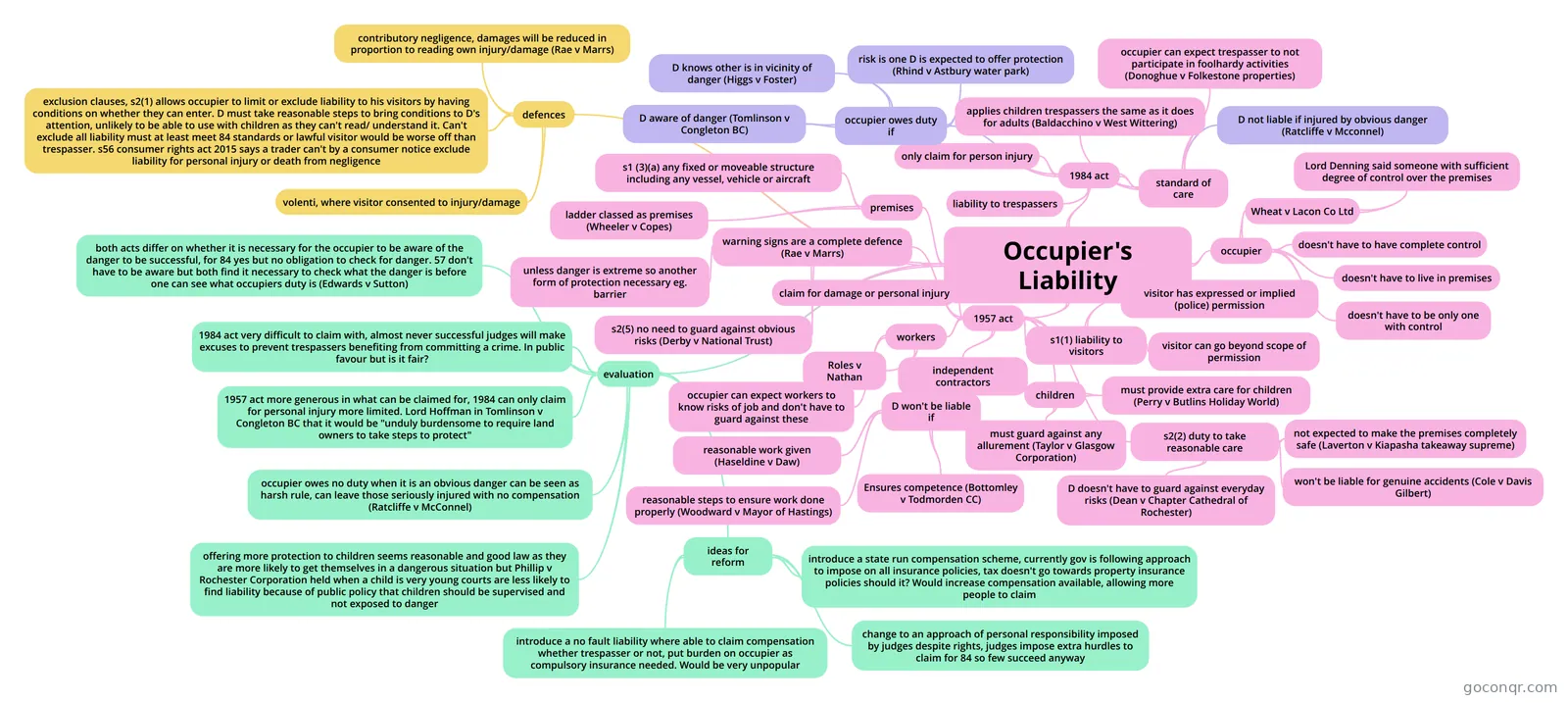
Mind map: Occupier's Liability
Conteúdo do mapa
Occupier's Liability
1957 act
- s1(1) liability to visitors
- visitor has expressed or implied (police) permission
- visitor can go beyond scope of permission
- claim for damage or personal injury
- workers
- occupier can expect workers to know risks of job and don't have to guard against these
- Roles v Nathan
- independent contractors
- D won't be liable if
- reasonable work given (Haseldine v Daw)
- Ensures competence (Bottomley v Todmorden CC)
- reasonable steps to ensure work done properly (Woodward v Mayor of Hastings)
- D won't be liable if
- children
- must provide extra care for children (Perry v Butlins Holiday World)
- must guard against any allurement (Taylor v Glasgow Corporation)
- warning signs are a complete defence (Rae v Marrs)
- unless danger is extreme so another form of protection necessary eg. barrier
- s2(5) no need to guard against obvious risks (Derby v National Trust)
- s2(2) duty to take reasonable care
- D doesn't have to guard against everyday risks (Dean v Chapter Cathedral of Rochester)
- not expected to make the premises completely safe (Laverton v Kiapasha takeaway supreme)
- won't be liable for genuine accidents (Cole v Davis Gilbert)
- s1(1) liability to visitors
1984 act
- liability to trespassers
- only claim for person injury
- standard of care
- occupier can expect trespasser to not participate in foolhardy activities (Donoghue v Folkestone properties)
- applies children trespassers the same as it does for adults (Baldacchino v West Wittering)
- D not liable if injured by obvious danger (Ratcliffe v Mcconnel)
- occupier owes duty if
- D aware of danger (Tomlinson v Congleton BC)
- D knows other is in vicinity of danger (Higgs v Foster)
- risk is one D is expected to offer protection (Rhind v Astbury water park)
occupier
- Wheat v Lacon Co Ltd
- Lord Denning said someone with sufficient degree of control over the premises
- doesn't have to have complete control
- doesn't have to live in premises
- doesn't have to be only one with control
- Wheat v Lacon Co Ltd
premises
- ladder classed as premises (Wheeler v Copes)
- s1 (3)(a) any fixed or moveable structure including any vessel, vehicle or aircraft
evaluation
- 1984 act very difficult to claim with, almost never successful judges will make excuses to prevent trespassers benefiting from committing a crime. In public favour but is it fair?
- 1957 act more generous in what can be claimed for, 1984 can only claim for personal injury more limited. Lord Hoffman in Tomlinson v Congleton BC that it would be "unduly burdensome to require land owners to take steps to protect"
- occupier owes no duty when it is an obvious danger can be seen as harsh rule, can leave those seriously injured with no compensation (Ratcliffe v McConnel)
- both acts differ on whether it is necessary for the occupier to be aware of the danger to be successful, for 84 yes but no obligation to check for danger. 57 don't have to be aware but both find it necessary to check what the danger is before one can see what occupiers duty is (Edwards v Sutton)
- offering more protection to children seems reasonable and good law as they are more likely to get themselves in a dangerous situation but Phillip v Rochester Corporation held when a child is very young courts are less likely to find liability because of public policy that children should be supervised and not exposed to danger
- ideas for reform
- introduce a no fault liability where able to claim compensation whether trespasser or not, put burden on occupier as compulsory insurance needed. Would be very unpopular
- introduce a state run compensation scheme, currently gov is following approach to impose on all insurance policies, tax doesn't go towards property insurance policies should it? Would increase compensation available, allowing more people to claim
- change to an approach of personal responsibility imposed by judges despite rights, judges impose extra hurdles to claim for 84 so few succeed anyway
defences
- contributory negligence, damages will be reduced in proportion to reading own injury/damage (Rae v Marrs)
- volenti, where visitor consented to injury/damage
- exclusion clauses, s2(1) allows occupier to limit or exclude liability to his visitors by having conditions on whether they can enter. D must take reasonable steps to bring conditions to D's attention, unlikely to be able to use with children as they can't read/ understand it. Can't exclude all liability must at least meet 84 standards or lawful visitor would be worse off than trespasser. s56 consumer rights act 2015 says a trader can't by a consumer notice exclude liability for personal injury or death from negligence
Informações
- Descrição
- A level Law (Tort Law (2B)) Mapa Mental sobre Occupier's Liability, criado por Josie Troop em 30-05-2022.
- Criado por
- Josie Troop
- Visualizações
- 0
- Avaliação