
Mapa mental
Persuasion
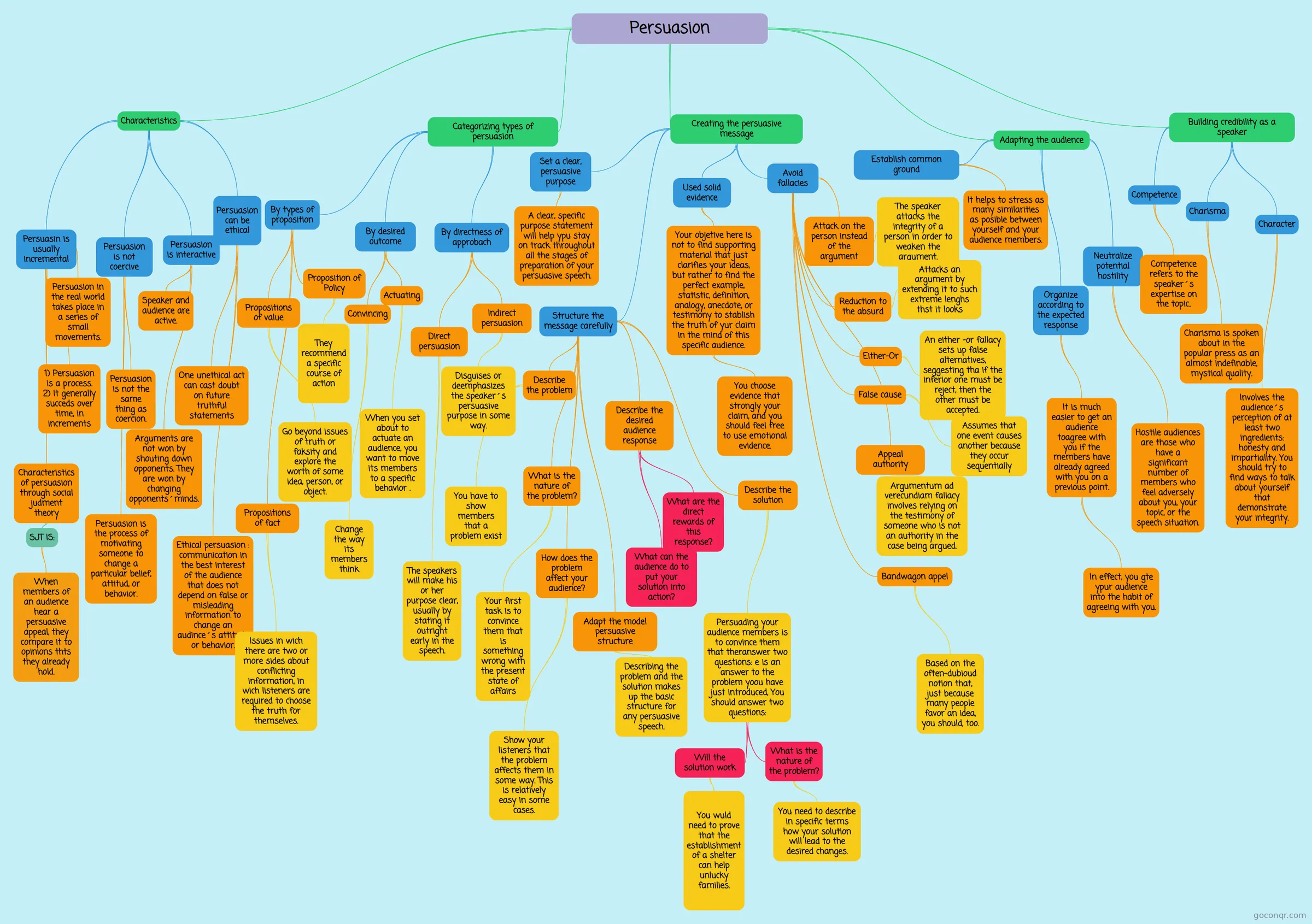
Mind map: Persuasion
Conteúdo do mapa
Persuasion
Characteristics
- Persuasion is not coercive
- Persuasion is the process of motivating someone to change a particular belief, attitud, or behavior.
- Persuasion is not the same thing as coercion.
- Persuasin is usually incremental
- 1) Persuasion is a process. 2) It generally succeds over time, in increments
- Characteristics of persuasion through social judment theory
- SJT IS:
- When members of an audience hear a persuasive appeal, they compare it to opinions thts they already hold.
- SJT IS:
- Persuasion in the real world takes place in a series of small movements.
- Persuasion is interactive
- Speaker and audience are active.
- Arguments are not won by shouting down opponents. They are won by changing opponents´minds.
- Persuasion can be ethical
- Ethical persuasion : communication in the best interest of the audience that does not depend on false or misleading information to change an audince´s attitude or behavior.
- One unethical act can cast doubt on future truthful statements
- Persuasion is not coercive
Categorizing types of persuasion
- By types of proposition
- Propositions of fact
- Issues in wich there are two or more sides about conflicting information, in wich listeners are required to choose the truth for themselves.
- Propositions of value
- Go beyond issues of truth or faksity and explore the worth of some idea, person, or object.
- Proposition of Policy
- They recommend a specific course of action
- Propositions of fact
- By desired outcome
- Convincing
- Change the way its members think
- Actuating
- When you set about to actuate an audience, you want to move its members to a specific behavior .
- Convincing
- By directness of approbach
- Direct persuasion
- The speakers will make his or her purpose clear, usually by stating it outright early in the speech.
- Indirect persuasion
- Disguises or deemphasizes the speaker´s persuasive purpose in some way.
- Direct persuasion
- By types of proposition
Creating the persuasive message
- Set a clear, persuasive purpose
- A clear, specific purpose statement will help ypu stay on track throughout all the stages of preparation of your persuasive speech.
- Structure the message carefully
- Adapt the model persuasive structure
- Describing the problem and the solution makes up the basic structure for any persuasive speech.
- Describe the solution
- Persuading your audience members is to convince them that theranswer two questions: e is an answer to the problem yoou have just introduced, You should answer two questions:
- Will the solution work
- You wuld need to prove that the establishment of a shelter can help unlucky families.
- What is the nature of the problem?
- You need to describe in specific terms how your solution will lead to the desired changes.
- Will the solution work
- Persuading your audience members is to convince them that theranswer two questions: e is an answer to the problem yoou have just introduced, You should answer two questions:
- Describe the problem
- You have to show members that a problem exist
- What is the nature of the problem?
- Your first task is to convince them that is something wrong with the present state of affairs
- How does the problem affect your audience?
- Show your listeners that the problem affects them in some way. This is relatively easy in some cases.
- Describe the desired audience response
- What can the audience do to put your solution into action?
- What are the direct rewards of this response?
- Adapt the model persuasive structure
- Used solid evidence
- Your objetive here is not to find supporting material that just clarifies your ideas, but rather to find the perfect example, statistic, definition, analogy, anecdote, or testimony to stablish the truth of yur claim in the mind of this specific audience.
- You choose evidence that strongly your claim, and you should feel free to use emotional evidence.
- Your objetive here is not to find supporting material that just clarifies your ideas, but rather to find the perfect example, statistic, definition, analogy, anecdote, or testimony to stablish the truth of yur claim in the mind of this specific audience.
- Avoid fallacies
- Either-Or
- An either -or fallacy sets up false alternatives, seggesting tha if the inferior one must be reject, then the other must be accepted.
- Attack on the person instead of the argument
- The speaker attacks the integrity of a person in order to weaken the argument.
- False cause
- Assumes that one event causes another because they occur sequentially
- Reduction to the absurd
- Attacks an argument by extending it to such extreme lenghs thst it looks
- Appeal authority
- Argumentum ad verecundiam fallacy involves relying on the testimony of someone who is not an authority in the case being argued.
- Bandwagon appel
- Based on the often-dubioud notion that, just because many people favor an idea, you should, too.
- Either-Or
- Set a clear, persuasive purpose
Adapting the audience
- Establish common ground
- It helps to stress as many similarities as posible between yourself and your audience members.
- Organize according to the expected response
- It is much easier to get an audience toagree with you if the members have already agreed with you on a previous point.
- In effect, you gte ypur audience into the habit of agreeing with you.
- It is much easier to get an audience toagree with you if the members have already agreed with you on a previous point.
- Neutralize potential hostility
- Hostile audiences are those who have a significant number of members who feel adversely about you, your topic, or the speech situation.
- Establish common ground
Building credibility as a speaker
- Competence
- Competence refers to the speaker´s expertise on the topic..
- Charisma
- Charisma is spoken about in the popular press as an almost indefinable, mystical quality.
- Character
- Involves the audience´s perception of at least two ingredients: honesty and impartiality. You should try to find ways to talk about yourself that demonstrate your integrity.
- Competence
Informações
- Descrição
- Mapa Mental sobre Persuasion, criado por ilse Torres em 22-10-2015.
- Criado por
- ilse Torres
- Visualizações
- 2
- Avaliação