
Mapa mental
Creating and Capturing Customer Value
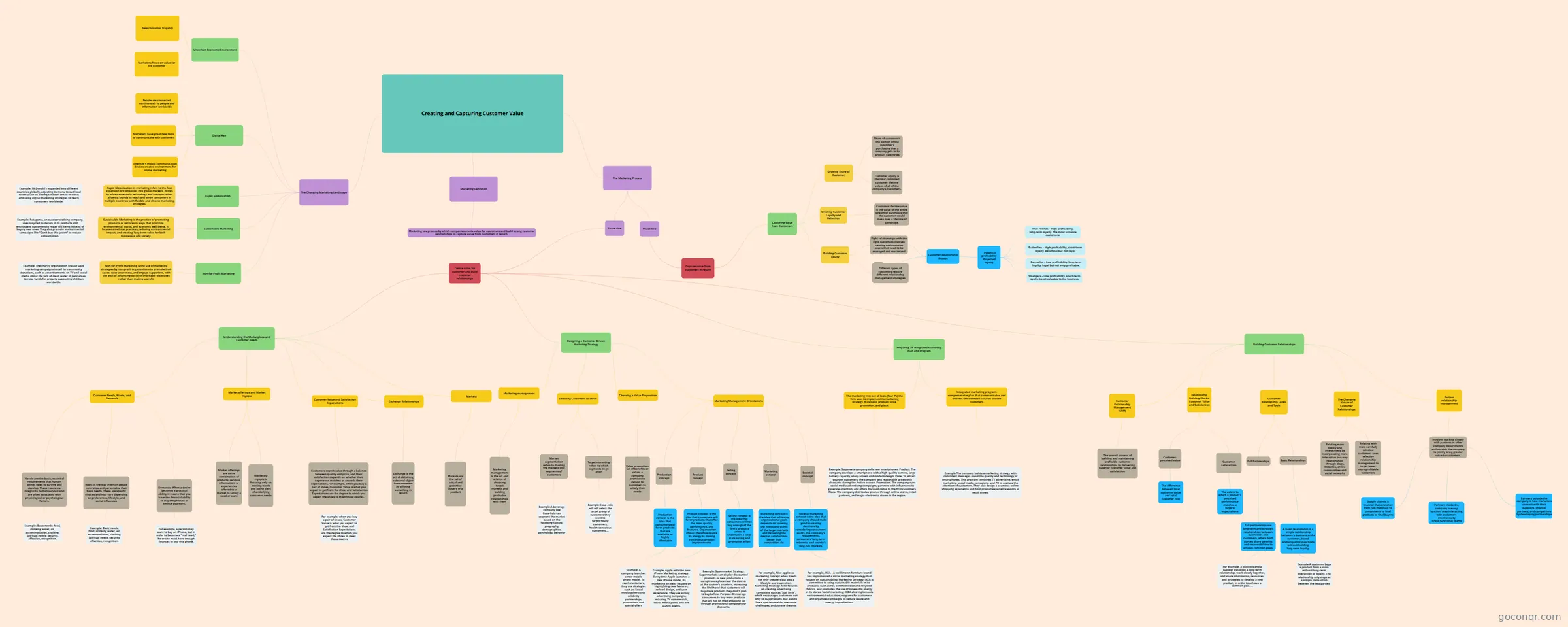
Mind map: Creating and Capturing Customer Value
Conteúdo do mapa
Creating and Capturing Customer Value
Marketing Definition
- Marketing is a process by which companies create value for customers and build strong customer relationships to capture value from customers in return.
The Marketing Process
- Phase One
- Create value for customer and build customer relationships
- Understanding the Marketplace and Customer Needs
- Customer Needs, Wants, and Demands
- Needs :are the basic, essential requirements that human beings need to survive and develop. These needs are integral to human survival and are often associated with physiological or psychological factors.
- Example: Basic needs: food, drinking water, air, accommodation, clothing. Spiritual needs: security, affection, recognition.
- Want: is the way in which people concretize and personalize their basic needs. These are specific choices and may vary depending on preferences, lifestyle, and social influences
- Example: Basic needs: food, drinking water, air, accommodation, clothing. Spiritual needs: security, affection, recognition.
- Demands: When a desire becomes a practical ability, it means that you have the financial ability to buy the product or service you want.
- For example, a person may want to buy an iPhone, but in order to become a "real need," he or she must have enough finances to buy this phone.
- Needs :are the basic, essential requirements that human beings need to survive and develop. These needs are integral to human survival and are often associated with physiological or psychological factors.
- Market offerings and Market myopia
- Market offerings are some combination of products, services, information, or experiences offered to a market to satisfy a need or want
- Marketing myopia is focusing only on existing wants and losing sight of underlying consumer needs
- Customer Value and Satisfaction Expectations
- Customers expect value through a balance between quality and price, and their satisfaction depends on whether their experience matches or exceeds their expectations.For example, when you buy a pair of shoes, Customer Value is what you expect to get from the shoe, and Satisfaction Expectations are the degree to which you expect the shoes to meet those desires.
- For example, when you buy a pair of shoes, Customer Value is what you expect to get from the shoe, and Satisfaction Expectations are the degree to which you expect the shoes to meet those desires
- Customers expect value through a balance between quality and price, and their satisfaction depends on whether their experience matches or exceeds their expectations.For example, when you buy a pair of shoes, Customer Value is what you expect to get from the shoe, and Satisfaction Expectations are the degree to which you expect the shoes to meet those desires.
- Markets
- Markets are the set of actual and potential buyers of a product
- Exchange Relationships
- Exchange is the act of obtaining a desired object from someone by offering something in return
- Customer Needs, Wants, and Demands
- Designing a Customer-Driven Marketing Strategy
- Marketing management
- Marketing management is the art and science of choosing target markets and building profitable relationships with them
- Selecting Customers to Serve
- Market segmentation refers to dividing the markets into segments of customers
- Example:A beverage company like Coca-Cola can segment the market based on the following factors: geography, demographics, psychology, behavior
- Target marketing refers to which segments to go after
- Example:Coca -cola will will select the target group of customers they want to target:Young customers, health-conscious customers,...
- Market segmentation refers to dividing the markets into segments of customers
- Choosing a Value Proposition
- Value proposition Set of benefits or values a company promises to deliver to customers to satisfy their needs
- Marketing Management Orientations
- Production concept
- Production concept is the idea that consumers will favor products that are available or highly affordable
- Example: A company launches a new mobile phone model. To reach customers, they use strategies such as: Social media advertising, celebrity partnerships, promotions and special offers
- Production concept is the idea that consumers will favor products that are available or highly affordable
- Product concept
- Product concept is the idea that consumers will favor products that offer the most quality, performance, and features. Organization should therefore devote its energy to making continuous product improvements.
- Example: Apple with the new iPhone Marketing strategy: Every time Apple launches a new iPhone model, its marketing strategy focuses on highlighting new features, refined design, and user experience. They use strong advertising campaigns, including TV commercials, social media posts, and live launch events.
- Product concept is the idea that consumers will favor products that offer the most quality, performance, and features. Organization should therefore devote its energy to making continuous product improvements.
- Selling concept
- Selling concept is the idea that consumers will not buy enough of the firm’s products unless it undertakes a large scale selling and promotion effort
- Example: Supermarket Strategy: Supermarkets can display discounted products or new products in a conspicuous place near the door or at the cashier's counters, increasing the likelihood that customers will buy more products they didn't plan to buy before. Purpose: Encourage consumers to buy more products that are not on their shopping list through promotional campaigns or discounts.
- Selling concept is the idea that consumers will not buy enough of the firm’s products unless it undertakes a large scale selling and promotion effort
- Marketing concept
- Marketing concept is the idea that achieving organizational goals depends on knowing the needs and wants of the target markets and delivering the desired satisfactions better than competitors do.
- For example, Nike applies a marketing concept when it sells not only sneakers but also a lifestyle and inspiration. Marketing Strategy: Nike focuses on creating advertising campaigns such as "Just Do It", which encourages customers not only to buy products, but also to live a sportsmanship, overcome challenges, and pursue dreams.
- Marketing concept is the idea that achieving organizational goals depends on knowing the needs and wants of the target markets and delivering the desired satisfactions better than competitors do.
- Societal concept
- Societal marketing concept is the idea that a company should make good marketing decisions by considering consumers' wants, the company's requirements, consumers' long-term interests, and society's long-run interests.
- For example, IKEA - A well-known furniture brand has implemented a social marketing strategy that focuses on sustainability. Marketing Strategy: IKEA is committed to using sustainable materials in its products, such as FSC-certified wood and recycled fabrics, and promotes the use of renewable energy in its stores. Social marketing: IKEA also implements environmental education programs for customers and organizes campaigns to reduce waste and energy in production.
- Societal marketing concept is the idea that a company should make good marketing decisions by considering consumers' wants, the company's requirements, consumers' long-term interests, and society's long-run interests.
- Production concept
- Marketing management
- Preparing an Integrated Marketing Plan and Program
- The marketing mix: set of tools (four Ps) the firm uses to implement its marketing strategy. It includes product, price, promotion, and place.
- Example: Suppose a company sells new smartphones: Product: The company develops a smartphone with a high-quality camera, large battery capacity, sharp screen and modern design. Price: To attract younger customers, the company sets reasonable prices with discounts during the festive season. Promotion: The company runs social media advertising campaigns, partners with influencers to generate attention, and offers discount codes to the first customers. Place: The company distributes phones through online stores, retail partners, and major electronics stores in the region.
- Integrated marketing program: comprehensive plan that communicates and delivers the intended value to chosen customers.
- Example:The company builds a marketing strategy with consistent messages about the quality and technology of smartphones. This program combines TV advertising, email marketing, social media campaigns, and PR to capture the attention of customers. They also design a seamless online shopping experience and host product experience events at retail stores.
- The marketing mix: set of tools (four Ps) the firm uses to implement its marketing strategy. It includes product, price, promotion, and place.
- Building Customer Relationships
- Customer Relationship Management (CRM)
- The overall process of building and maintaining profitable customer relationships by delivering superior customer value and satisfaction
- Relationship Building Blocks: Customer Value and Satisfaction
- Customer- perceived value
- The difference between total customer value and total customer cost
- Customer satisfaction
- The extent to which a product’s perceived performance matches a buyer’s expectations
- Customer- perceived value
- Customer Relationship Levels and Tools
- Basic Relationships
- A basic relationship is a simple relationship between a business and a customer, based primarily on transactions without building long-term loyalty.
- Example:A customer buys a product from a store without long-term interaction or loyalty. The relationship only stops at a simple transaction between the two parties.
- A basic relationship is a simple relationship between a business and a customer, based primarily on transactions without building long-term loyalty.
- Full Partnerships
- Full partnerships are long-term and strategic relationships between businesses and customers, where both parties share benefits and responsibilities to achieve common goals.
- For example, a business and a supplier establish a long-term relationship, work closely together, and share information, resources, and strategies to develop a new product, in order to achieve a common goal. ...
- Full partnerships are long-term and strategic relationships between businesses and customers, where both parties share benefits and responsibilities to achieve common goals.
- Basic Relationships
- The Changing Nature of Customer Relationships
- Relating with more carefully selected customers uses selective relationship management to target fewer, more profitable customers
- Relating more deeply and interactively by incorporating more interactive two way relationships through blogs, Websites, online communities and social networks
- Partner relationship management
- involves working closely with partners in other company departments and outside the company to jointly bring greater value to customers.
- Partners inside the company is every function area interacting with customers -Electronically -Cross-functional teams
- Partners outside the company is how marketers connect with their suppliers, channel partners, and competitors by developing partnerships
- Supply chain is a channel that stretches from raw materials to components to final products to final buyers
- involves working closely with partners in other company departments and outside the company to jointly bring greater value to customers.
- Customer Relationship Management (CRM)
- Understanding the Marketplace and Customer Needs
- Create value for customer and build customer relationships
- Phase two
- Capture value from customers in return
- Capturing Value from Customers
- Creating Customer Loyalty and Retention
- Customer lifetime value is the value of the entire stream of purchases that the customer would make over a lifetime of patronage.
- Growing Share of Customer
- Share of customer is the portion of the customer’s purchasing that a company gets in its product categories
- Customer equity is the total combined customer lifetime values of all of the company’s customers.
- Building Customer Equity
- Right relationships with the right customers involves treating customers as assets that need to be managed and maximized
- Customer Relationship Groups
- - Potential profitability -Projected loyalty
- True Friends – High profitability, long-term loyalty. The most valuable customers.
- Butterflies – High profitability, short-term loyalty. Beneficial but not loyal.
- Barnacles – Low profitability, long-term loyalty. Loyal but not very profitable.
- Strangers – Low profitability, short-term loyalty. Least valuable to the business.
- - Potential profitability -Projected loyalty
- Customer Relationship Groups
- Different types of customers require different relationship management strategies.
- Right relationships with the right customers involves treating customers as assets that need to be managed and maximized
- Creating Customer Loyalty and Retention
- Capturing Value from Customers
- Capture value from customers in return
- Phase One
The Changing Marketing Landscape
- Uncertain Economic Environment
- Marketers focus on value for the customer
- New consumer frugality
- Digital Age
- People are connected continuously to people and information worldwide
- Marketers have great new tools to communicate with customers
- Internet + mobile communication devices creates environment for online marketing
- Rapid Globalization
- Rapid Globalization in marketing refers to the fast expansion of companies into global markets, driven by advancements in technology and transportation, allowing brands to reach and serve consumers in multiple countries with flexible and diverse marketing strategies.
- Example: McDonald's expanded into different countries globally, adjusting its menu to suit local tastes (such as adding tandoori bread in India) and using digital marketing strategies to reach consumers worldwide.
- Rapid Globalization in marketing refers to the fast expansion of companies into global markets, driven by advancements in technology and transportation, allowing brands to reach and serve consumers in multiple countries with flexible and diverse marketing strategies.
- Sustainable Marketing
- Sustainable Marketing is the practice of promoting products or services in ways that prioritize environmental, social, and economic well-being. It focuses on ethical practices, reducing environmental impact, and creating long-term value for both businesses and society.
- Example: Patagonia, an outdoor clothing company, uses recycled materials in its products and encourages customers to repair old items instead of buying new ones. They also promote environmental campaigns like "Don't buy this jacket" to reduce consumption.
- Sustainable Marketing is the practice of promoting products or services in ways that prioritize environmental, social, and economic well-being. It focuses on ethical practices, reducing environmental impact, and creating long-term value for both businesses and society.
- Non-for-Profit Marketing
- Non-for-Profit Marketing is the use of marketing strategies by non-profit organizations to promote their cause, raise awareness, and engage supporters, with the goal of advancing social or charitable objectives rather than making a profit.
- Example: The charity organization UNICEF uses marketing campaigns to call for community donations, such as advertisements on TV and social media about the lack of clean water in poor areas, to raise funds for projects supporting children worldwide.
- Non-for-Profit Marketing is the use of marketing strategies by non-profit organizations to promote their cause, raise awareness, and engage supporters, with the goal of advancing social or charitable objectives rather than making a profit.
- Uncertain Economic Environment
Informações
- Descrição
- Design Mapa Mental sobre Creating and Capturing Customer Value, criado por Trang Thu em 21-02-2025.
- Criado por
- Trang Thu
- Visualizações
- 0
- Tags
- Avaliação