
Mapa mental
Right Realism
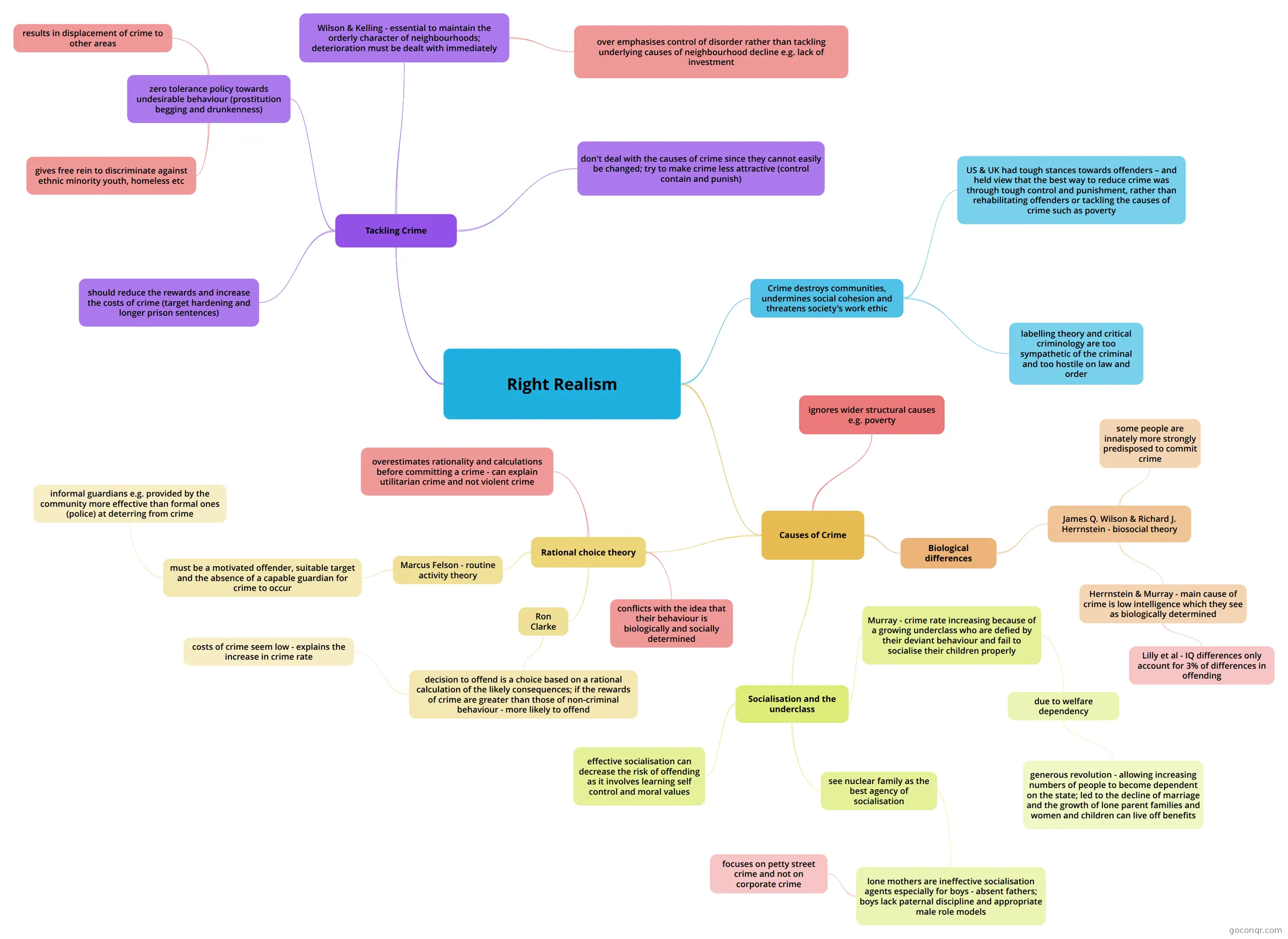
Mind map: Right realism criminology
Conteúdo do mapa
Right Realism
Crime destroys communities, undermines social cohesion and threatens society's work ethic
- US & UK had tough stances towards offenders – and held view that the best way to reduce crime was through tough control and punishment, rather than rehabilitating offenders or tackling the causes of crime such as poverty
- labelling theory and critical criminology are too sympathetic of the criminal and too hostile on law and order
- Right realism focuses less on the causes of crime but more on how to provide practical solutions
Causes of Crime
- go against marxist theory - old are poor but have low crime rates
- Biological differences
- James Q. Wilson & Richard J. Herrnstein - biosocial theory
- some people are innately more strongly predisposed to commit crime
- e.g. personality traits such as aggression extroversion risk taking and low impulse control - greater risk to offend
- Herrnstein & Murray - main cause of crime is low intelligence which they see as biologically determined
- Lilly et al - IQ differences only account for 3% of differences in offending
- some people are innately more strongly predisposed to commit crime
- James Q. Wilson & Richard J. Herrnstein - biosocial theory
- Socialisation and the underclass
- effective socialisation can decrease the risk of offending as it involves learning self control and moral values
- see nuclear family as the best agency of socialisation
- lone mothers are ineffective socialisation agents especially for boys - absent fathers; boys lack paternal discipline and appropriate male role models
- young males turn to delinquent male role models and street crime in order to gain status
- focuses on petty street crime and not on corporate crime
- lone mothers are ineffective socialisation agents especially for boys - absent fathers; boys lack paternal discipline and appropriate male role models
- Murray - crime rate increasing because of a growing underclass who are defied by their deviant behaviour and fail to socialise their children properly
- due to welfare dependency
- generous revolution - allowing increasing numbers of people to become dependent on the state; led to the decline of marriage and the growth of lone parent families and women and children can live off benefits
- men no longer take responsibility for supporting their families = no longer need to work
- generous revolution - allowing increasing numbers of people to become dependent on the state; led to the decline of marriage and the growth of lone parent families and women and children can live off benefits
- due to welfare dependency
- Rational choice theory
- individuals have free will and the power of reason
- Ron Clarke
- decision to offend is a choice based on a rational calculation of the likely consequences; if the rewards of crime are greater than those of non-criminal behaviour - more likely to offend
- costs of crime seem low - explains the increase in crime rate
- decision to offend is a choice based on a rational calculation of the likely consequences; if the rewards of crime are greater than those of non-criminal behaviour - more likely to offend
- Marcus Felson - routine activity theory
- must be a motivated offender, suitable target and the absence of a capable guardian for crime to occur
- informal guardians e.g. provided by the community more effective than formal ones (police) at deterring from crime
- e.g. after Hurricane Andrew in Florida - patrols by local citizens to protect property during absence of police prevented looting and crime rates decreased during this time (Cromwell et al)
- informal guardians e.g. provided by the community more effective than formal ones (police) at deterring from crime
- must be a motivated offender, suitable target and the absence of a capable guardian for crime to occur
- overestimates rationality and calculations before committing a crime - can explain utilitarian crime and not violent crime
- conflicts with the idea that their behaviour is biologically and socially determined
- ignores wider structural causes e.g. poverty
Tackling Crime
- don't deal with the causes of crime since they cannot easily be changed; try to make crime less attractive (control contain and punish)
- Wilson & Kelling - essential to maintain the orderly character of neighbourhoods; deterioration must be dealt with immediately
- over emphasises control of disorder rather than tackling underlying causes of neighbourhood decline e.g. lack of investment
- zero tolerance policy towards undesirable behaviour (prostitution begging and drunkenness)
- gives free rein to discriminate against ethnic minority youth, homeless etc
- results in displacement of crime to other areas
- Jones - right realist policies in the USA failed to prevent the crime rate increasing
- should reduce the rewards and increase the costs of crime (target hardening and longer prison sentences)
Informações
- Descrição
- Crime & Deviance (Topic 4) Mapa Mental sobre Right Realism, criado por CarrotSticks em 01-02-2014.
- Criado por
- CarrotSticks
- Visualizações
- 104
- Tags
- Avaliação