
Mapa mental
Chemistry
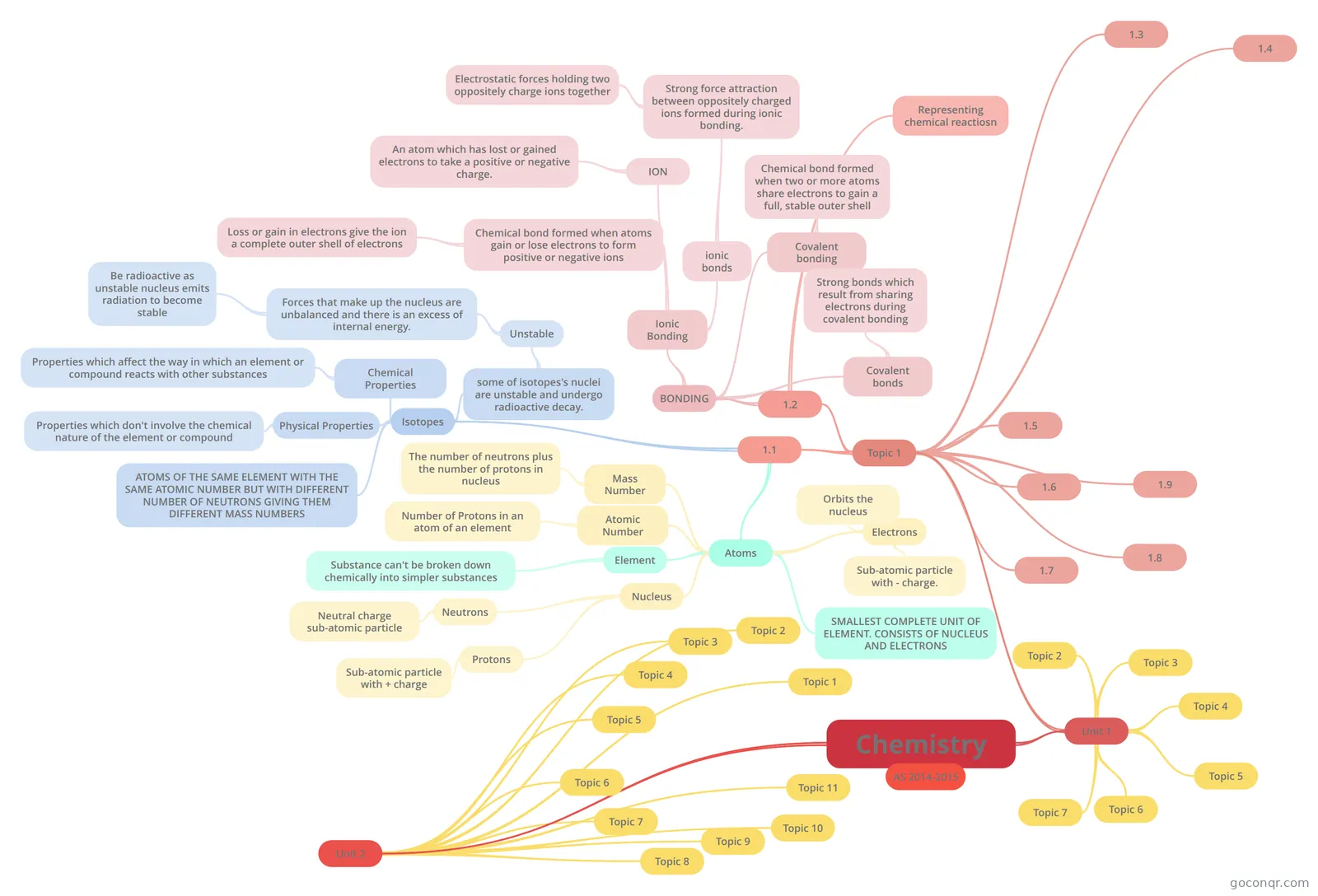
Mind map: chemistry
Conteúdo do mapa
Chemistry
AS 2014-2015
Unit 1
- Topic 1
- 1.1
- Atoms
- Nucleus
- Protons
- Sub-atomic particle with + charge
- Neutrons
- Neutral charge sub-atomic particle
- Protons
- Electrons
- Sub-atomic particle with - charge.
- Orbits the nucleus
- Element
- Substance can't be broken down chemically into simpler substances
- Atomic Number
- Number of Protons in an atom of an element
- Mass Number
- The number of neutrons plus the number of protons in nucleus
- SMALLEST COMPLETE UNIT OF ELEMENT. CONSISTS OF NUCLEUS AND ELECTRONS
- Nucleus
- Isotopes
- ATOMS OF THE SAME ELEMENT WITH THE SAME ATOMIC NUMBER BUT WITH DIFFERENT NUMBER OF NEUTRONS GIVING THEM DIFFERENT MASS NUMBERS
- Physical Properties
- Properties which don't involve the chemical nature of the element or compound
- Chemical Properties
- Properties which affect the way in which an element or compound reacts with other substances
- some of isotopes's nuclei are unstable and undergo radioactive decay.
- Unstable
- Forces that make up the nucleus are unbalanced and there is an excess of internal energy.
- Be radioactive as unstable nucleus emits radiation to become stable
- Forces that make up the nucleus are unbalanced and there is an excess of internal energy.
- Unstable
- Atoms
- 1.2
- BONDING
- Ionic Bonding
- Chemical bond formed when atoms gain or lose electrons to form positive or negative ions
- Loss or gain in electrons give the ion a complete outer shell of electrons
- ION
- An atom which has lost or gained electrons to take a positive or negative charge.
- ionic bonds
- Strong force attraction between oppositely charged ions formed during ionic bonding.
- Electrostatic forces holding two oppositely charge ions together
- Strong force attraction between oppositely charged ions formed during ionic bonding.
- Chemical bond formed when atoms gain or lose electrons to form positive or negative ions
- Covalent bonding
- Chemical bond formed when two or more atoms share electrons to gain a full, stable outer shell
- Covalent bonds
- Strong bonds which result from sharing electrons during covalent bonding
- Ionic Bonding
- Representing chemical reactiosn
- BONDING
- 1.3
- 1.4
- 1.5
- 1.6
- 1.7
- 1.8
- 1.9
- 1.1
- Topic 2
- Topic 3
- Topic 4
- Topic 5
- Topic 6
- Topic 7
- Topic 1
Unit 2
- Topic 1
- Topic 2
- Topic 3
- Topic 4
- Topic 5
- Topic 6
- Topic 7
- Topic 11
- Topic 10
- Topic 8
- Topic 9