
Mapa mental
Labelling theory
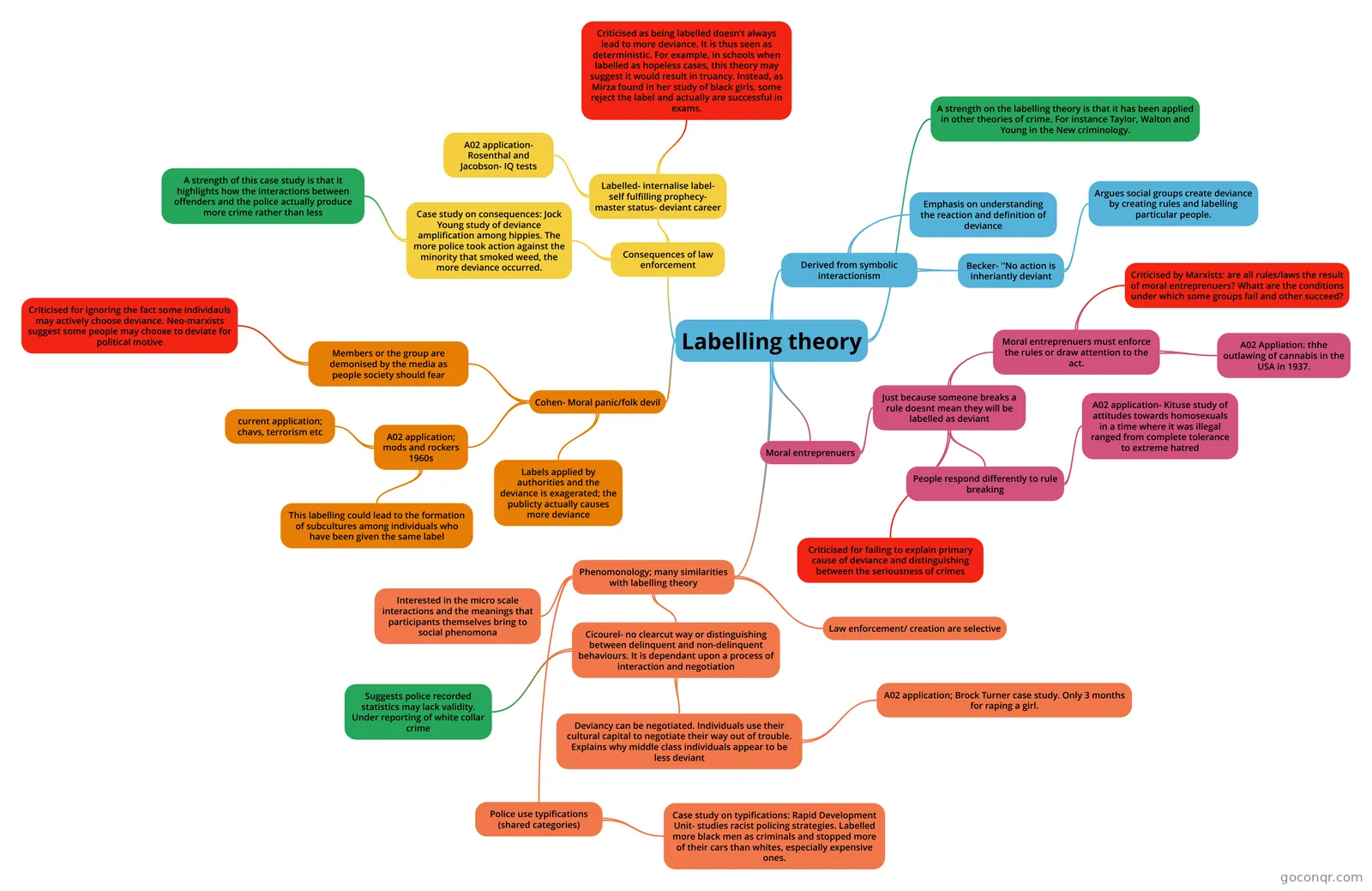
Mind map: Labelling theory
Conteúdo do mapa
Labelling theory
Derived from symbolic interactionism
- Emphasis on understanding the reaction and definition of deviance
- Becker- ''No action is inheriantly deviant
- Argues social groups create deviance by creating rules and labelling particular people.
A strength on the labelling theory is that it has been applied in other theories of crime. For instance Taylor, Walton and Young in the New criminology.
Moral entreprenuers
- Just because someone breaks a rule doesnt mean they will be labelled as deviant
- Moral entreprenuers must enforce the rules or draw attention to the act.
- Criticised by Marxists: are all rules/laws the result of moral entreprenuers? Whatt are the conditions under which some groups fail and other succeed?
- A02 Appliation: thhe outlawing of cannabis in the USA in 1937.
- People respond differently to rule breaking
- A02 application- Kituse study of attitudes towards homosexuals in a time where it was illegal ranged from complete tolerance to extreme hatred
- Criticised for failing to explain primary cause of deviance and distinguishing between the seriousness of crimes
- Moral entreprenuers must enforce the rules or draw attention to the act.
- Just because someone breaks a rule doesnt mean they will be labelled as deviant
Consequences of law enforcement
- Labelled- internalise label- self fulfilling prophecy- master status- deviant career
- Master status- occurs when a label has been successfully applied to an individual and all other characteristics become unimportant/ irrelevant.
- A02 application- Rosenthal and Jacobson- IQ tests
- Criticised as being labelled doesn't always lead to more deviance. It is thus seen as deterministic. For example, in schools when labelled as hopeless cases, this theory may suggest it would result in truancy. Instead, as Mirza found in her study of black girls, some reject the label and actually are successful in exams.
- Case study on consequences: Jock Young study of deviance amplification among hippies. The more police took action against the minority that smoked weed, the more deviance occurred.
- A strength of this case study is that it highlights how the interactions between offenders and the police actually produce more crime rather than less
- Labelled- internalise label- self fulfilling prophecy- master status- deviant career
Cohen- Moral panic/folk devil
- Members or the group are demonised by the media as people society should fear
- Criticised for ignoring the fact some individauls may actively choose deviance. Neo-marxists suggest some people may chooxe to deviate for political motive
- Labels applied by authorities and the deviance is exagerated; the publicty actually causes more deviance
- A02 application; mods and rockers 1960s
- current application; chavs, terrorism etc
- This labelling could lead to the formation of subcultures among individuals who have been given the same label
- Members or the group are demonised by the media as people society should fear
Phenomonology; many similarities with labelling theory
- Interested in the micro scale interactions and the meanings that participants themselves bring to social phenomona
- Cicourel- no clearcut way or distinguishing between delinquent and non-delinquent behaviours. It is dependant upon a process of interaction and negotiation
- Deviancy can be negotiated. Individuals use their cultural capital to negotiate their way out of trouble. Explains why middle class individuals appear to be less deviant
- A02 application; Brock Turner case study. Only 3 months for raping a girl.
- Suggests police recorded statistics may lack validity. Under reporting of white collar crime
- Deviancy can be negotiated. Individuals use their cultural capital to negotiate their way out of trouble. Explains why middle class individuals appear to be less deviant
- Law enforcement/ creation are selective
- Police use typifications (shared categories)
- Case study on typifications: Rapid Development Unit- studies racist policing strategies. Labelled more black men as criminals and stopped more of their cars than whites, especially expensive ones.
Informações
- Descrição
- A level Sociology (Crime and deviance) Mapa Mental sobre Labelling theory, criado por Jess Bailey em 10-01-2017.
- Criado por
- Jess Bailey
- Visualizações
- 142
- Avaliação