
Mapa mental
B2.5 Simple Inheritance in Animals and Plants
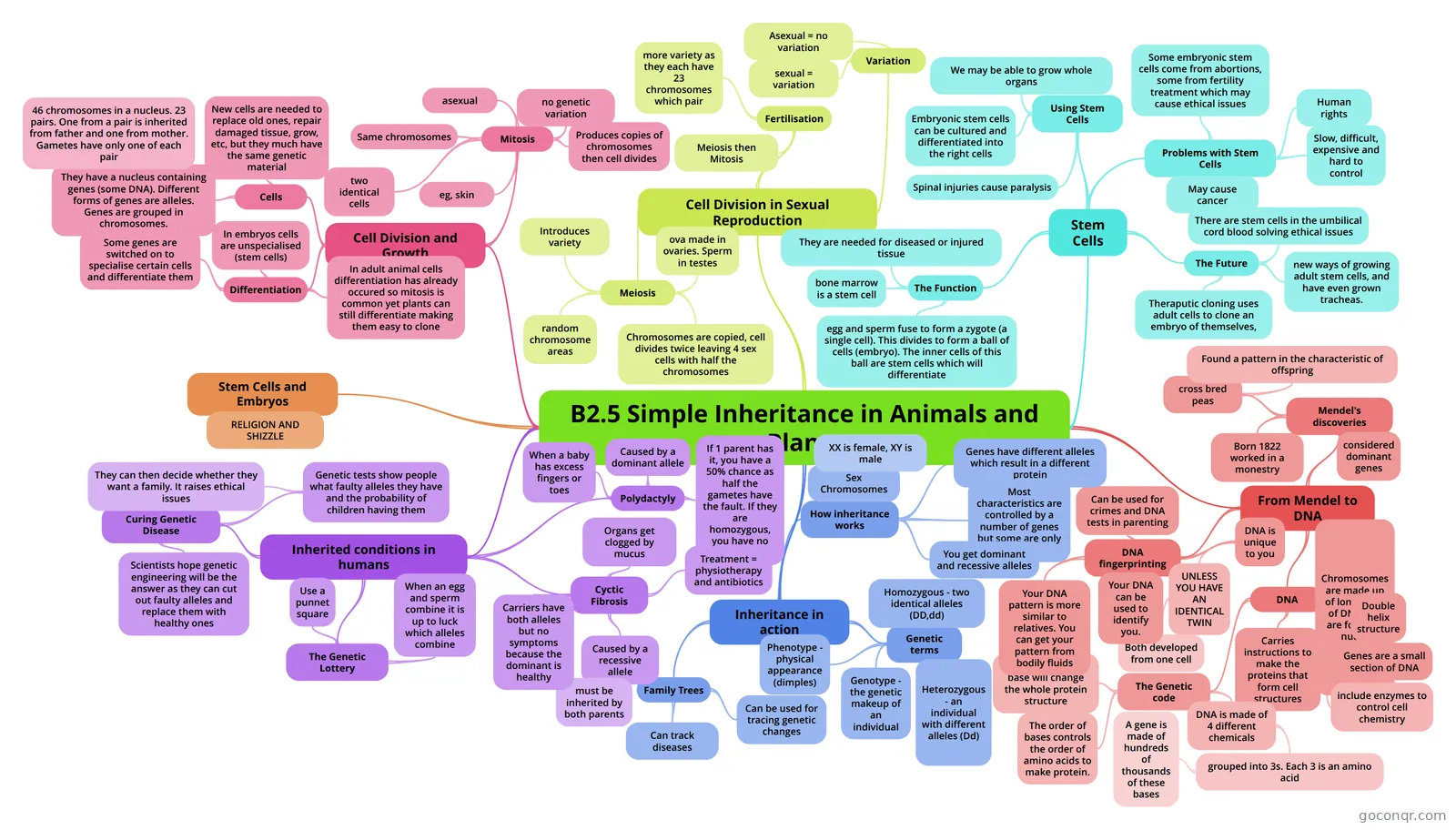
Mind map: Simple inheritance in animals and plants
Conteúdo do mapa
B2.5 Simple Inheritance in Animals and Plants
Cell Division and Growth
- Cells
- New cells are needed to replace old ones, repair damaged tissue, grow, etc, but they much have the same genetic material
- They have a nucleus containing genes (some DNA). Different forms of genes are alleles. Genes are grouped in chromosomes.
- 46 chromosomes in a nucleus. 23 pairs. One from a pair is inherited from father and one from mother. Gametes have only one of each pair
- Mitosis
- two identical cells
- Same chromosomes
- asexual
- no genetic variation
- Produces copies of chromosomes then cell divides
- eg, skin
- Differentiation
- In embryos cells are unspecialised (stem cells)
- Some genes are switched on to specialise certain cells and differentiate them
- In adult animal cells differentiation has already occured so mitosis is common yet plants can still differentiate making them easy to clone
- Cells
Cell Division in Sexual Reproduction
- Meiosis
- ova made in ovaries. Sperm in testes
- Chromosomes are copied, cell divides twice leaving 4 sex cells with half the chromosomes
- Introduces variety
- random chromosome areas
- Fertilisation
- more variety as they each have 23 chromosomes which pair
- Meiosis then Mitosis
- Variation
- Asexual = no variation
- sexual = variation
- Meiosis
Stem Cells
- The Function
- egg and sperm fuse to form a zygote (a single cell). This divides to form a ball of cells (embryo). The inner cells of this ball are stem cells which will differentiate
- bone marrow is a stem cell
- They are needed for diseased or injured tissue
- Using Stem Cells
- Spinal injuries cause paralysis
- Embryonic stem cells can be cultured and differentiated into the right cells
- We may be able to grow whole organs
- Problems with Stem Cells
- Some embryonic stem cells come from abortions, some from fertility treatment which may cause ethical issues
- Human rights
- Slow, difficult, expensive and hard to control
- May cause cancer
- The Future
- There are stem cells in the umbilical cord blood solving ethical issues
- new ways of growing adult stem cells, and have even grown tracheas.
- Theraputic cloning uses adult cells to clone an embryo of themselves,
- The Function
From Mendel to DNA
- Mendel's discoveries
- Born 1822 worked in a monestry
- cross bred peas
- Found a pattern in the characteristic of offspring
- considered dominant genes
- DNA
- Chromosomes are made up of long chain of DNA and are found in nuclei
- Double helix structure
- Genes are a small section of DNA
- Carries instructions to make the proteins that form cell structures
- include enzymes to control cell chemistry
- The Genetic code
- DNA is made of 4 different chemicals
- grouped into 3s. Each 3 is an amino acid
- A gene is made of hundreds of thousands of these bases
- grouped into 3s. Each 3 is an amino acid
- The order of bases controls the order of amino acids to make protein.
- A mutation in a base will change the whole protein structure
- DNA is made of 4 different chemicals
- DNA fingerprinting
- DNA is unique to you
- UNLESS YOU HAVE AN IDENTICAL TWIN
- Both developed from one cell
- UNLESS YOU HAVE AN IDENTICAL TWIN
- Your DNA can be used to identify you.
- Your DNA pattern is more similar to relatives. You can get your pattern from bodily fluids
- Can be used for crimes and DNA tests in parenting
- DNA is unique to you
- Mendel's discoveries
Inheritance in action
- How inheritance works
- Sex Chromosomes
- XX is female, XY is male
- Genes have different alleles which result in a different protein
- Most characteristics are controlled by a number of genes but some are only 1.
- You get dominant and recessive alleles
- Sex Chromosomes
- Genetic terms
- Homozygous - two identical alleles (DD,dd)
- Heterozygous - an individual with different alleles (Dd)
- Genotype - the genetic makeup of an individual
- Phenotype - physical appearance (dimples)
- Family Trees
- Can be used for tracing genetic changes
- Can track diseases
- How inheritance works
Inherited conditions in humans
- Polydactyly
- When a baby has excess fingers or toes
- Caused by a dominant allele
- If 1 parent has it, you have a 50% chance as half the gametes have the fault. If they are homozygous, you have no chance
- Cyctic Fibrosis
- Organs get clogged by mucus
- Treatment = physiotherapy and antibiotics
- Caused by a recessive allele
- must be inherited by both parents
- Carriers have both alleles but no symptoms because the dominant is healthy
- The Genetic Lottery
- When an egg and sperm combine it is up to luck which alleles combine
- Use a punnet square
- Curing Genetic Disease
- Scientists hope genetic engineering will be the answer as they can cut out faulty alleles and replace them with healthy ones
- Genetic tests show people what faulty alleles they have and the probability of children having them
- They can then decide whether they want a family. It raises ethical issues
- Polydactyly
Stem Cells and Embryos
- RELIGION AND SHIZZLE
Informações
- Descrição
- GCSE Biology (B2 ) Mapa Mental sobre B2.5 Simple Inheritance in Animals and Plants, criado por mhancoc3 em 23-04-2014.
- Criado por
- mhancoc3
- Visualizações
- 218
- Avaliação