
Mapa mental
Parenting, the Neo-Conventional Family and the Rapoports
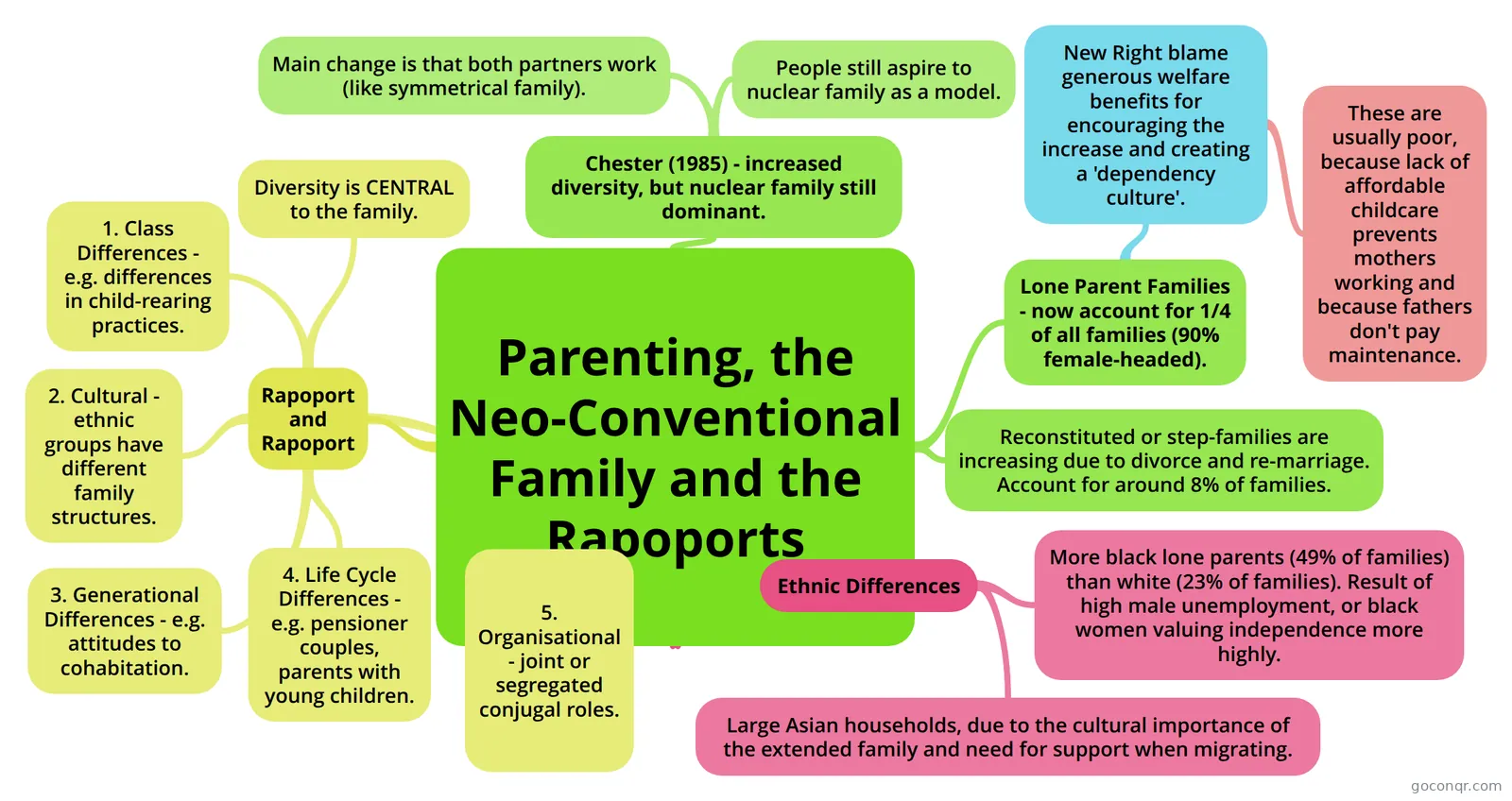
Mind map: Parenting, the neo-conventional family and the Rapoports
Conteúdo do mapa
Parenting, the Neo-Conventional Family and the Rapoports
Lone Parent Families - now account for 1/4 of all families (90% female-headed).
- New Right blame generous welfare benefits for encouraging the increase and creating a 'dependency culture'.
- These are usually poor, because lack of affordable childcare prevents mothers working and because fathers don't pay maintenance.
- New Right blame generous welfare benefits for encouraging the increase and creating a 'dependency culture'.
Reconstituted or step-families are increasing due to divorce and re-marriage. Account for around 8% of families.
Chester (1985) - increased diversity, but nuclear family still dominant.
- Main change is that both partners work (like symmetrical family).
- People still aspire to nuclear family as a model.
Rapoport and Rapoport
- Diversity is CENTRAL to the family.
- 5. Organisational - joint or segregated conjugal roles.
- 2. Cultural - ethnic groups have different family structures.
- 1. Class Differences - e.g. differences in child-rearing practices.
- 4. Life Cycle Differences - e.g. pensioner couples, parents with young children.
- 3. Generational Differences - e.g. attitudes to cohabitation.
Ethnic Differences
- More black lone parents (49% of families) than white (23% of families). Result of high male unemployment, or black women valuing independence more highly.
- Large Asian households, due to the cultural importance of the extended family and need for support when migrating.
Informações
- Descrição
- A Levels Sociology (Family) Mapa Mental sobre Parenting, the Neo-Conventional Family and the Rapoports, criado por Robeban em 24-04-2014.
- Criado por
- Robeban
- Visualizações
- 54
- Avaliação