
Mapa mental
Language and imagery
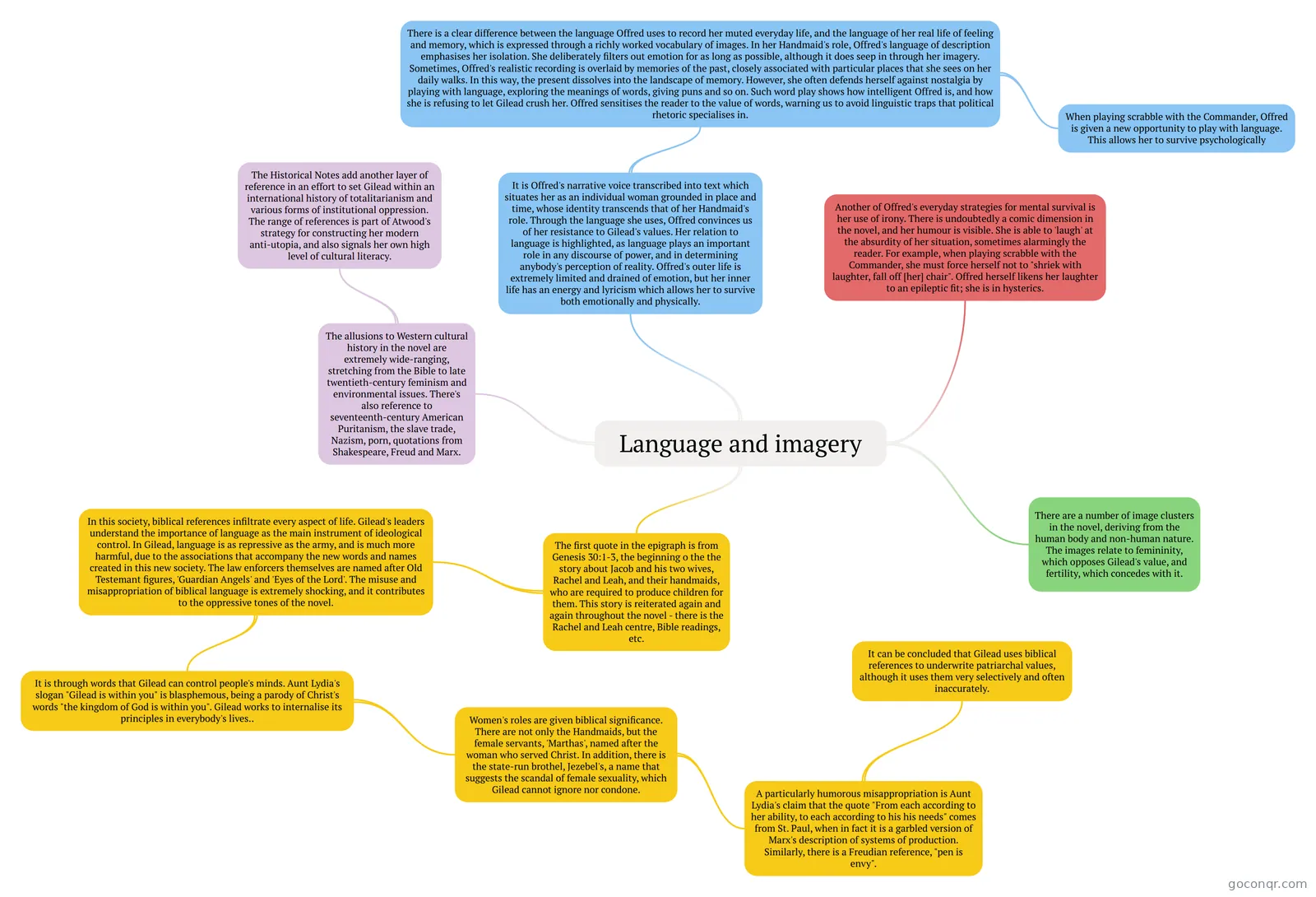
Mind map: Language and imagery in The Handmaid's Tale
Conteúdo do mapa
Language and imagery
The allusions to Western cultural history in the novel are extremely wide-ranging, stretching from the Bible to late twentieth-century feminism and environmental issues. There's also reference to seventeenth-century American Puritanism, the slave trade, Nazism, porn, quotations from Shakespeare, Freud and Marx.
- The Historical Notes add another layer of reference in an effort to set Gilead within an international history of totalitarianism and various forms of institutional oppression. The range of references is part of Atwood's strategy for constructing her modern anti-utopia, and also signals her own high level of cultural literacy.
It is Offred's narrative voice transcribed into text which situates her as an individual woman grounded in place and time, whose identity transcends that of her Handmaid's role. Through the language she uses, Offred convinces us of her resistance to Gilead's values. Her relation to language is highlighted, as language plays an important role in any discourse of power, and in determining anybody's perception of reality. Offred's outer life is extremely limited and drained of emotion, but her inner life has an energy and lyricism which allows her to survive both emotionally and physically.
- There is a clear difference between the language Offred uses to record her muted everyday life, and the language of her real life of feeling and memory, which is expressed through a richly worked vocabulary of images. In her Handmaid's role, Offred's language of description emphasises her isolation. She deliberately filters out emotion for as long as possible, although it does seep in through her imagery. Sometimes, Offred's realistic recording is overlaid by memories of the past, closely associated with particular places that she sees on her daily walks. In this way, the present dissolves into the landscape of memory. However, she often defends herself against nostalgia by playing with language, exploring the meanings of words, giving puns and so on. Such word play shows how intelligent Offred is, and how she is refusing to let Gilead crush her. Offred sensitises the reader to the value of words, warning us to avoid linguistic traps that political rhetoric specialises in.
- When playing scrabble with the Commander, Offred is given a new opportunity to play with language. This allows her to survive psychologically
- There is a clear difference between the language Offred uses to record her muted everyday life, and the language of her real life of feeling and memory, which is expressed through a richly worked vocabulary of images. In her Handmaid's role, Offred's language of description emphasises her isolation. She deliberately filters out emotion for as long as possible, although it does seep in through her imagery. Sometimes, Offred's realistic recording is overlaid by memories of the past, closely associated with particular places that she sees on her daily walks. In this way, the present dissolves into the landscape of memory. However, she often defends herself against nostalgia by playing with language, exploring the meanings of words, giving puns and so on. Such word play shows how intelligent Offred is, and how she is refusing to let Gilead crush her. Offred sensitises the reader to the value of words, warning us to avoid linguistic traps that political rhetoric specialises in.
Another of Offred's everyday strategies for mental survival is her use of irony. There is undoubtedly a comic dimension in the novel, and her humour is visible. She is able to 'laugh' at the absurdity of her situation, sometimes alarmingly the reader. For example, when playing scrabble with the Commander, she must force herself not to "shriek with laughter, fall off [her] chair". Offred herself likens her laughter to an epileptic fit; she is in hysterics.
There are a number of image clusters in the novel, deriving from the human body and non-human nature. The images relate to femininity, which opposes Gilead's value, and fertility, which concedes with it.
The first quote in the epigraph is from Genesis 30:1-3, the beginning o the the story about Jacob and his two wives, Rachel and Leah, and their handmaids, who are required to produce children for them. This story is reiterated again and again throughout the novel - there is the Rachel and Leah centre, Bible readings, etc.
- In this society, biblical references infiltrate every aspect of life. Gilead's leaders understand the importance of language as the main instrument of ideological control. In Gilead, language is as repressive as the army, and is much more harmful, due to the associations that accompany the new words and names created in this new society. The law enforcers themselves are named after Old Testemant figures, 'Guardian Angels' and 'Eyes of the Lord'. The misuse and misappropriation of biblical language is extremely shocking, and it contributes to the oppressive tones of the novel.
- It is through words that Gilead can control people's minds. Aunt Lydia's slogan "Gilead is within you" is blasphemous, being a parody of Christ's words "the kingdom of God is within you". Gilead works to internalise its principles in everybody's lives..
- Women's roles are given biblical significance. There are not only the Handmaids, but the female servants, 'Marthas', named after the woman who served Christ. In addition, there is the state-run brothel, Jezebel's, a name that suggests the scandal of female sexuality, which Gilead cannot ignore nor condone.
- A particularly humorous misappropriation is Aunt Lydia's claim that the quote "From each according to her ability, to each according to his his needs" comes from St. Paul, when in fact it is a garbled version of Marx's description of systems of production. Similarly, there is a Freudian reference, "pen is envy".
- It can be concluded that Gilead uses biblical references to underwrite patriarchal values, although it uses them very selectively and often inaccurately.
- A particularly humorous misappropriation is Aunt Lydia's claim that the quote "From each according to her ability, to each according to his his needs" comes from St. Paul, when in fact it is a garbled version of Marx's description of systems of production. Similarly, there is a Freudian reference, "pen is envy".
- Women's roles are given biblical significance. There are not only the Handmaids, but the female servants, 'Marthas', named after the woman who served Christ. In addition, there is the state-run brothel, Jezebel's, a name that suggests the scandal of female sexuality, which Gilead cannot ignore nor condone.
- It is through words that Gilead can control people's minds. Aunt Lydia's slogan "Gilead is within you" is blasphemous, being a parody of Christ's words "the kingdom of God is within you". Gilead works to internalise its principles in everybody's lives..
- In this society, biblical references infiltrate every aspect of life. Gilead's leaders understand the importance of language as the main instrument of ideological control. In Gilead, language is as repressive as the army, and is much more harmful, due to the associations that accompany the new words and names created in this new society. The law enforcers themselves are named after Old Testemant figures, 'Guardian Angels' and 'Eyes of the Lord'. The misuse and misappropriation of biblical language is extremely shocking, and it contributes to the oppressive tones of the novel.
Informações
- Descrição
- A level English (The Handmaid's Tale) Mapa Mental sobre Language and imagery, criado por Em Maskrey em 27-02-2017.
- Criado por
- Em Maskrey
- Visualizações
- 1
- Avaliação
Mais sobre Language, Imagery and Symbolism