
Mapa mental
Homologous series
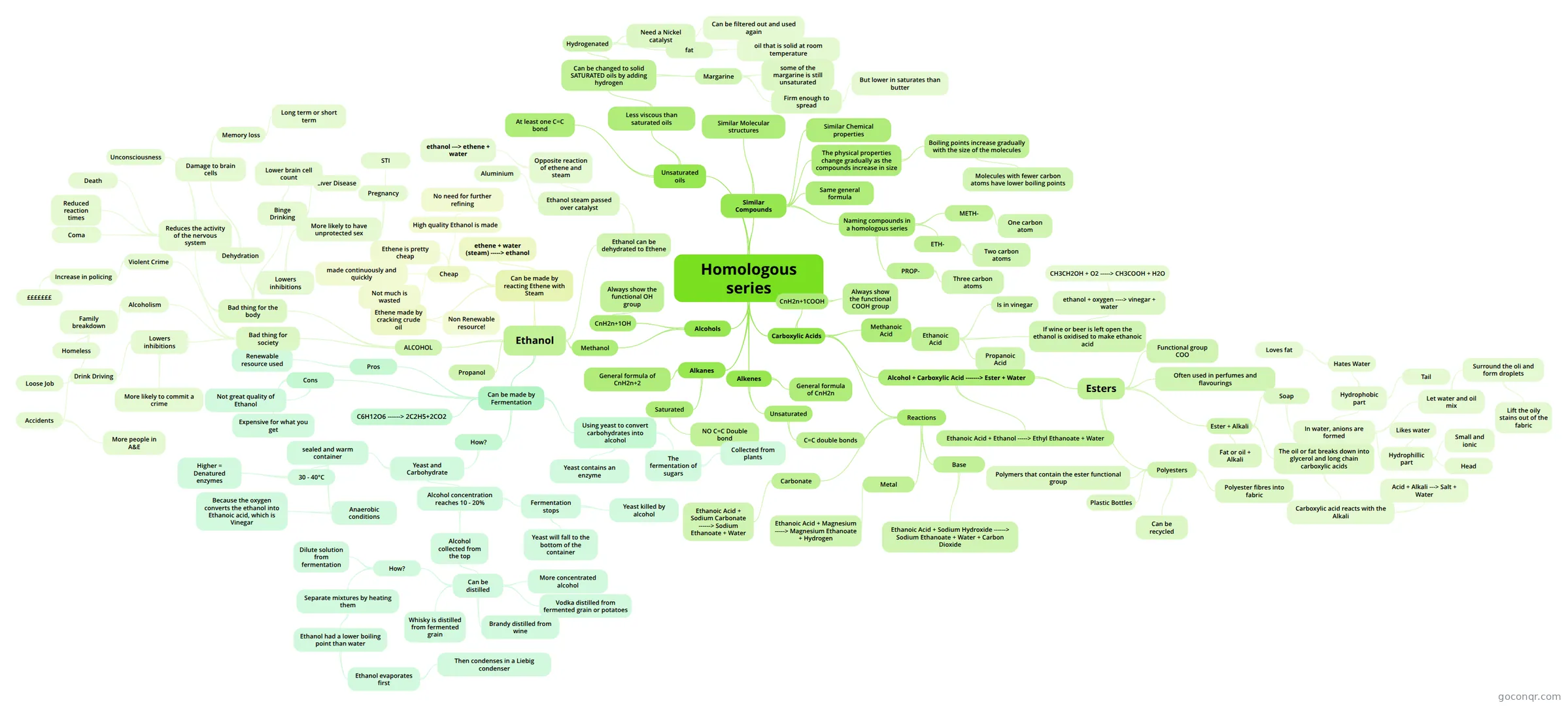
Mind map: Homologous series
Conteúdo do mapa
Homologous series
Similar Compounds
- Same general formula
- Similar Molecular structures
- Similar Chemical properties
- The physical properties change gradually as the compounds increase in size
- Boiling points increase gradually with the size of the molecules
- Molecules with fewer carbon atoms have lower boiling points
- Boiling points increase gradually with the size of the molecules
- Naming compounds in a homologous series
- METH-
- One carbon atom
- ETH-
- Two carbon atoms
- PROP-
- Three carbon atoms
- METH-
Alkenes
- General formula of CnH2n
- Unsaturated
- C=C double bonds
Alkanes
- Saturated
- NO C=C Double bond
- General formula of CnH2n+2
- Saturated
Alcohols
- CnH2n+1OH
- Always show the functional OH group
- Methanol
- Ethanol
- Propanol
- Can be made by Fermentation
- Using yeast to convert carbohydrates into alcohol
- The fermentation of sugars
- Collected from plants
- Yeast contains an enzyme
- The fermentation of sugars
- C6H12O6 ------> 2C2H5+2CO2
- How?
- Yeast and Carbohydrate
- sealed and warm container
- 30 - 40°C
- Higher = Denatured enzymes
- Anaerobic conditions
- Because the oxygen converts the ethanol into Ethanoic acid, which is Vinegar
- 30 - 40°C
- Alcohol concentration reaches 10 - 20%
- Fermentation stops
- Yeast killed by alcohol
- Yeast will fall to the bottom of the container
- Alcohol collected from the top
- Can be distilled
- More concentrated alcohol
- Brandy distilled from wine
- Whisky is distilled from fermented grain
- Vodka distilled from fermented grain or potatoes
- How?
- Dilute solution from fermentation
- Separate mixtures by heating them
- Ethanol had a lower boiling point than water
- Ethanol evaporates first
- Then condenses in a Liebig condenser
- Ethanol evaporates first
- Ethanol had a lower boiling point than water
- Can be distilled
- Fermentation stops
- sealed and warm container
- Yeast and Carbohydrate
- Pros
- Renewable resource used
- Cons
- Not great quality of Ethanol
- Expensive for what you get
- Using yeast to convert carbohydrates into alcohol
- Can be made by reacting Ethene with Steam
- Ethene made by cracking crude oil
- Non Renewable resource!
- Cheap
- Not much is wasted
- Ethene is pretty cheap
- made continuously and quickly
- High quality Ethanol is made
- No need for further refining
- ethene + water (steam) -----> ethanol
- Ethene made by cracking crude oil
- ALCOHOL
- Bad thing for the body
- Lowers inhibitions
- More likely to have unprotected sex
- STI
- Pregnancy
- More likely to have unprotected sex
- Reduces the activity of the nervous system
- Unconsciousness
- Coma
- Death
- Reduced reaction times
- Binge Drinking
- Liver Disease
- Lower brain cell count
- Dehydration
- Damage to brain cells
- Memory loss
- Long term or short term
- Memory loss
- Damage to brain cells
- Lowers inhibitions
- Bad thing for society
- Lowers inhibitions
- More likely to commit a crime
- Drink Driving
- Accidents
- More people in A&E
- Accidents
- Violent Crime
- Increase in policing
- £££££££
- Increase in policing
- Alcoholism
- Family breakdown
- Loose Job
- Homeless
- Family breakdown
- Lowers inhibitions
- Bad thing for the body
- Ethanol can be dehydrated to Ethene
- Ethanol steam passed over catalyst
- Aluminium
- Opposite reaction of ethene and steam
- ethanol ---> ethene + water
- Ethanol steam passed over catalyst
- Ethanol
- CnH2n+1OH
Carboxylic Acids
- CnH2n+1COOH
- Always show the functional COOH group
- Methanoic Acid
- Ethanoic Acid
- Propanoic Acid
- Is in vinegar
- If wine or beer is left open the ethanol is oxidised to make ethanoic acid
- ethanol + oxygen ----> vinegar + water
- CH3CH2OH + O2 -----> CH3COOH + H2O
- ethanol + oxygen ----> vinegar + water
- Ethanoic Acid
- Reactions
- Carbonate
- Ethanoic Acid + Sodium Carbonate ------> Sodium Ethanoate + Water
- Metal
- Ethanoic Acid + Magnesium -----> Magnesium Ethanoate + Hydrogen
- Base
- Ethanoic Acid + Sodium Hydroxide ------> Sodium Ethanoate + Water + Carbon Dioxide
- Carbonate
- Alcohol + Carboxylic Acid -------> Ester + Water
- Esters
- Functional group COO
- Often used in perfumes and flavourings
- Polyesters
- Polymers that contain the ester functional group
- Plastic Bottles
- Polyester fibres into fabric
- Can be recycled
- Ester + Alkali
- Soap
- In water, anions are formed
- Hydrophobic part
- Hates Water
- Loves fat
- Tail
- Hates Water
- Hydrophillic part
- Likes water
- Head
- Small and ionic
- Let water and oil mix
- Surround the oli and form droplets
- Lift the oily stains out of the fabric
- Surround the oli and form droplets
- Hydrophobic part
- In water, anions are formed
- Fat or oil + Alkali
- The oil or fat breaks down into glycerol and long chain carboxylic acids
- Carboxylic acid reacts with the Alkali
- Acid + Alkali ---> Salt + Water
- Carboxylic acid reacts with the Alkali
- Soap
- Ethanoic Acid + Ethanol -----> Ethyl Ethanoate + Water
- Esters
- CnH2n+1COOH
Unsaturated oils
- At least one C=C bond
- Less viscous than saturated oils
- Can be changed to solid SATURATED oils by adding hydrogen
- Hydrogenated
- Need a Nickel catalyst
- Can be filtered out and used again
- fat
- oil that is solid at room temperature
- Need a Nickel catalyst
- Margarine
- some of the margarine is still unsaturated
- Firm enough to spread
- But lower in saturates than butter
- Hydrogenated
- Can be changed to solid SATURATED oils by adding hydrogen
Informações
- Descrição
- GCSE Chemistry Mapa Mental sobre Homologous series, criado por Clare Baker em 14-05-2013.
- Criado por
- Clare Baker
- Visualizações
- 134
- Tags
- Avaliação