
Mapa mental
biological molecules
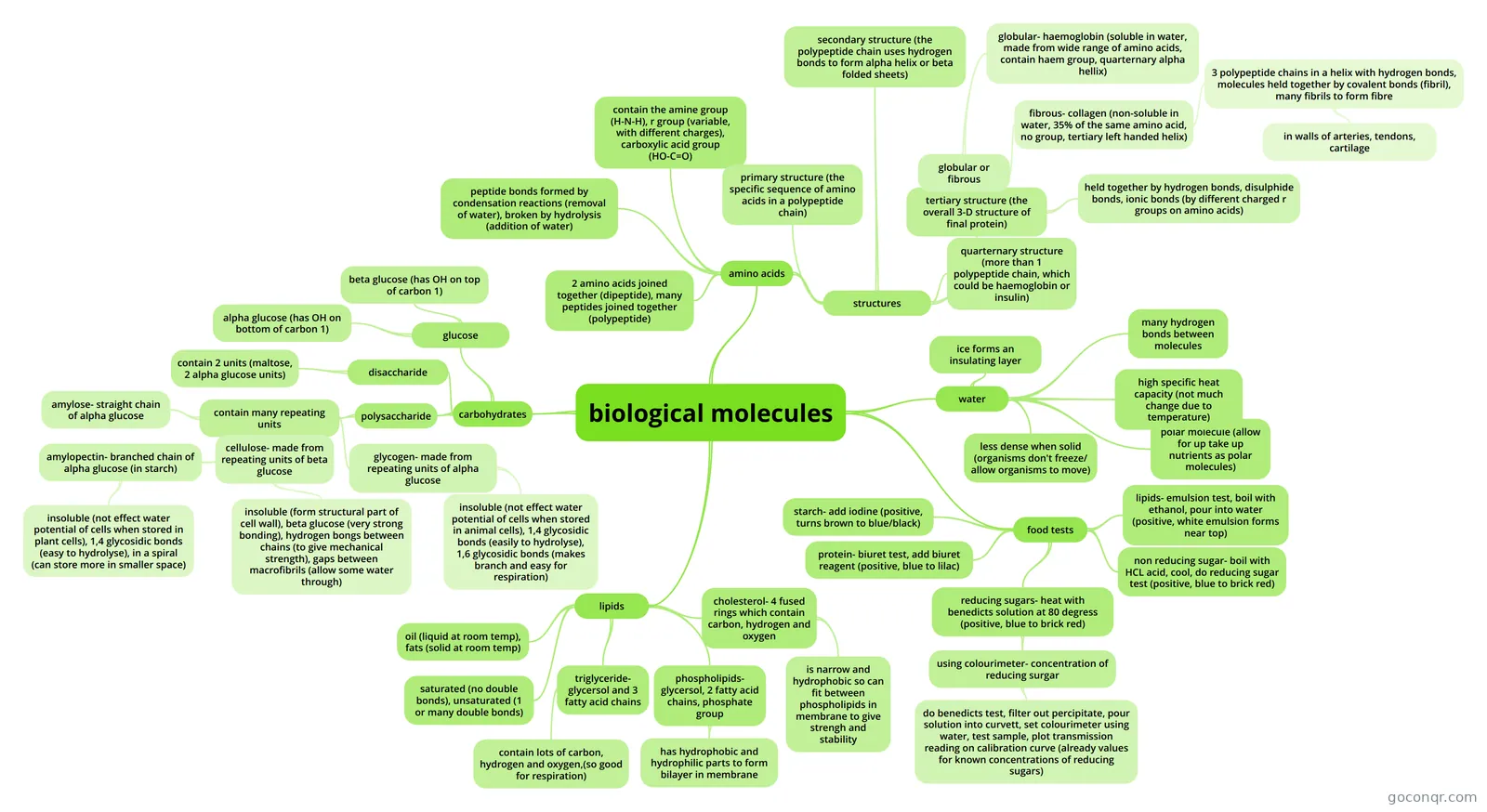
Mind map: biological molecules
Conteúdo do mapa
biological molecules
water
- polar molecule (allow for up take up nutrients as polar molecules)
- ice forms an insulating layer
- many hydrogen bonds between molecules
- high specific heat capacity (not much change due to temperature)
- less dense when solid (organisms don't freeze/ allow organisms to move)
amino acids
- contain the amine group (H-N-H), r group (variable, with different charges), carboxylic acid group (HO-C=O)
- peptide bonds formed by condensation reactions (removal of water), broken by hydrolysis (addition of water)
- 2 amino acids joined together (dipeptide), many peptides joined together (polypeptide)
- structures
- primary structure (the specific sequence of amino acids in a polypeptide chain)
- secondary structure (the polypeptide chain uses hydrogen bonds to form alpha helix or beta folded sheets)
- quarternary structure (more than 1 polypeptide chain, which could be haemoglobin or insulin)
- tertiary structure (the overall 3-D structure of final protein)
- held together by hydrogen bonds, disulphide bonds, ionic bonds (by different charged r groups on amino acids)
- globular or fibrous
- globular- haemoglobin (soluble in water, made from wide range of amino acids, contain haem group, quarternary alpha hellix)
- fibrous- collagen (non-soluble in water, 35% of the same amino acid, no group, tertiary left handed helix)
- 3 polypeptide chains in a helix with hydrogen bonds, molecules held together by covalent bonds (fibril), many fibrils to form fibre
- in walls of arteries, tendons, cartilage
- 3 polypeptide chains in a helix with hydrogen bonds, molecules held together by covalent bonds (fibril), many fibrils to form fibre
carbohydrates
- glucose
- beta glucose (has OH on top of carbon 1)
- alpha glucose (has OH on bottom of carbon 1)
- disaccharide
- contain 2 units (maltose, 2 alpha glucose units)
- polysaccharide
- contain many repeating units
- amylose- straight chain of alpha glucose
- amylopectin- branched chain of alpha glucose (in starch)
- insoluble (not effect water potential of cells when stored in plant cells), 1,4 glycosidic bonds (easy to hydrolyse), in a spiral (can store more in smaller space)
- glycogen- made from repeating units of alpha glucose
- insoluble (not effect water potential of cells when stored in animal cells), 1,4 glycosidic bonds (easily to hydrolyse), 1,6 glycosidic bonds (makes branch and easy for respiration)
- cellulose- made from repeating units of beta glucose
- insoluble (form structural part of cell wall), beta glucose (very strong bonding), hydrogen bongs between chains (to give mechanical strength), gaps between macrofibrils (allow some water through)
- contain many repeating units
- glucose
lipids
- oil (liquid at room temp), fats (solid at room temp)
- saturated (no double bonds), unsaturated (1 or many double bonds)
- triglyceride- glycersol and 3 fatty acid chains
- contain lots of carbon, hydrogen and oxygen,(so good for respiration)
- phospholipids- glycersol, 2 fatty acid chains, phosphate group
- has hydrophobic and hydrophilic parts to form bilayer in membrane
- cholesterol- 4 fused rings which contain carbon, hydrogen and oxygen
- is narrow and hydrophobic so can fit between phospholipids in membrane to give strengh and stability
food tests
- lipids- emulsion test, boil with ethanol, pour into water (positive, white emulsion forms near top)
- starch- add iodine (positive, turns brown to blue/black)
- protein- biuret test, add biuret reagent (positive, blue to lilac)
- non reducing sugar- boil with HCL acid, cool, do reducing sugar test (positive, blue to brick red)
- reducing sugars- heat with benedicts solution at 80 degress (positive, blue to brick red)
- using colourimeter- concentration of reducing surgar
- do benedicts test, filter out percipitate, pour solution into curvett, set colourimeter using water, test sample, plot transmission reading on calibration curve (already values for known concentrations of reducing sugars)
- using colourimeter- concentration of reducing surgar
Informações
- Descrição
- (biology) Mapa Mental sobre biological molecules, criado por becca.dodd em 15-05-2013.
- Criado por
- becca.dodd
- Visualizações
- 181
- Tags
- Avaliação