
Mapa mental
Controlling Cell Division
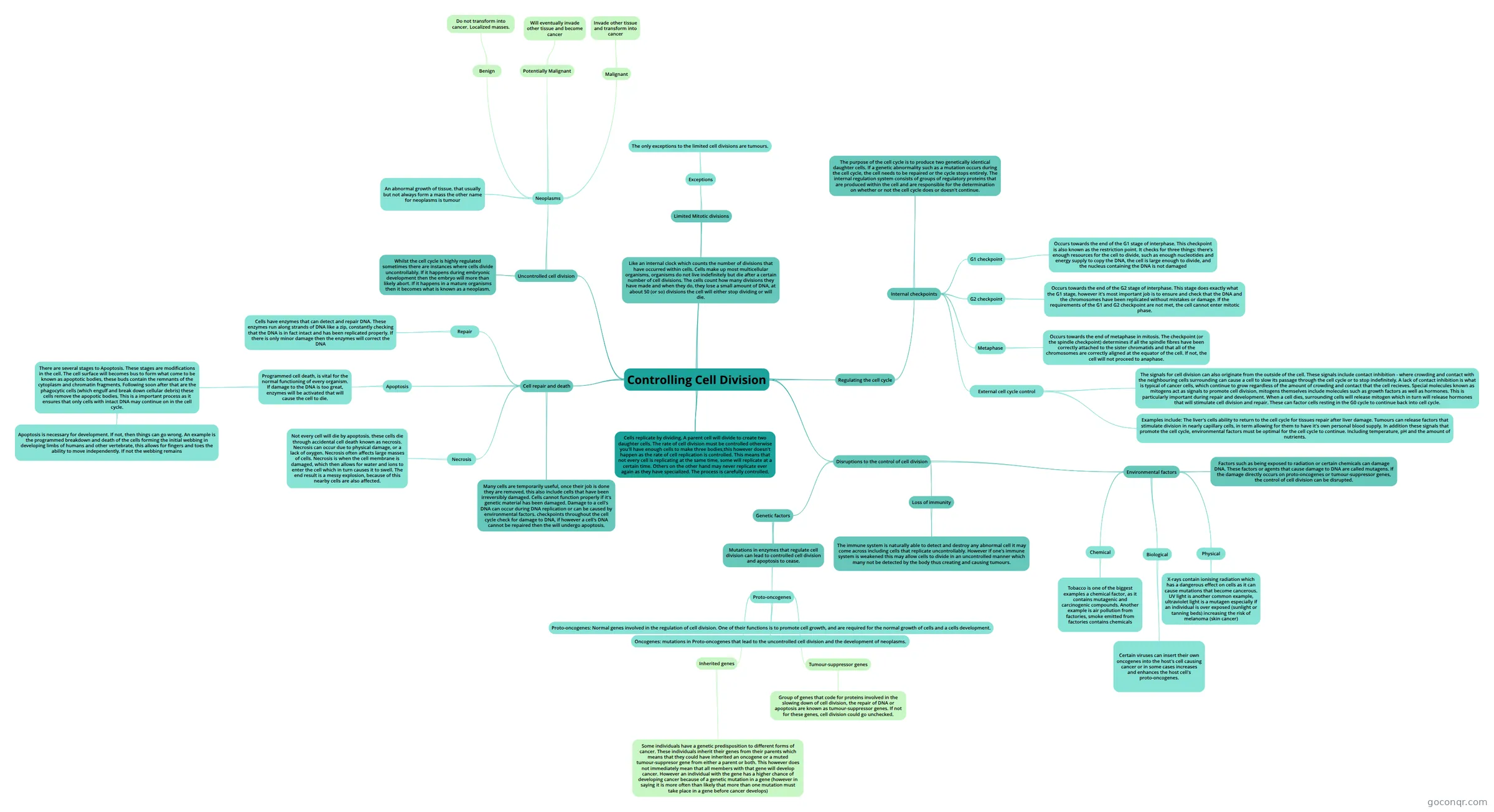
Mind map: Controlling cell division
Conteúdo do mapa
Controlling Cell Division
Cells replicate by dividing. A parent cell will divide to create two daughter cells. The rate of cell division must be controlled otherwise you'll have enough cells to make three bodies,this however doesn't happen as the rate of cell replication is controlled. This means that not every cell is replicating at the same time, some will replicate at a certain time. Others on the other hand may never replicate ever again as they have specialized. The process is carefully controlled.
Regulating the cell cycle
- Internal checkpoints
- G1 checkpoint
- Occurs towards the end of the G1 stage of interphase. This checkpoint is also known as the restriction point. It checks for three things: there's enough resources for the cell to divide, such as enough nucleotides and energy supply to copy the DNA, the cell is large enough to divide, and the nucleus containing the DNA is not damaged
- G2 checkpoint
- Occurs towards the end of the G2 stage of interphase. This stage does exactly what the G1 stage, however it's most important job is to ensure and check that the DNA and the chromosomes have been replicated without mistakes or damage. If the requirements of the G1 and G2 checkpoint are not met, the cell cannot enter mitotic phase.
- Metaphase
- Occurs towards the end of metaphase in mitosis. The checkpoint (or the spindle checkpoint) determines if all the spindle fibres have been correctly attached to the sister chromatids and that all of the chromosomes are correctly aligned at the equator of the cell. If not, the cell will not proceed to anaphase.
- External cell cycle control
- The signals for cell division can also originate from the outside of the cell. These signals include contact inhibition - where crowding and contact with the neighbouring cells surrounding can cause a cell to slow its passage through the cell cycle or to stop indefinitely. A lack of contact inhibition is what is typical of cancer cells, which continue to grow regardless of the amount of crowding and contact that the cell recieves. Special molecules known as mitogens act as signals to promote cell division, mitogens themselves include molecules such as growth factors as well as hormones. This is particularly important during repair and development. When a cell dies, surrounding cells will release mitogen which in turn will release hormones that will stimulate cell division and repair. These can factor cells resting in the G0 cycle to continue back into cell cycle.
- Examples include: The liver's cells ability to return to the cell cycle for tissues repair after liver damage. Tumours can release factors that stimulate division in nearly capillary cells, in term allowing for them to have it's own personal blood supply. In addition these signals that promote the cell cycle, environmental factors must be optimal for the cell cycle to continue. Including temperature, pH and the amount of nutrients.
- The purpose of the cell cycle is to produce two genetically identical daughter cells. If a genetic abnormality such as a mutation occurs during the cell cycle, the cell needs to be repaired or the cycle stops entirely. The internal regulation system consists of groups of regulatory proteins that are produced within the cell and are responsible for the determination on whether or not the cell cycle does or doesn't continue.
- G1 checkpoint
- Internal checkpoints
Cell repair and death
- Repair
- Cells have enzymes that can detect and repair DNA. These enzymes run along strands of DNA like a zip, constantly checking that the DNA is in fact intact and has been replicated properly. If there is only minor damage then the enzymes will correct the DNA
- Apoptosis
- Programmed cell death, is vital for the normal functioning of every organism. If damage to the DNA is too great, enzymes will be activated that will cause the cell to die.
- There are several stages to Apoptosis. These stages are modifications in the cell. The cell surface will becomes bus to form what come to be known as apoptotic bodies, these buds contain the remnants of the cytoplasm and chromatin fragments. Following soon after that are the phagocytic cells (which engulf and break down cellular debris) these cells remove the apopotic bodies. This is a important process as it ensures that only cells with intact DNA may continue on in the cell cycle.
- Apoptosis is necessary for development. If not, then things can go wrong. An example is the programmed breakdown and death of the cells forming the initial webbing in developing limbs of humans and other vertebrate, this allows for fingers and toes the ability to move independently. If not the webbing remains
- There are several stages to Apoptosis. These stages are modifications in the cell. The cell surface will becomes bus to form what come to be known as apoptotic bodies, these buds contain the remnants of the cytoplasm and chromatin fragments. Following soon after that are the phagocytic cells (which engulf and break down cellular debris) these cells remove the apopotic bodies. This is a important process as it ensures that only cells with intact DNA may continue on in the cell cycle.
- Programmed cell death, is vital for the normal functioning of every organism. If damage to the DNA is too great, enzymes will be activated that will cause the cell to die.
- Necrosis
- Not every cell will die by apoptosis. these cells die through accidental cell death known as necrosis. Necrosis can occur due to physical damage, or a lack of oxygen. Necrosis often affects large masses of cells. Necrosis is when the cell membrane is damaged, which then allows for water and ions to enter the cell which in turn causes it to swell. The end result is a messy explosion, because of this nearby cells are also affected.
- Many cells are temporarily useful, once their job is done they are removed, this also include cells that have been irreversibly damaged. Cells cannot function properly if it's genetic material has been damaged. Damage to a cell's DNA can occur during DNA replication or can be caused by environmental factors. checkpoints throughout the cell cycle check for damage to DNA, if however a cell's DNA cannot be repaired then the will undergo apoptosis.
- Repair
Limited Mitotic divisions
- Exceptions
- The only exceptions to the limited cell divisions are tumours.
- Like an internal clock which counts the number of divisions that have occurred within cells. Cells make up most multicellular organisms, organisms do not live indefinitely but die after a certain number of cell divisions. The cells count how many divisions they have made and when they do, they lose a small amount of DNA, at about 50 (or so) divisions the cell will either stop dividing or will die.
- Exceptions
Uncontrolled cell division
- Neoplasms
- Benign
- Do not transform into cancer. Localized masses.
- Malignant
- Invade other tissue and transform into cancer
- An abnormal growth of tissue. that usually but not always form a mass the other name for neoplasms is tumour
- Potentially Malignant
- Will eventually invade other tissue and become cancer
- Benign
- Whilst the cell cycle is highly regulated sometimes there are instances where cells divide uncontrollably. If it happens during embryonic development then the embryo will more than likely abort. If it happens in a mature organisms then it becomes what is known as a neoplasm.
- Neoplasms
Disruptions to the control of cell division
- Genetic factors
- Proto-oncogenes
- Tumour-suppressor genes
- Group of genes that code for proteins involved in the slowing down of cell division, the repair of DNA or apoptosis are known as tumour-suppressor genes. If not for these genes, cell division could go unchecked.
- Inherited genes
- Some individuals have a genetic predisposition to different forms of cancer. These individuals inherit their genes from their parents which means that they could have inherited an oncogene or a muted tumour-suppresor gene from either a parent or both. This however does not immediately mean that all members with that gene will develop cancer. However an individual with the gene has a higher chance of developing cancer because of a genetic mutation in a gene (however in saying it is more often than likely that more than one mutation must take place in a gene before cancer develops)
- Proto-oncogenes: Normal genes involved in the regulation of cell division. One of their functions is to promote cell growth, and are required for the normal growth of cells and a cells development.
- Oncogenes: mutations in Proto-oncogenes that lead to the uncontrolled cell division and the development of neoplasms.
- Tumour-suppressor genes
- Mutations in enzymes that regulate cell division can lead to controlled cell division and apoptosis to cease.
- Proto-oncogenes
- Environmental factors
- Chemical
- Tobacco is one of the biggest examples a chemical factor, as it contains mutagenic and carcinogenic compounds. Another example is air pollution from factories, smoke emitted from factories contains chemicals
- Physical
- X-rays contain ionising radiation which has a dangerous effect on cells as it can cause mutations that become cancerous. UV light is another common example, ultraviolet light is a mutagen especially if an individual is over exposed (sunlight or tanning beds) increasing the risk of melanoma (skin cancer)
- Biological
- Certain viruses can insert their own oncogenes into the host's cell causing cancer or in some cases increases and enhances the host cell's proto-oncogenes.
- Factors such as being exposed to radiation or certain chemicals can damage DNA. These factors or agents that cause damage to DNA are called mutagens. If the damage directly occurs on proto-oncogenes or tumour-suppressor genes, the control of cell division can be disrupted.
- Chemical
- Loss of immunity
- The immune system is naturally able to detect and destroy any abnormal cell it may come across including cells that replicate uncontrollably. However if one's immune system is weakened this may allow cells to divide in an uncontrolled manner which many not be detected by the body thus creating and causing tumours.
- Genetic factors
Informações
- Descrição
- Year 11 Biology (Unit Two: Chapter Eight: Cell Replication) Mapa Mental sobre Controlling Cell Division, criado por Chloe Phang em 31-07-2017.
- Criado por
- Chloe Phang
- Visualizações
- 0
- Avaliação
Mais sobre Cell Cycle Regulation and Cancer