
Mapa mental
LIPIDS
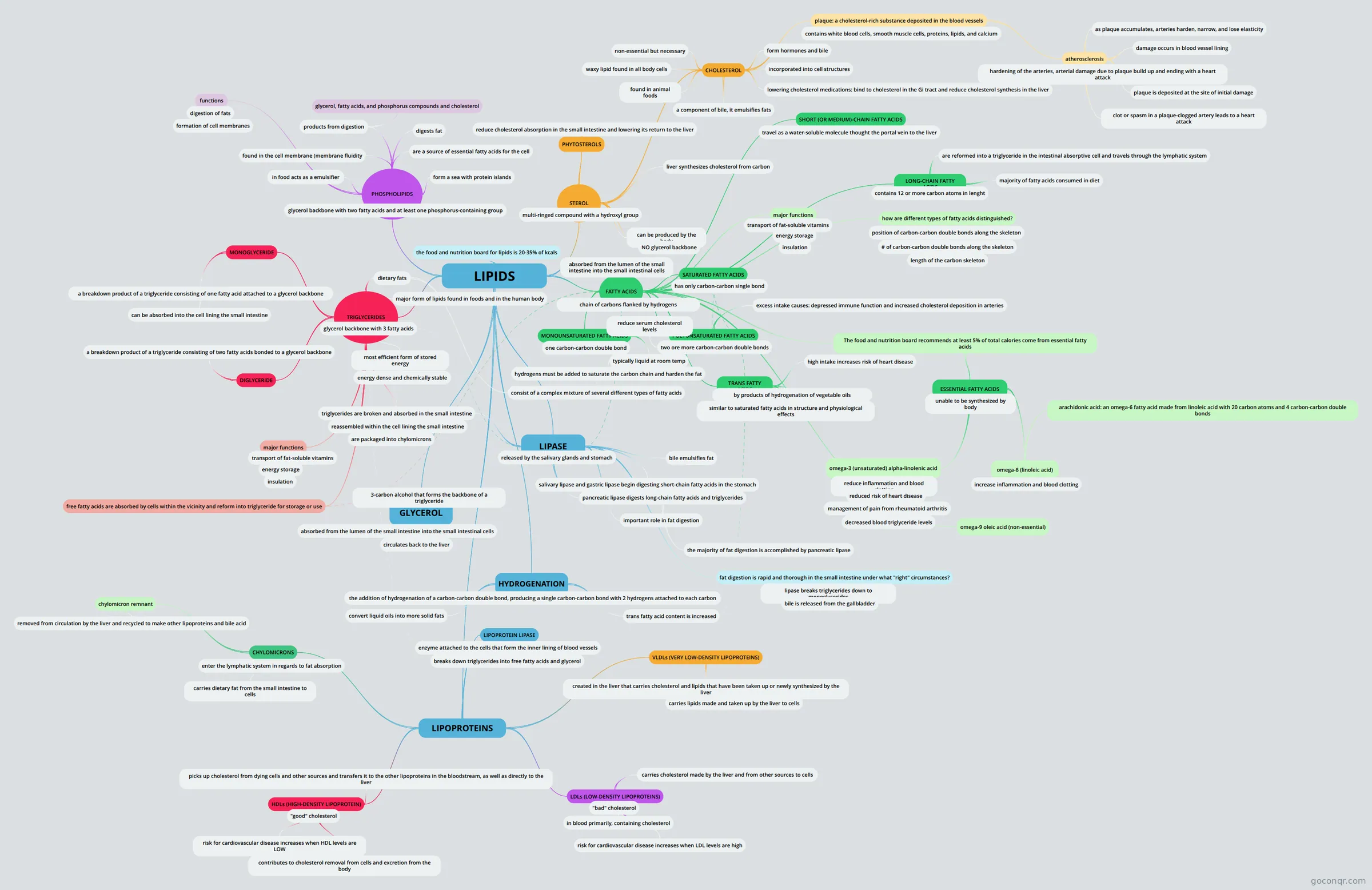
Mind map: Lipids
Conteúdo do mapa
LIPIDS
FATTY ACIDS
- chain of carbons flanked by hydrogens
- MONOUNSATURATED FATTY ACIDS
- typically liquid at room temp
- hydrogens must be added to saturate the carbon chain and harden the fat
- one carbon-carbon double bond
- typically liquid at room temp
- POLYUNSATURATED FATTY ACIDS
- two ore more carbon-carbon double bonds
- reduce serum cholesterol levels
- excess intake causes: depressed immune function and increased cholesterol deposition in arteries
- two ore more carbon-carbon double bonds
- SATURATED FATTY ACIDS
- has only carbon-carbon single bond
- TRANS FATTY ACIDS
- by products of hydrogenation of vegetable oils
- similar to saturated fatty acids in structure and physiological effects
- high intake increases risk of heart disease
- major functions
- transport of fat-soluble vitamins
- energy storage
- insulation
- energy storage
- transport of fat-soluble vitamins
- The food and nutrition board recommends at least 5% of total calories come from essential fatty acids
- ESSENTIAL FATTY ACIDS
- unable to be synthesized by body
- omega-3 (unsaturated) alpha-linolenic acid
- reduce inflammation and blood clotting
- reduced risk of heart disease
- management of pain from rheumatoid arthritis
- decreased blood triglyceride levels
- management of pain from rheumatoid arthritis
- reduced risk of heart disease
- reduce inflammation and blood clotting
- omega-6 (linoleic acid)
- increase inflammation and blood clotting
- arachidonic acid: an omega-6 fatty acid made from linoleic acid with 20 carbon atoms and 4 carbon-carbon double bonds
- ESSENTIAL FATTY ACIDS
- omega-9 oleic acid (non-essential)
- LONG-CHAIN FATTY ACIDS
- contains 12 or more carbon atoms in lenght
- are reformed into a triglyceride in the intestinal absorptive cell and travels through the lymphatic system
- majority of fatty acids consumed in diet
- absorbed from the lumen of the small intestine into the small intestinal cells
- how are different types of fatty acids distinguished?
- position of carbon-carbon double bonds along the skeleton
- # of carbon-carbon double bonds along the skeleton
- length of the carbon skeleton
- # of carbon-carbon double bonds along the skeleton
- position of carbon-carbon double bonds along the skeleton
- SHORT (OR MEDIUM)-CHAIN FATTY ACIDS
- travel as a water-soluble molecule thought the portal vein to the liver
TRIGLYCERIDES
- DIGLYCERIDE
- a breakdown product of a triglyceride consisting of two fatty acids bonded to a glycerol backbone
- MONOGLYCERIDE
- a breakdown product of a triglyceride consisting of one fatty acid attached to a glycerol backbone
- can be absorbed into the cell lining the small intestine
- a breakdown product of a triglyceride consisting of one fatty acid attached to a glycerol backbone
- glycerol backbone with 3 fatty acids
- most efficient form of stored energy
- energy dense and chemically stable
- most efficient form of stored energy
- dietary fats
- consist of a complex mixture of several different types of fatty acids
- major form of lipids found in foods and in the human body
- major functions
- transport of fat-soluble vitamins
- energy storage
- insulation
- energy storage
- transport of fat-soluble vitamins
- reassembled within the cell lining the small intestine
- are packaged into chylomicrons
- free fatty acids are absorbed by cells within the vicinity and reform into triglyceride for storage or use
- DIGLYCERIDE
PHOSPHOLIPIDS
- glycerol backbone with two fatty acids and at least one phosphorus-containing group
- found in the cell membrane (membrane fluidity
- in food acts as a emulsifier
- products from digestion
- glycerol, fatty acids, and phosphorus compounds and cholesterol
- digests fat
- are a source of essential fatty acids for the cell
- form a sea with protein islands
- functions
- digestion of fats
- formation of cell membranes
- digestion of fats
STEROL
- multi-ringed compound with a hydroxyl group
- PHYTOSTEROLS
- reduce cholesterol absorption in the small intestine and lowering its return to the liver
- CHOLESTEROL
- non-essential but necessary
- found in animal foods
- lowering cholesterol medications: bind to cholesterol in the Gi tract and reduce cholesterol synthesis in the liver
- form hormones and bile
- incorporated into cell structures
- a component of bile, it emulsifies fats
- waxy lipid found in all body cells
- plaque: a cholesterol-rich substance deposited in the blood vessels
- contains white blood cells, smooth muscle cells, proteins, lipids, and calcium
- atherosclerosis
- hardening of the arteries, arterial damage due to plaque build up and ending with a heart attack
- damage occurs in blood vessel lining
- plaque is deposited at the site of initial damage
- as plaque accumulates, arteries harden, narrow, and lose elasticity
- clot or spasm in a plaque-clogged artery leads to a heart attack
- liver synthesizes cholesterol from carbon
- can be produced by the body
- NO glycerol backbone
GLYCEROL
- 3-carbon alcohol that forms the backbone of a triglyceride
- absorbed from the lumen of the small intestine into the small intestinal cells
- circulates back to the liver
LIPASE
- released by the salivary glands and stomach
- salivary lipase and gastric lipase begin digesting short-chain fatty acids in the stomach
- bile emulsifies fat
- pancreatic lipase digests long-chain fatty acids and triglycerides
- the majority of fat digestion is accomplished by pancreatic lipase
- triglycerides are broken and absorbed in the small intestine
- important role in fat digestion
- fat digestion is rapid and thorough in the small intestine under what "right" circumstances?
- lipase breaks triglycerides down to monoglycerides
- bile is released from the gallbladder
- lipase breaks triglycerides down to monoglycerides
HYDROGENATION
- the addition of hydrogenation of a carbon-carbon double bond, producing a single carbon-carbon bond with 2 hydrogens attached to each carbon
- trans fatty acid content is increased
- convert liquid oils into more solid fats
LIPOPROTEINS
- CHYLOMICRONS
- enter the lymphatic system in regards to fat absorption
- carries dietary fat from the small intestine to cells
- chylomicron remnant
- removed from circulation by the liver and recycled to make other lipoproteins and bile acid
- HDLs (HIGH-DENSITY LIPOPROTEIN)
- "good" cholesterol
- risk for cardiovascular disease increases when HDL levels are LOW
- picks up cholesterol from dying cells and other sources and transfers it to the other lipoproteins in the bloodstream, as well as directly to the liver
- contributes to cholesterol removal from cells and excretion from the body
- VLDLs (VERY LOW-DENSITY LIPOPROTEINS)
- created in the liver that carries cholesterol and lipids that have been taken up or newly synthesized by the liver
- carries lipids made and taken up by the liver to cells
- created in the liver that carries cholesterol and lipids that have been taken up or newly synthesized by the liver
- LDLs (LOW-DENSITY LIPOPROTEINS)
- risk for cardiovascular disease increases when LDL levels are high
- "bad" cholesterol
- in blood primarily, containing cholesterol
- carries cholesterol made by the liver and from other sources to cells
- LIPOPROTEIN LIPASE
- enzyme attached to the cells that form the inner lining of blood vessels
- breaks down triglycerides into free fatty acids and glycerol
- CHYLOMICRONS
the food and nutrition board for lipids is 20-35% of kcals
Informações
- Descrição
- nutrition Mapa Mental sobre LIPIDS, criado por Abbey Cook em 10-10-2017.
- Criado por
- Abbey Cook
- Visualizações
- 2
- Avaliação