
Mapa mental
Biological molecules
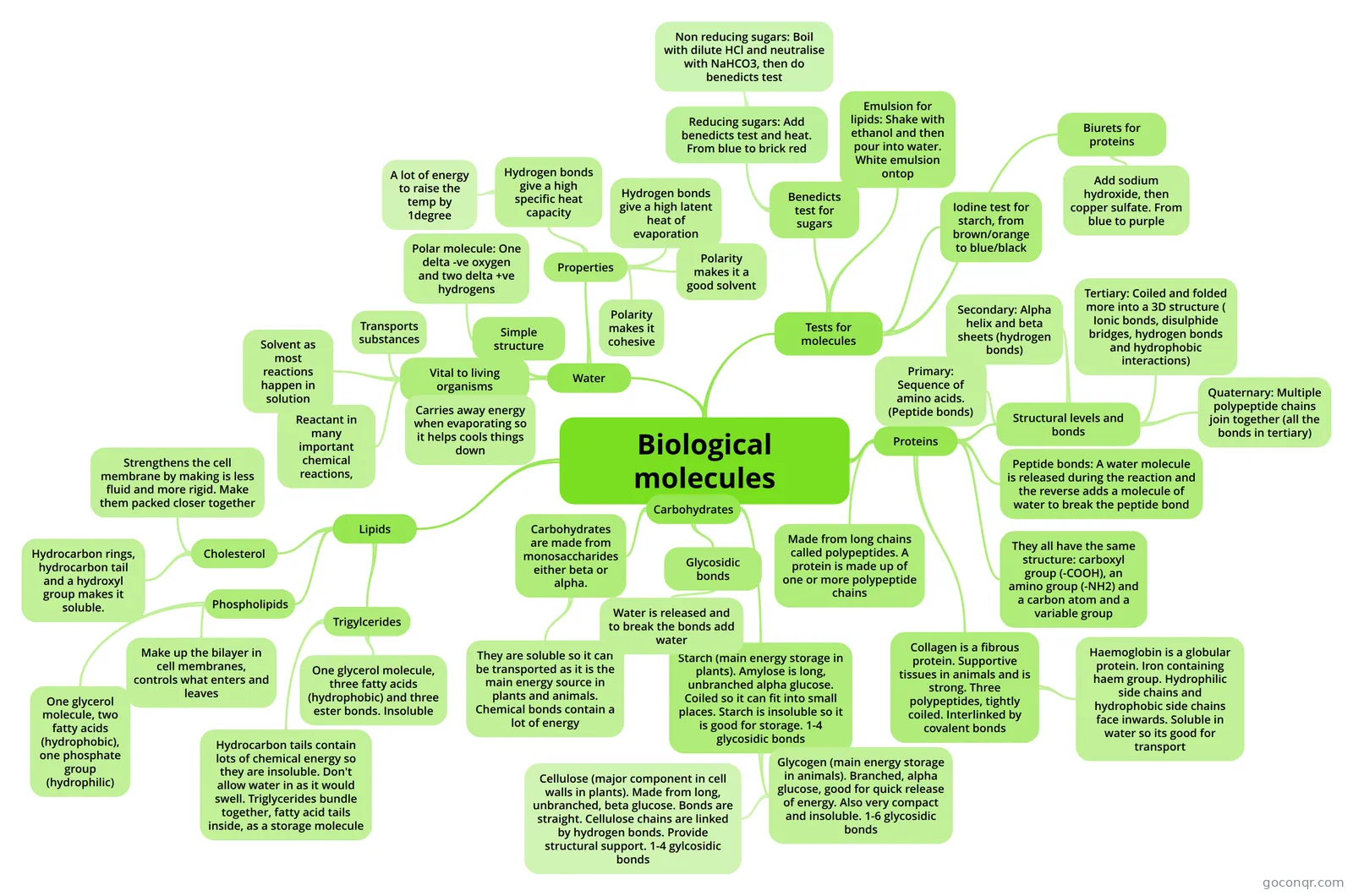
Mind map: biological molecules
Conteúdo do mapa
Biological molecules
Water
- Vital to living organisms
- Reactant in many important chemical reactions,
- Solvent as most reactions happen in solution
- Transports substances
- Carries away energy when evaporating so it helps cools things down
- Simple structure
- Polar molecule: One delta -ve oxygen and two delta +ve hydrogens
- Properties
- Hydrogen bonds give a high specific heat capacity
- A lot of energy to raise the temp by 1degree
- Hydrogen bonds give a high latent heat of evaporation
- Polarity makes it cohesive
- Polarity makes it a good solvent
- Hydrogen bonds give a high specific heat capacity
- Vital to living organisms
Proteins
- Made from long chains called polypeptides. A protein is made up of one or more polypeptide chains
- They all have the same structure: carboxyl group (-COOH), an amino group (-NH2) and a carbon atom and a variable group
- Peptide bonds: A water molecule is released during the reaction and the reverse adds a molecule of water to break the peptide bond
- Structural levels and bonds
- Primary: Sequence of amino acids. (Peptide bonds)
- Secondary: Alpha helix and beta sheets (hydrogen bonds)
- Tertiary: Coiled and folded more into a 3D structure ( Ionic bonds, disulphide bridges, hydrogen bonds and hydrophobic interactions)
- Quaternary: Multiple polypeptide chains join together (all the bonds in tertiary)
- Collagen is a fibrous protein. Supportive tissues in animals and is strong. Three polypeptides, tightly coiled. Interlinked by covalent bonds
- Haemoglobin is a globular protein. Iron containing haem group. Hydrophilic side chains and hydrophobic side chains face inwards. Soluble in water so its good for transport
Carbohydrates
- Carbohydrates are made from monosaccharides either beta or alpha.
- They are soluble so it can be transported as it is the main energy source in plants and animals. Chemical bonds contain a lot of energy
- Glycosidic bonds
- Water is released and to break the bonds add water
- Starch (main energy storage in plants). Amylose is long, unbranched alpha glucose. Coiled so it can fit into small places. Starch is insoluble so it is good for storage. 1-4 glycosidic bonds
- Glycogen (main energy storage in animals). Branched, alpha glucose, good for quick release of energy. Also very compact and insoluble. 1-6 glycosidic bonds
- Cellulose (major component in cell walls in plants). Made from long, unbranched, beta glucose. Bonds are straight. Cellulose chains are linked by hydrogen bonds. Provide structural support. 1-4 gylcosidic bonds
- Glycogen (main energy storage in animals). Branched, alpha glucose, good for quick release of energy. Also very compact and insoluble. 1-6 glycosidic bonds
- Carbohydrates are made from monosaccharides either beta or alpha.
Lipids
- Trigylcerides
- One glycerol molecule, three fatty acids (hydrophobic) and three ester bonds. Insoluble
- Hydrocarbon tails contain lots of chemical energy so they are insoluble. Don't allow water in as it would swell. Triglycerides bundle together, fatty acid tails inside, as a storage molecule
- Phospholipids
- One glycerol molecule, two fatty acids (hydrophobic), one phosphate group (hydrophilic)
- Make up the bilayer in cell membranes, controls what enters and leaves
- Cholesterol
- Hydrocarbon rings, hydrocarbon tail and a hydroxyl group makes it soluble.
- Strengthens the cell membrane by making is less fluid and more rigid. Make them packed closer together
- Trigylcerides
Tests for molecules
- Benedicts test for sugars
- Reducing sugars: Add benedicts test and heat. From blue to brick red
- Non reducing sugars: Boil with dilute HCl and neutralise with NaHCO3, then do benedicts test
- Reducing sugars: Add benedicts test and heat. From blue to brick red
- Iodine test for starch, from brown/orange to blue/black
- Biurets for proteins
- Add sodium hydroxide, then copper sulfate. From blue to purple
- Emulsion for lipids: Shake with ethanol and then pour into water. White emulsion ontop
- Benedicts test for sugars
Informações
- Descrição
- Biology (F212) Mapa Mental sobre Biological molecules, criado por Nikita96 em 28-05-2013.
- Criado por
- Nikita96
- Visualizações
- 122
- Tags
- Avaliação