
Mapa mental
Application PED (3)
Conteúdo do mapa
Application PED (3)
Unstable prices of Agricultrual Products
- Fluctuations in equilirbium price will be smaller if consumers and poducers are very responsive to price changes [Demand and supply being price elastic]
- Fluctuations in equilibrium price will be larger if either it not very responsive [Demand and/or supply being price inelastic]
- (EG) The prices of agricultrual products tend to fluctuate widely from year to year.
- Reasons: 1. Demand for agricultural products tend to be price inelastic in short run as food and raw materials have few substitutues.
- Reason 2: Supply of agricultural products tends to increase/decrease sporadically. This is due to mainly unexpected changes in weather and incidences of diseases among animals and plants.
- Reasons: 1. Demand for agricultural products tend to be price inelastic in short run as food and raw materials have few substitutues.
- (EG) The prices of agricultrual products tend to fluctuate widely from year to year.
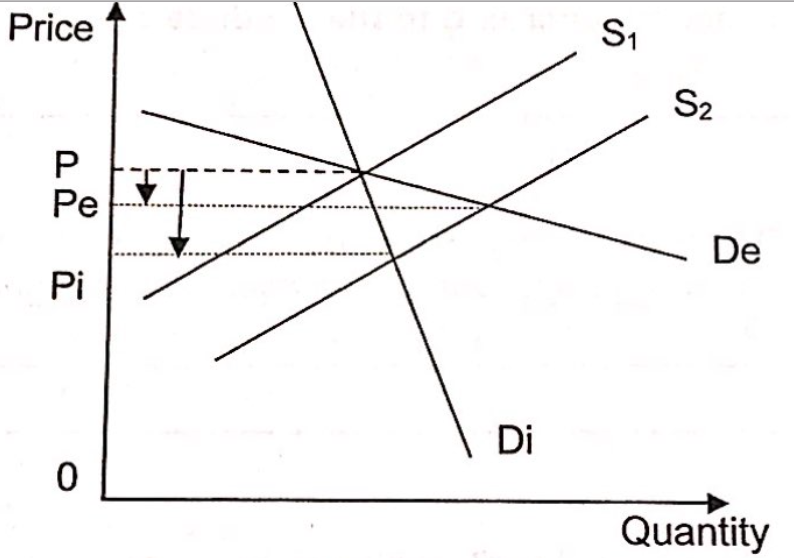
- Figure Analysis:
- With increase in supply from S1-S2, there is larger fall in price from P to Pi in the case where agricultural goods where demand tends to be price inelastic (Di).
- If diagram depicts manufatured goods where demand tends to be relatively more price elastic (De), the price would have fallen to a smaller extent from P to Pe.
- 1. Supply of agricultural products also tend to be price inelastic in short run once farmers have planted and cultivated crops - they can supply no more no less unless they decide to store or destroy crops.
- In recent years, demand for supply of agricultural products have been increasing due to rising income and population.
- Similarly, due to price inelastic of supply of agricultural products, when demand for agricultrual products change, prices tend to change more as compared to when supply is price elastic.
- Hence, price of agri products tend to be unstable and fluctuate greatly due to combinations of factors:
- 1. Price inelastic demand with frequent fluctuations of supply;
- 2. Price inelastic supply with frequent fluctuations (increase) of demand;
- 3. Govt concerned with these wide fluctuations might implement policies to stabilize prices (Price Ceilings)
- 2. Price inelastic supply with frequent fluctuations (increase) of demand;
- 1. Price inelastic demand with frequent fluctuations of supply;
- Hence, price of agri products tend to be unstable and fluctuate greatly due to combinations of factors:
- 1. Supply of agricultural products also tend to be price inelastic in short run once farmers have planted and cultivated crops - they can supply no more no less unless they decide to store or destroy crops.
- If diagram depicts manufatured goods where demand tends to be relatively more price elastic (De), the price would have fallen to a smaller extent from P to Pe.
- With increase in supply from S1-S2, there is larger fall in price from P to Pi in the case where agricultural goods where demand tends to be price inelastic (Di).
Limitations with the use of elasticity figures
- Concept of PED PES look only at the responsiveness of quantity demanded/supplied and demand/supply in 3 factors - Price of good itself, income and price of another good.
- + When we calculate PES PED, we assume that everything else remains constant, ceterius paribus. However, in reality, there can be many factors affecting demand and supply simaltaneously and it is hard to put a figure on many of the factors.
- + Many of the elasticity values obtained are historical estimates of consumers behaviour and alot may have changed over the years.
- There may be cases where data only application to certain group of people. Thus, wrong to assume that the data provided is accurate. Hence, PED given may be outdated for another country or another group of consumers.
- (EG) PED 0.1 for weights training equipment may only be applicable to men, as they see it as a necessity. But this figure may not be true for women, thus conclusion yield from this data for women will be wrong.
- There may be cases where data only application to certain group of people. Thus, wrong to assume that the data provided is accurate. Hence, PED given may be outdated for another country or another group of consumers.
- + Many of the elasticity values obtained are historical estimates of consumers behaviour and alot may have changed over the years.
- + When we calculate PES PED, we assume that everything else remains constant, ceterius paribus. However, in reality, there can be many factors affecting demand and supply simaltaneously and it is hard to put a figure on many of the factors.
- Concept of PED PES look only at the responsiveness of quantity demanded/supplied and demand/supply in 3 factors - Price of good itself, income and price of another good.
Imagens e arquivos do mapa
Informações
- Descrição
- H1 Economics Mapa Mental sobre Application PED (3), criado por Carolyn Kho em 28-04-2018.
- Criado por
- Carolyn Kho
- Visualizações
- 7
- Avaliação