
Mapa mental
ORGANIZATIONAL CHANGE
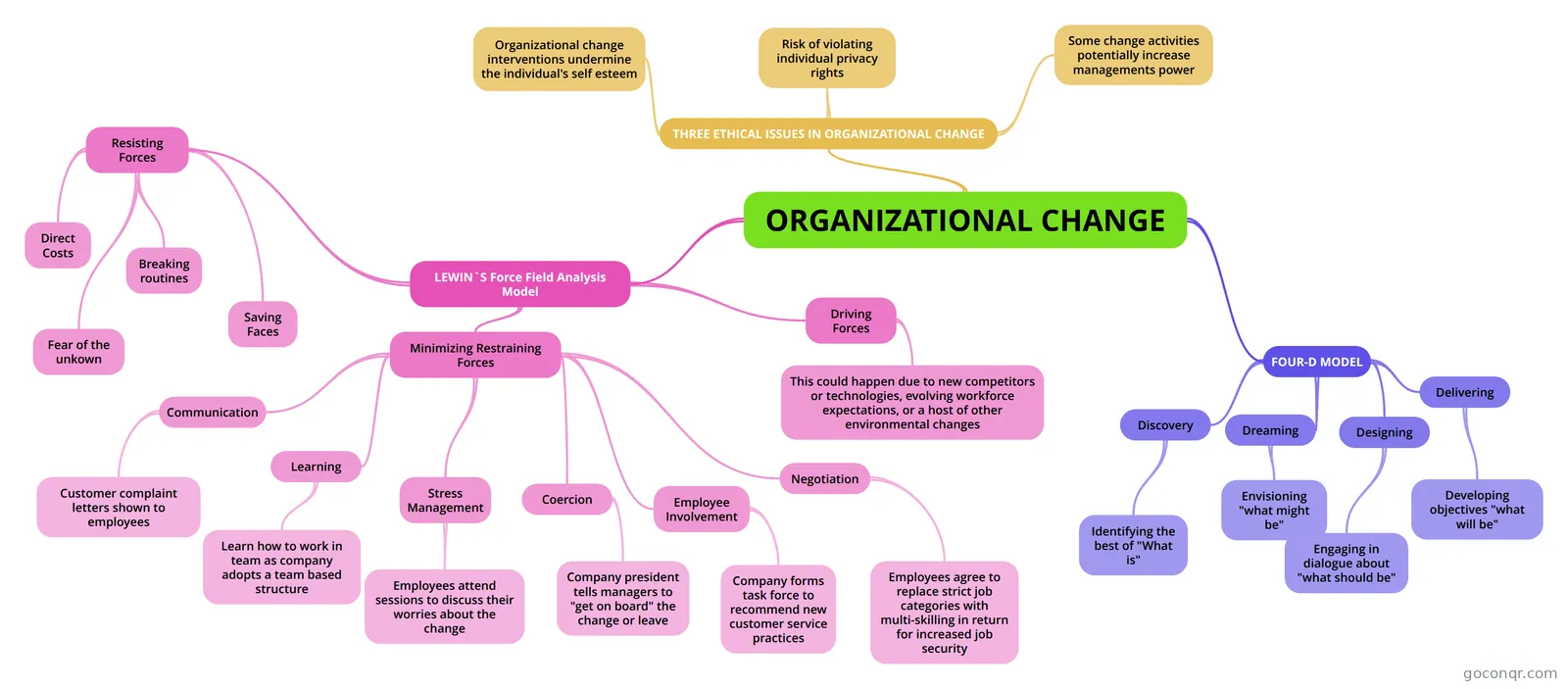
Mind map: organizational change
Conteúdo do mapa
ORGANIZATIONAL CHANGE
LEWIN`S Force Field Analysis Model
- BEFORE CHANGE: -Restraining Forces = Driving Forces DURING A CHANGE: -Less Restraining Forces and More Driving Forces AFTER CHANGE: -Restraining Forces = Driving Forces
- UNFREEZING - The change agent produces disequilibrium between the driving forces and the restraining forces.
- FREEZING - A change process in which systems and conditions are introduced that reinforce and maintain the desired behaviours.
- Resisting Forces
- Direct Costs
- Resources, personal status, and career opportunities might necessarily be removed.
- Saving Faces
- Some people resist change as a political strategy to "prove" that the decision is wrong or that the person encouraging is incompetent.
- Fear of the unkown
- People resist change out of worry that they cannot adjust to the new work requirements. This fear of the unknown increases the risk of personal loss.
- Breaking routines
- This means that the employee needs to abandon habits and routines that are no longer appropriate.
- Direct Costs
- Minimizing Restraining Forces
- Restraining Forces - Resistance to Change
- Communication
- Customer complaint letters shown to employees
- -Time consuming -potentially costly
- Customer complaint letters shown to employees
- Learning
- Learn how to work in team as company adopts a team based structure
- -Time consuming -Potentially costly
- Learn how to work in team as company adopts a team based structure
- Employee Involvement
- Company forms task force to recommend new customer service practices
- -Very time consuming -Might lead to conflict and poor decisions if the employee's interests are incompatible with the organizations needs
- Company forms task force to recommend new customer service practices
- Stress Management
- Employees attend sessions to discuss their worries about the change
- -Time consuming -Potentially costly -Some methods might be ineffective for all or some employees
- Employees attend sessions to discuss their worries about the change
- Negotiation
- Employees agree to replace strict job categories with multi-skilling in return for increased job security
- -May be expensive -Tends to produce compliance but not commitment to the change
- Employees agree to replace strict job categories with multi-skilling in return for increased job security
- Coercion
- Company president tells managers to "get on board" the change or leave
- -Can lead to more subtle form of resistance
- Company president tells managers to "get on board" the change or leave
- Driving Forces
- This could happen due to new competitors or technologies, evolving workforce expectations, or a host of other environmental changes
FOUR-D MODEL
- Discovery
- Identifying the best of "What is"
- Dreaming
- Envisioning "what might be"
- Designing
- Engaging in dialogue about "what should be"
- Delivering
- Developing objectives "what will be"
- Discovery
THREE ETHICAL ISSUES IN ORGANIZATIONAL CHANGE
- Risk of violating individual privacy rights
- Some change activities potentially increase managements power
- Organizational change interventions undermine the individual's self esteem
Informações
- Descrição
- Bachelors Business 260 (Organizational Processes) Mapa Mental sobre ORGANIZATIONAL CHANGE, criado por Mohammad Noufil em 25-06-2013.
- Criado por
- Mohammad Noufil
- Visualizações
- 90
- Tags
- Avaliação