
Mind map
ORGANIZATIONAL CULTURE
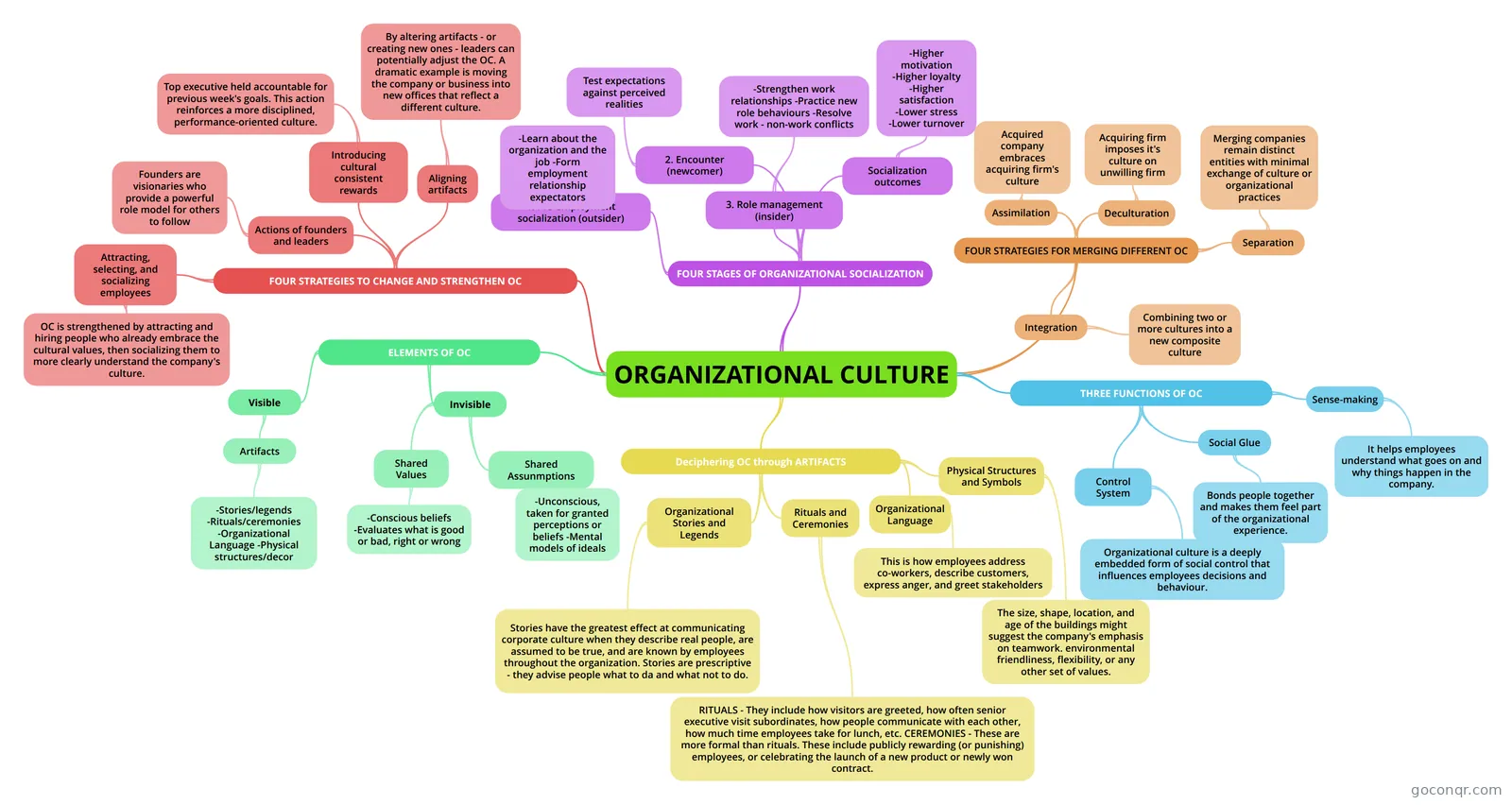
Mind map: Organizational culture
Map content
ORGANIZATIONAL CULTURE
ELEMENTS OF OC
- Visible
- Artifacts
- -Stories/legends -Rituals/ceremonies -Organizational Language -Physical structures/decor
- Artifacts
- Invisible
- Shared Values
- -Conscious beliefs -Evaluates what is good or bad, right or wrong
- Shared Assunmptions
- -Unconscious, taken for granted perceptions or beliefs -Mental models of ideals
- Shared Values
- Visible
Deciphering OC through ARTIFACTS
- Organizational Stories and Legends
- Stories have the greatest effect at communicating corporate culture when they describe real people, are assumed to be true, and are known by employees throughout the organization. Stories are prescriptive - they advise people what to da and what not to do.
- Stories have the greatest effect at communicating corporate culture when they describe real people, are assumed to be true, and are known by employees throughout the organization. Stories are prescriptive - they advise people what to da and what not to do.
- Rituals and Ceremonies
- RITUALS - They include how visitors are greeted, how often senior executive visit subordinates, how people communicate with each other, how much time employees take for lunch, etc. CEREMONIES - These are more formal than rituals. These include publicly rewarding (or punishing) employees, or celebrating the launch of a new product or newly won contract.
- RITUALS - They include how visitors are greeted, how often senior executive visit subordinates, how people communicate with each other, how much time employees take for lunch, etc. CEREMONIES - These are more formal than rituals. These include publicly rewarding (or punishing) employees, or celebrating the launch of a new product or newly won contract.
- Organizational Language
- This is how employees address co-workers, describe customers, express anger, and greet stakeholders
- This is how employees address co-workers, describe customers, express anger, and greet stakeholders
- Physical Structures and Symbols
- The size, shape, location, and age of the buildings might suggest the company's emphasis on teamwork. environmental friendliness, flexibility, or any other set of values.
- The size, shape, location, and age of the buildings might suggest the company's emphasis on teamwork. environmental friendliness, flexibility, or any other set of values.
- Organizational Stories and Legends
THREE FUNCTIONS OF OC
- Control System
- Organizational culture is a deeply embedded form of social control that influences employees decisions and behaviour.
- Organizational culture is a deeply embedded form of social control that influences employees decisions and behaviour.
- Social Glue
- Bonds people together and makes them feel part of the organizational experience.
- Bonds people together and makes them feel part of the organizational experience.
- Sense-making
- It helps employees understand what goes on and why things happen in the company.
- It helps employees understand what goes on and why things happen in the company.
- Control System
FOUR STRATEGIES TO CHANGE AND STRENGTHEN OC
- Attracting, selecting, and socializing employees
- OC is strengthened by attracting and hiring people who already embrace the cultural values, then socializing them to more clearly understand the company's culture.
- OC is strengthened by attracting and hiring people who already embrace the cultural values, then socializing them to more clearly understand the company's culture.
- Actions of founders and leaders
- Founders are visionaries who provide a powerful role model for others to follow
- Introducing cultural consistent rewards
- Top executive held accountable for previous week's goals. This action reinforces a more disciplined, performance-oriented culture.
- Top executive held accountable for previous week's goals. This action reinforces a more disciplined, performance-oriented culture.
- Aligning artifacts
- By altering artifacts - or creating new ones - leaders can potentially adjust the OC. A dramatic example is moving the company or business into new offices that reflect a different culture.
- By altering artifacts - or creating new ones - leaders can potentially adjust the OC. A dramatic example is moving the company or business into new offices that reflect a different culture.
- Attracting, selecting, and socializing employees
FOUR STAGES OF ORGANIZATIONAL SOCIALIZATION
- This is the process by which individuals learn the values, expected behavious, and social knowledge necessary to assume their roles in the organization
- 1. Pre-employment socialization (outsider)
- -Learn about the organization and the job -Form employment relationship expectators
- -Learn about the organization and the job -Form employment relationship expectators
- 2. Encounter (newcomer)
- Test expectations against perceived realities
- Test expectations against perceived realities
- 3. Role management (insider)
- -Strengthen work relationships -Practice new role behaviours -Resolve work - non-work conflicts
- -Strengthen work relationships -Practice new role behaviours -Resolve work - non-work conflicts
- Socialization outcomes
- -Higher motivation -Higher loyalty -Higher satisfaction -Lower stress -Lower turnover
- -Higher motivation -Higher loyalty -Higher satisfaction -Lower stress -Lower turnover
FOUR STRATEGIES FOR MERGING DIFFERENT OC
- Assimilation
- Acquired company embraces acquiring firm's culture
- Deculturation
- Acquiring firm imposes it's culture on unwilling firm
- Integration
- Combining two or more cultures into a new composite culture
- Separation
- Merging companies remain distinct entities with minimal exchange of culture or organizational practices
- Assimilation
Information
- Description
- Bachelors Business 260 (Organizational Processes) Mind Map on ORGANIZATIONAL CULTURE, created by Mohammad Noufil on 25/06/2013.
- Created by
- Mohammad Noufil
- Views
- 153
- Tags
- Rating
More on Types and Dimensions of Organisational Culture