
Mapa mental
Never Let Me Go Themes
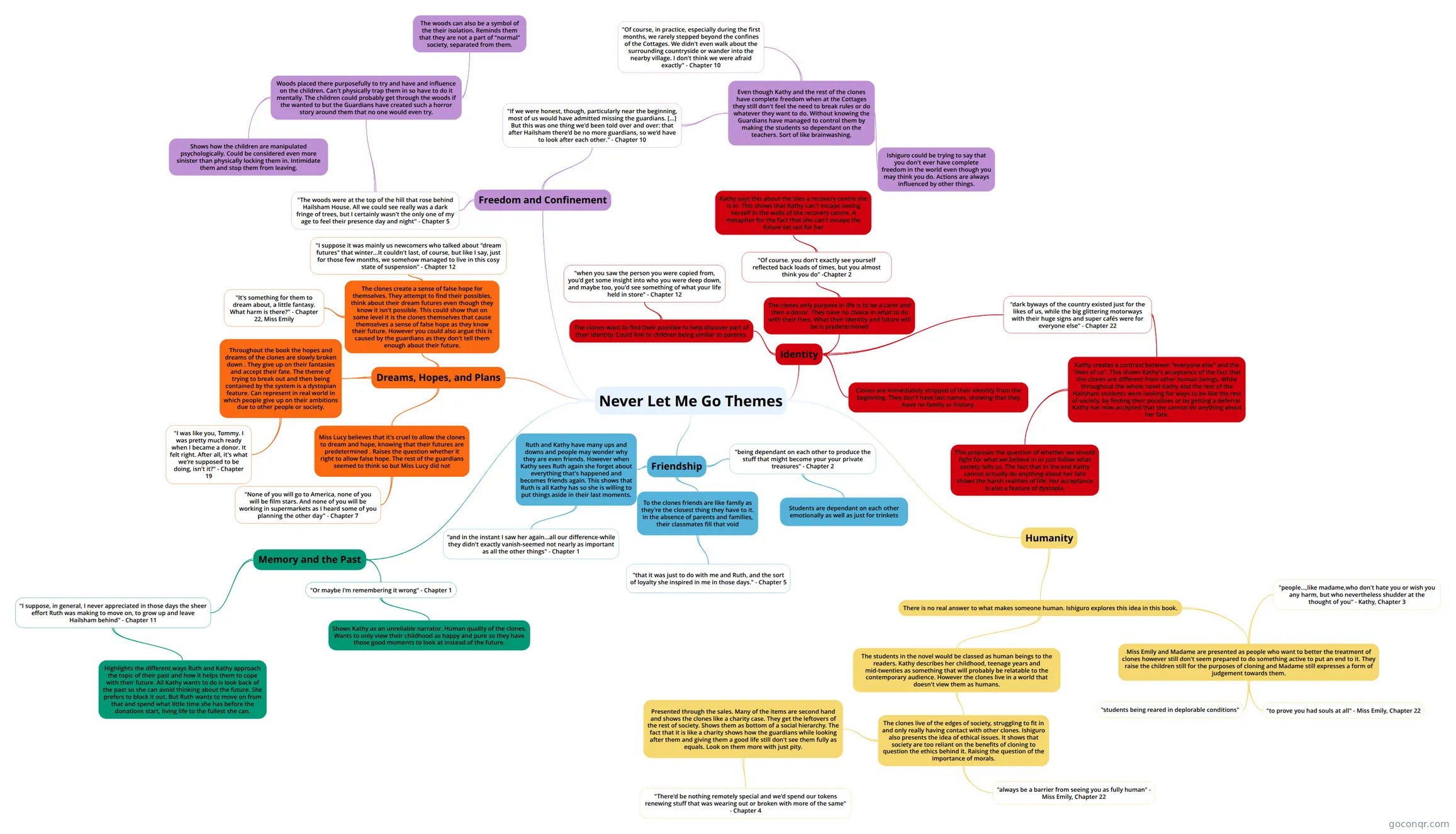
Mind map: Never Let Me Go Themes
Conteúdo do mapa
Never Let Me Go Themes
Friendship
- To the clones friends are like family as they're the closest thing they have to it. In the absence of parents and families, their classmates fill that void
- "that it was just to do with me and Ruth, and the sort of loyalty she inspired in me in those days." - Chapter 5
- Ruth and Kathy have many ups and downs and people may wonder why they are even friends. However when Kathy sees Ruth again she forget about everything that's happened and becomes friends again. This shows that Ruth is all Kathy has so she is willing to put things aside in their last moments.
- "and in the instant I saw her again...all our difference-while they didn't exactly vanish-seemed not nearly as important as all the other things" - Chapter 1
- "being dependant on each other to produce the stuff that might become your your private treasures" - Chapter 2
- Students are dependant on each other emotionally as well as just for trinkets
- To the clones friends are like family as they're the closest thing they have to it. In the absence of parents and families, their classmates fill that void
Identity
- Clones are immediately stripped of their identity from the beginning. They don't have last names, showing that they have no family or history.
- The clones only purpose in life is to be a carer and then a donor. They have no choice in what to do with their lives. What their identity and future will be is predetermined
- "Of course. you don't exactly see yourself reflected back loads of times, but you almost think you do" -Chapter 2
- Kathy says this about the tiles a recovery centre she is in. This shows that Kathy can't escape seeing herself in the walls of the recovery centre. A metaphor for the fact that she can't escape the future set out for her
- "Of course. you don't exactly see yourself reflected back loads of times, but you almost think you do" -Chapter 2
- The clones want to find their possible to help discover part of their identity. Could link to children being similar to parents.
- "when you saw the person you were copied from, you'd get some insight into who you were deep down, and maybe too, you'd see something of what your life held in store" - Chapter 12
- "dark byways of the country existed just for the likes of us, while the big glittering motorways with their huge signs and super cafés were for everyone else" - Chapter 22
- Kathy creates a contrast between "everyone else" and the "likes of us". This shows Kathy's acceptance of the fact that the clones are different from other human beings. While throughout the whole novel Kathy and the rest of the Hailsham students were looking for ways to be like the rest of society, by finding their possibles or by getting a deferral. Kathy has now accepted that she cannot do anything about her fate.
- This proposes the question of whether we should fight for what we believe in or just follow what society tells us. The fact that in the end Kathy cannot actually do anything about her fate shows the harsh realities of life. Her acceptance is also a feature of dystopia.
- Kathy creates a contrast between "everyone else" and the "likes of us". This shows Kathy's acceptance of the fact that the clones are different from other human beings. While throughout the whole novel Kathy and the rest of the Hailsham students were looking for ways to be like the rest of society, by finding their possibles or by getting a deferral. Kathy has now accepted that she cannot do anything about her fate.
Dreams, Hopes, and Plans
- Miss Lucy believes that it's cruel to allow the clones to dream and hope, knowing that their futures are predetermined . Raises the question whether it right to allow false hope. The rest of the guardians seemed to think so but Miss Lucy did not
- "None of you will go to America, none of you will be film stars. And none of you will be working in supermarkets as I heard some of you planning the other day" - Chapter 7
- The clones create a sense of false hope for themselves. They attempt to find their possibles, think about their dream futures even though they know it isn't possible. This could show that on some level it is the clones themselves that cause themselves a sense of false hope as they know their future. However you could also argue this is caused by the guardians as they don't tell them enough about their future.
- "I suppose it was mainly us newcomers who talked about "dream futures" that winter...It couldn't last, of course, but like I say, just for those few months, we somehow managed to live in this cosy state of suspension" - Chapter 12
- "It's something for them to dream about, a little fantasy. What harm is there?" - Chapter 22, Miss Emily
- Throughout the book the hopes and dreams of the clones are slowly broken down . They give up on their fantasies and accept their fate. The theme of trying to break out and then being contained by the system is a dystopian feature. Can represent in real world in which people give up on their ambitions due to other people or society.
- "I was like you, Tommy. I was pretty much ready when I became a donor. It felt right. After all, it's what we're supposed to be doing, isn't it?" - Chapter 19
- Miss Lucy believes that it's cruel to allow the clones to dream and hope, knowing that their futures are predetermined . Raises the question whether it right to allow false hope. The rest of the guardians seemed to think so but Miss Lucy did not
Freedom and Confinement
- "If we were honest, though, particularly near the beginning, most of us would have admitted missing the guardians. […] But this was one thing we'd been told over and over: that after Hailsham there'd be no more guardians, so we'd have to look after each other." - Chapter 10
- Even though Kathy and the rest of the clones have complete freedom when at the Cottages they still don't feel the need to break rules or do whatever they want to do. Without knowing the Guardians have managed to control them by making the students so dependant on the teachers. Sort of like brainwashing.
- Ishiguro could be trying to say that you don't ever have complete freedom in the world even though you may think you do. Actions are always influenced by other things.
- "Of course, in practice, especially during the first months, we rarely stepped beyond the confines of the Cottages. We didn't even walk about the surrounding countryside or wander into the nearby village. I don't think we were afraid exactly" - Chapter 10
- Even though Kathy and the rest of the clones have complete freedom when at the Cottages they still don't feel the need to break rules or do whatever they want to do. Without knowing the Guardians have managed to control them by making the students so dependant on the teachers. Sort of like brainwashing.
- "The woods were at the top of the hill that rose behind Hailsham House. All we could see really was a dark fringe of trees, but I certainly wasn't the only one of my age to feel their presence day and night" - Chapter 5
- Woods placed there purposefully to try and have and influence on the children. Can't physically trap them in so have to do it mentally. The children could probably get through the woods if the wanted to but the Guardians have created such a horror story around them that no one would even try.
- Shows how the children are manipulated psychologically. Could be considered even more sinister than physically locking them in. Intimidate them and stop them from leaving.
- The woods can also be a symbol of the their isolation. Reminds them that they are not a part of "normal" society, separated from them.
- Woods placed there purposefully to try and have and influence on the children. Can't physically trap them in so have to do it mentally. The children could probably get through the woods if the wanted to but the Guardians have created such a horror story around them that no one would even try.
- "If we were honest, though, particularly near the beginning, most of us would have admitted missing the guardians. […] But this was one thing we'd been told over and over: that after Hailsham there'd be no more guardians, so we'd have to look after each other." - Chapter 10
Memory and the Past
- "Or maybe I'm remembering it wrong" - Chapter 1
- Shows Kathy as an unreliable narrator. Human quality of the clones. Wants to only view their childhood as happy and pure so they have those good moments to look at instead of the future.
- "I suppose, in general, I never appreciated in those days the sheer effort Ruth was making to move on, to grow up and leave Hailsham behind" - Chapter 11
- Highlights the different ways Ruth and Kathy approach the topic of their past and how it helps them to cope with their future. All Kathy wants to do is look back of the past so she can avoid thinking about the future. She prefers to block it out. But Ruth wants to move on from that and spend what little time she has before the donations start, living life to the fullest she can.
- "Or maybe I'm remembering it wrong" - Chapter 1
Humanity
- There is no real answer to what makes someone human. Ishiguro explores this idea in this book.
- The students in the novel would be classed as human beings to the readers. Kathy describes her childhood, teenage years and mid-twenties as something that will probably be relatable to the contemporary audience. However the clones live in a world that doesn't view them as humans.
- The clones live of the edges of society, struggling to fit in and only really having contact with other clones. Ishiguro also presents the idea of ethical issues. It shows that society are too reliant on the benefits of cloning to question the ethics behind it. Raising the question of the importance of morals.
- Presented through the sales. Many of the items are second hand and shows the clones like a charity case. They get the leftovers of the rest of society. Shows them as bottom of a social hierarchy. The fact that it is like a charity shows how the guardians while looking after them and giving them a good life still don't see them fully as equals. Look on them more with just pity.
- "There'd be nothing remotely special and we'd spend our tokens renewing stuff that was wearing out or broken with more of the same" - Chapter 4
- "always be a barrier from seeing you as fully human" - Miss Emily, Chapter 22
- Presented through the sales. Many of the items are second hand and shows the clones like a charity case. They get the leftovers of the rest of society. Shows them as bottom of a social hierarchy. The fact that it is like a charity shows how the guardians while looking after them and giving them a good life still don't see them fully as equals. Look on them more with just pity.
- The clones live of the edges of society, struggling to fit in and only really having contact with other clones. Ishiguro also presents the idea of ethical issues. It shows that society are too reliant on the benefits of cloning to question the ethics behind it. Raising the question of the importance of morals.
- Miss Emily and Madame are presented as people who want to better the treatment of clones however still don't seem prepared to do something active to put an end to it. They raise the children still for the purposes of cloning and Madame still expresses a form of judgement towards them.
- "students being reared in deplorable conditions"
- "people...,like madame,who don't hate you or wish you any harm, but who nevertheless shudder at the thought of you" - Kathy, Chapter 3
- "to prove you had souls at all" - Miss Emily, Chapter 22
- The students in the novel would be classed as human beings to the readers. Kathy describes her childhood, teenage years and mid-twenties as something that will probably be relatable to the contemporary audience. However the clones live in a world that doesn't view them as humans.
- There is no real answer to what makes someone human. Ishiguro explores this idea in this book.
Informações
- Descrição
- GCSE English Mapa Mental sobre Never Let Me Go Themes, criado por Dona Deric em 09-12-2018.
- Criado por
- Dona Deric
- Visualizações
- 6
- Avaliação