
Mapa mental
Mass Spectrometry
Conteúdo do mapa
Mass Spectrometry
Uses
- Relative atomic mass
- Relative molecular mass
- relative isotopic abundance
- Molecular structure
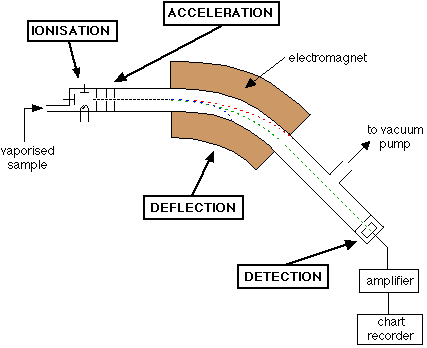
Step 1- Vaporisation
- The sample is vaporised by an electrical heater
Step 2- Ionisation
- The gas particles are bombarded with high energy electrons to ionise them by knocking off electrons, leaving positive ions.
Step 3- Acceleration
- The positive ions are accelerated by an electric field
Step 4- Deflection
- The positive ions' paths are altered with a magnetic field. Lighter ions have less momentum so are deflected more than heavier ions. For a given magnetic field, only ions with a particular mass/charge ratio make it to the detector.
Step 5- Detection
- The magnetic field strength is slowly increased. As this happens, different ions can reach the detector. As they hit the detector they release a current.The bigger the current the more of that isotope is present in the sample. A mass spectrum is produced.