
Mapa mental
Gender, feminism and religion
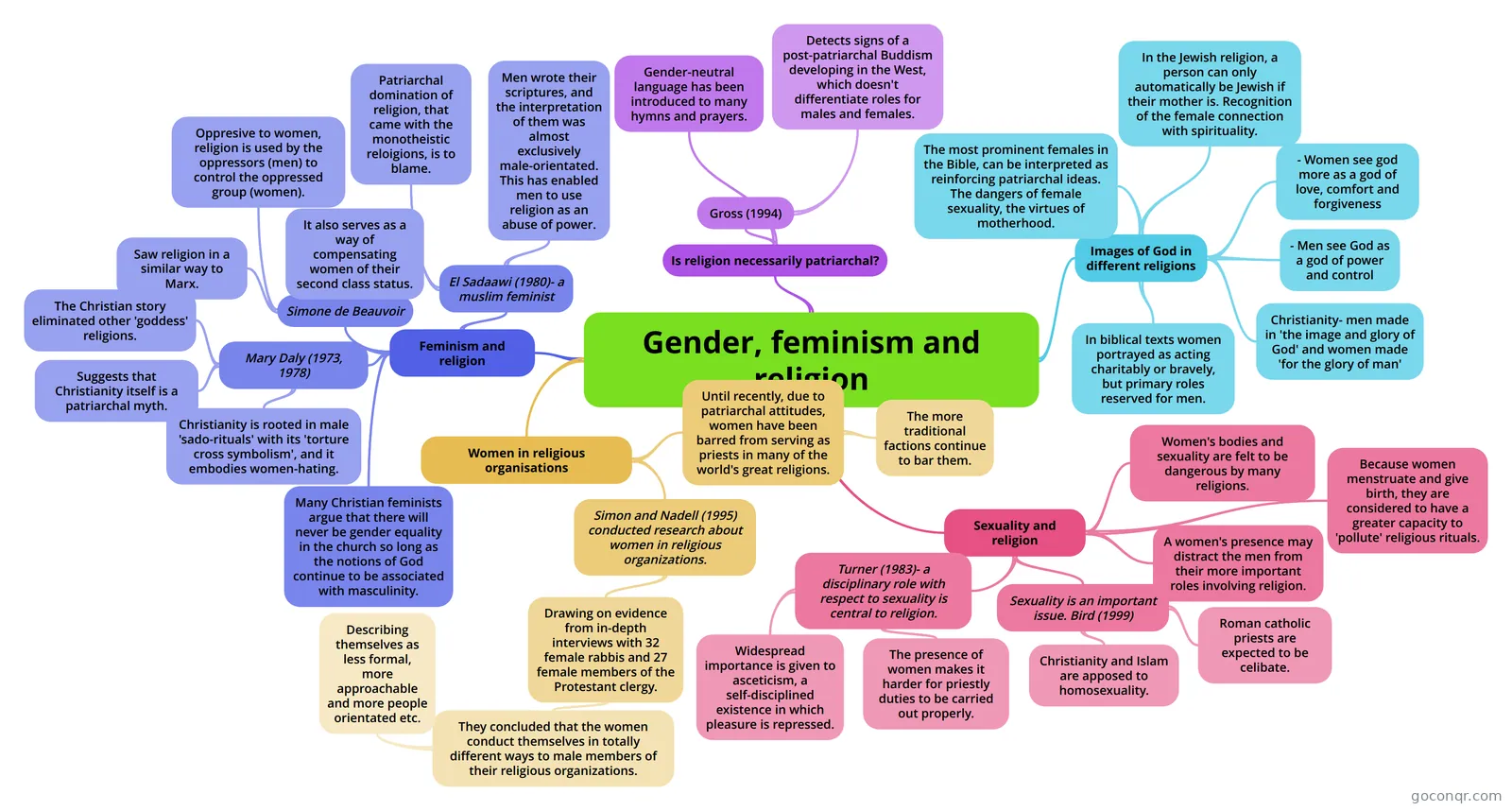
Mind map: Gender, feminism and religion
Conteúdo do mapa
Gender, feminism and religion
Images of God in different religions
- - Women see god more as a god of love, comfort and forgiveness
- - Men see God as a god of power and control
- In the Jewish religion, a person can only automatically be Jewish if their mother is. Recognition of the female connection with spirituality.
- Christianity- men made in 'the image and glory of God' and women made 'for the glory of man'
- In biblical texts women portrayed as acting charitably or bravely, but primary roles reserved for men.
- The most prominent females in the Bible, can be interpreted as reinforcing patriarchal ideas. The dangers of female sexuality, the virtues of motherhood.
Sexuality and religion
- Women's bodies and sexuality are felt to be dangerous by many religions.
- Because women menstruate and give birth, they are considered to have a greater capacity to 'pollute' religious rituals.
- A women's presence may distract the men from their more important roles involving religion.
- Sexuality is an important issue. Bird (1999)
- Roman catholic priests are expected to be celibate.
- Christianity and Islam are apposed to homosexuality.
- Turner (1983)- a disciplinary role with respect to sexuality is central to religion.
- The presence of women makes it harder for priestly duties to be carried out properly.
- Widespread importance is given to asceticism, a self-disciplined existence in which pleasure is repressed.
Women in religious organisations
- Until recently, due to patriarchal attitudes, women have been barred from serving as priests in many of the world's great religions.
- The more traditional factions continue to bar them.
- Simon and Nadell (1995) conducted research about women in religious organizations.
- Drawing on evidence from in-depth interviews with 32 female rabbis and 27 female members of the Protestant clergy.
- They concluded that the women conduct themselves in totally different ways to male members of their religious organizations.
- Describing themselves as less formal, more approachable and more people orientated etc.
- They concluded that the women conduct themselves in totally different ways to male members of their religious organizations.
- Drawing on evidence from in-depth interviews with 32 female rabbis and 27 female members of the Protestant clergy.
- Until recently, due to patriarchal attitudes, women have been barred from serving as priests in many of the world's great religions.
Feminism and religion
- Many Christian feminists argue that there will never be gender equality in the church so long as the notions of God continue to be associated with masculinity.
- Mary Daly (1973, 1978)
- Suggests that Christianity itself is a patriarchal myth.
- The Christian story eliminated other 'goddess' religions.
- Christianity is rooted in male 'sado-rituals' with its 'torture cross symbolism', and it embodies women-hating.
- Simone de Beauvoir
- Saw religion in a similar way to Marx.
- Oppresive to women, religion is used by the oppressors (men) to control the oppressed group (women).
- It also serves as a way of compensating women of their second class status.
- El Sadaawi (1980)- a muslim feminist
- Patriarchal domination of religion, that came with the monotheistic reloigions, is to blame.
- Men wrote their scriptures, and the interpretation of them was almost exclusively male-orientated. This has enabled men to use religion as an abuse of power.
Is religion necessarily patriarchal?
- Gender-neutral language has been introduced to many hymns and prayers.
- Gross (1994)
- Detects signs of a post-patriarchal Buddism developing in the West, which doesn't differentiate roles for males and females.
Informações
- Descrição
- Sociology Mapa Mental sobre Gender, feminism and religion, criado por becci.holland11 em 17-09-2013.
- Criado por
- becci.holland11
- Visualizações
- 136
- Tags
- Avaliação