
Mapa mental
Full and bare infinitives Alessandra_Vicencio
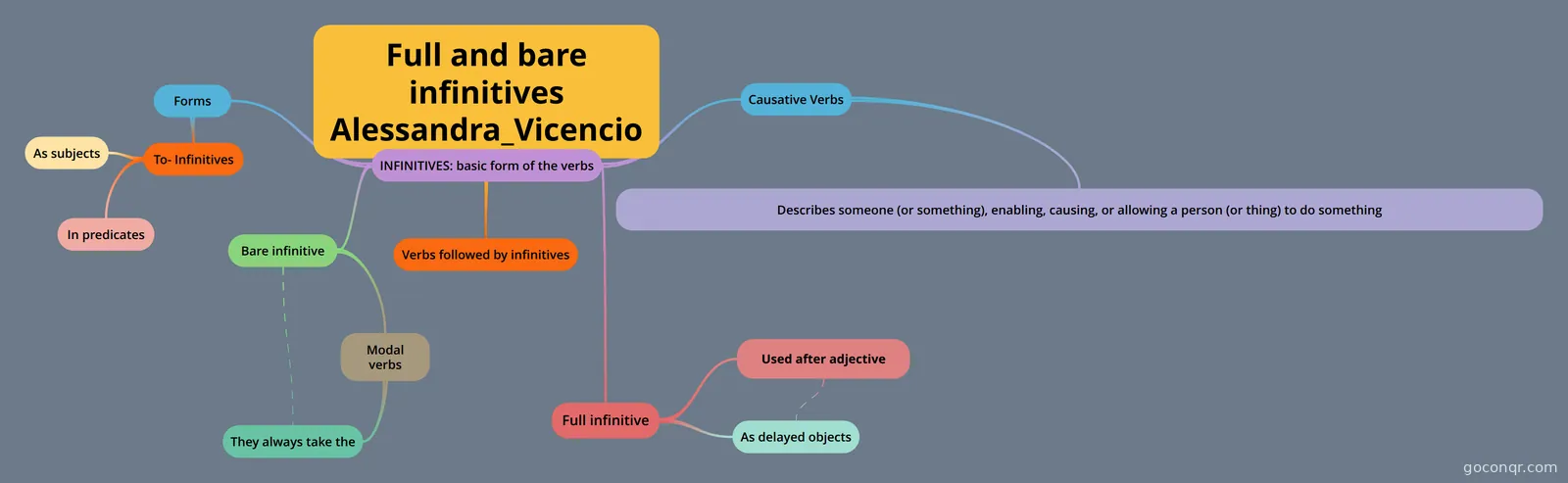
Mind map: Full and bare infinitives
Conteúdo do mapa
Full and bare infinitives Alessandra_Vicencio
INFINITIVES: basic form of the verbs
- Forms
- To- Infinitives
- Cause, get, force, allow, ask, tell, encourage, persuade, convince, and help are followed by an object and the to-infinitive form of a verb. Ex. -They persuaded us to join their group. -She convinced me to leave early. - I asked the waiter to bring a menu.
- As subjects
- A to-infinitive phrase may be used as the subject of a sentence. To-infinitive phrase ( long): sentence begins with it and the infinitive phrase comes at the end of the sentence. Ex. -It is unusual to see an owl during the day. -It takes time to learn a new language.
- In predicates
- A to-infinitive can be placed in several different positions within a sentence.
- A to-infinitive can come after the linking verbs be, seem, and appear as a subject complement. Ex. -Michael seems to know a lot about literature. -The city appears to have a problem with pollution.
- A to-infinitive can come after certain verbs as the direct object. These verbs include: begin, choose, claim, decide, expect, learn, like, love, manage, offer, plan, prefer, promise, refuse, start, try, want, wish. Ex. -They wanted to stay for a few extra days. -We are learning to speak Italian.
- A to-infinitive can come after the objects of certain verbs. These verbs include: ask, convince, expect, help, order, persuade, remind, teach, tell. Ex.-Parents teach kids to say please and thank you. - I expected them to be home before midnight.
- A to-infinitive can come after certain adjectives. These adjectives include: amazed, ashamed, disappointed, excited, glad, happy, likely, pleased, ready, reluctant, sad, shocked, sorry, surprised, upset, willing. Ex.-I’m not quite ready to leave the house yet. - He will be disappointed not to see you.
- To- Infinitives
- Causative Verbs
- Describes someone (or something), enabling, causing, or allowing a person (or thing) to do something
- Bare infinitive
- -Let, make, have, and help are followed by an object and the bare infinitive form of a verb. Ex. -My parents did not let me go to the rock concert. -That food made my stomach feel sick. -The teacher had me do the sum on the board.
- Modal verbs
- Can, could, have to, must, might, should, ought to Ex. -We mustn’t be late for class.-We had to write an essay this morning.
- They always take the
- Full infinitive
- Used after adjective
- Ex. -I'm happy to see my friends. -We were surprised to get first place.
- As delayed objects
- Ex. -It is healthy to swim -It is dangerous to smoke
- Used after adjective
- Forms
Verbs followed by infinitives
- -Afford, choose, hurry, pay, seem, agree, consent, intend, plan, want, appear, decide, invite, prepare, warn, arrange, demand, learn, pretend, wish, ask, deserve, manage, promise, would like, attempt, expect, mean, refuse, claim, can't afford, fail, need, remind, hesitate, can't wait, hope, offer, request, swear
Informações
- Descrição
- Tercero Inglés Mapa Mental sobre Full and bare infinitives Alessandra_Vicencio, criado por Ale Vicencio em 23-03-2020.
- Criado por
- Ale Vicencio
- Visualizações
- 6
- Avaliação