
Mapa mental
Coordination and Response in Humans
Conteúdo do mapa
Coordination and Response in Humans
Homeostasis
- The ability of an organism to maintain a constant internal environment in response to changing environmental or internal conditions
- Negative feedback
- If a particular variable (e.g. temperature) moves away from its normal value, different mechanisms work together to bring it back to the norm
Thermoregulation
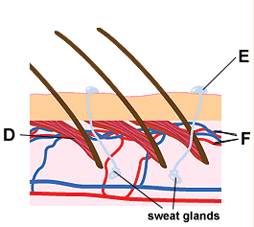
- Heat given off by
- F - Blood flow in capillaries increases
- Vasodilation
- D - Hair muscles relax. Hairs lie flat so heat can escape.
- E - Sweat secreted by sweat glands. Cools skin by evaporation.
- Skeletal muscles shiver - energy released due to increased movement
- F - Blood flow in capillaries increases
- Heat conserved by
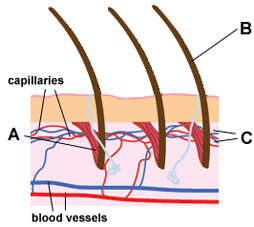
- C - Blood flow in capillaries decreases.
- Vasoconstriction
- A - Hair muscles pull hairs on end.
- B - Erect hairs trap air.
- C - Blood flow in capillaries decreases.
- Thermoregulatory centre in brain
- receptors which are sensitive to temperature of blood flowing through the brain
- Impulses from skin recepors
- Heat given off by
Nervous system
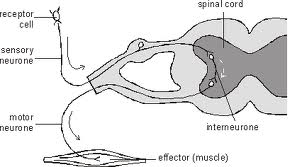
- Receptors detect a stimulus
- Sensory neurones carry electrical impulses to spinal cord
- Relay neurones carry the impulses in the spinal cord
- Motor neurones carry the impulses to the effector
- Effectors carry out the response
- Reflex Arc - Sensory, Relay, Motor
- Motor neurones carry the impulses to the effector
- sticky out circle means sensory
- Relay neurones carry the impulses in the spinal cord
- Sensory neurones carry electrical impulses to spinal cord
- Responds to change
- Fast, short lived response
- Central Nervous System decides what to do
- Effectors are a muscle or gland
- NOT a part of nervous system
- Receptors detect a stimulus
Hormones
- Responds to change
- Slow, long lasting response
- ADH
- Increased permeability of kidney tubules to water, so more water is reabsorbed and less urine is produced
- Pituitary gland
- Increased permeability of kidney tubules to water, so more water is reabsorbed and less urine is produced
- Adrenaline
- 'Fight or flight' hormone, increases heart and breathing rate, diverts blood flow to skeletal muscles and brain
- Adrenal glands
- 'Fight or flight' hormone, increases heart and breathing rate, diverts blood flow to skeletal muscles and brain
- Insulin
- Produced when blood glucose level increases. Enables the liver to convert glucose to glycogen for storage.
- Pancreas
- Produced when blood glucose level increases. Enables the liver to convert glucose to glycogen for storage.
- Testosterone
- Development of male secondary sexual characteristics
- Testes
- Development of male secondary sexual characteristics
- Oestrogen
- Development of female secondary sexual characteristics, control of the menstrual cycle
- Ovaries
- Development of female secondary sexual characteristics, control of the menstrual cycle
- Progesterone
- Maintains the uterus lining (endometrium) during pregnancy
- Ovaries
- Maintains the uterus lining (endometrium) during pregnancy
- Responds to change
The Eye
- Iris Reflex
- Bright Light
- Circular muscles contract, Pupil constricts, Less light enters eye
- Dim Light
- Radial muscles contract, Pupil dilates, More light enters eye
- Bright Light
- Iris Reflex
Imagens e arquivos do mapa
Informações
- Descrição
- Cambridge IGCSE Biology (Coordination and Response) Mapa Mental sobre Coordination and Response in Humans, criado por MusicGirl98 em 29-09-2013.
- Criado por
- MusicGirl98
- Visualizações
- 1.212
- Tags
- Avaliação