
Mapa mental
B6a Summary
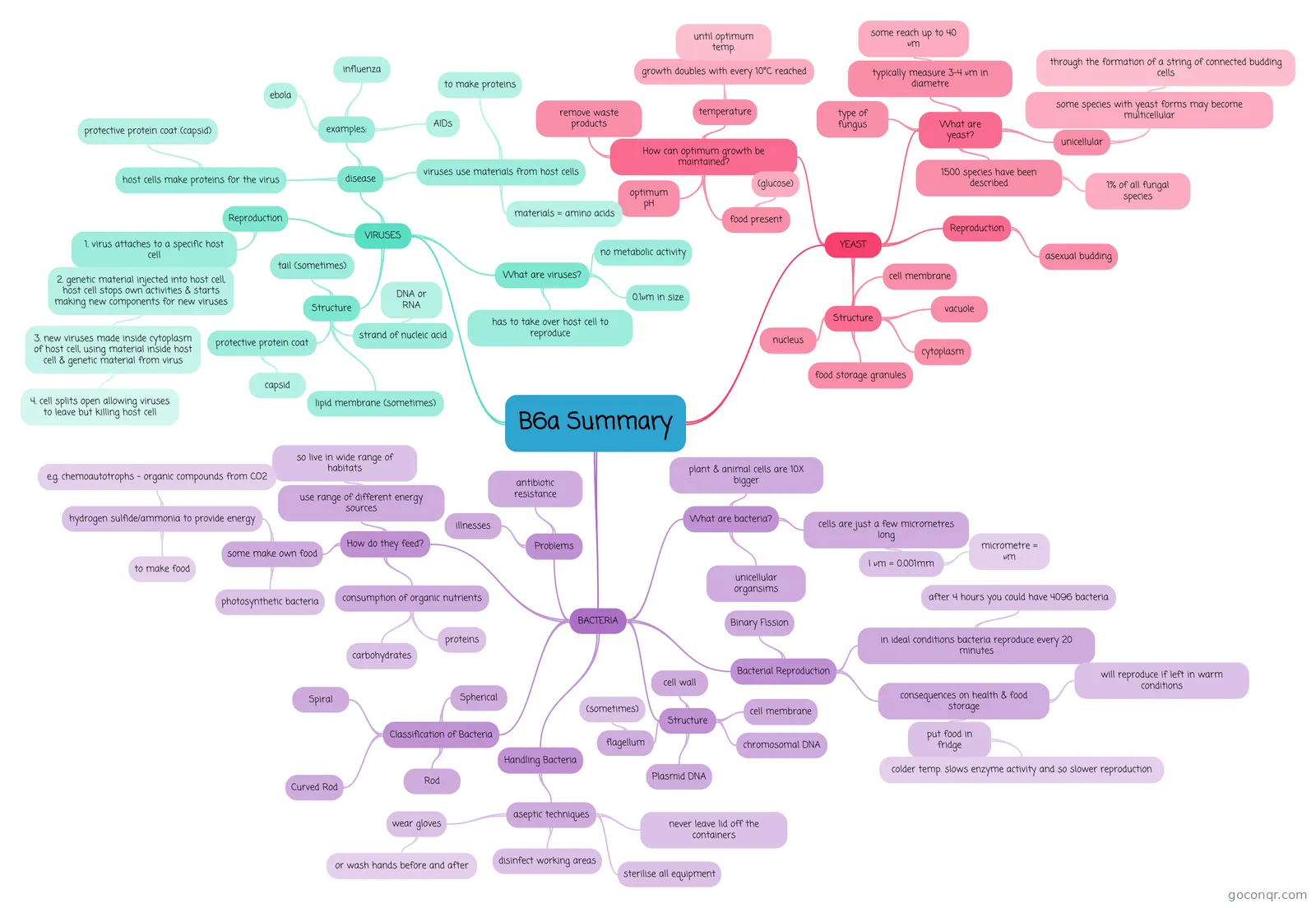
Mind map: B6a summary bacteria yeast viruses
Conteúdo do mapa
B6a Summary
BACTERIA
- What are bacteria?
- unicellular organsims
- cells are just a few micrometres long
- I µm = 0.001mm
- micrometre = µm
- I µm = 0.001mm
- plant & animal cells are 10X bigger
- Classification of Bacteria
- Rod
- Curved Rod
- Spherical
- Spiral
- Handling Bacteria
- aseptic techniques
- wear gloves
- or wash hands before and after
- disinfect working areas
- sterilise all equipment
- never leave lid off the containers
- wear gloves
- aseptic techniques
- Bacterial Reproduction
- Binary Fission
- in ideal conditions bacteria reproduce every 20 minutes
- after 4 hours you could have 4096 bacteria
- consequences on health & food storage
- will reproduce if left in warm conditions
- put food in fridge
- colder temp. slows enzyme activity and so slower reproduction
- How do they feed?
- consumption of organic nutrients
- carbohydrates
- proteins
- some make own food
- photosynthetic bacteria
- hydrogen sulfide/ammonia to provide energy
- to make food
- e.g. chemoautotrophs - organic compounds from CO2
- use range of different energy sources
- so live in wide range of habitats
- consumption of organic nutrients
- Problems
- illnesses
- antibiotic resistance
- Structure
- Plasmid DNA
- chromosomal DNA
- cell wall
- flagellum
- (sometimes)
- cell membrane
- What are bacteria?
YEAST
- Reproduction
- asexual budding
- Structure
- food storage granules
- cytoplasm
- vacuole
- cell membrane
- nucleus
- What are yeast?
- type of fungus
- 1500 species have been described
- 1% of all fungal species
- unicellular
- some species with yeast forms may become multicellular
- through the formation of a string of connected budding cells
- some species with yeast forms may become multicellular
- typically measure 3-4 µm in diametre
- some reach up to 40 µm
- How can optimum growth be maintained?
- food present
- (glucose)
- temperature
- growth doubles with every 10°C reached
- until optimum temp.
- growth doubles with every 10°C reached
- optimum pH
- remove waste products
- food present
- Reproduction
VIRUSES
- Reproduction
- 1. virus attaches to a specific host cell
- 2. genetic material injected into host cell, host cell stops own activities & starts making new components for new viruses
- 3. new viruses made inside cytoplasm of host cell, using material inside host cell & genetic material from virus
- 4. cell splits open allowing viruses to leave but killing host cell
- 3. new viruses made inside cytoplasm of host cell, using material inside host cell & genetic material from virus
- 2. genetic material injected into host cell, host cell stops own activities & starts making new components for new viruses
- 1. virus attaches to a specific host cell
- Structure
- strand of nucleic acid
- DNA or RNA
- protective protein coat
- capsid
- tail (sometimes)
- lipid membrane (sometimes)
- strand of nucleic acid
- What are viruses?
- 0.1µm in size
- no metabolic activity
- has to take over host cell to reproduce
- disease
- host cells make proteins for the virus
- protective protein coat (capsid)
- examples:
- ebola
- influenza
- AIDs
- viruses use materials from host cells
- to make proteins
- materials = amino acids
- host cells make proteins for the virus
- Reproduction
Informações
- Descrição
- B6a: Understanding Microbes
- Criado por
- Ciara Comerford
- Visualizações
- 64
- Tags
- Avaliação