
Mapa mental
Marx on Alienation
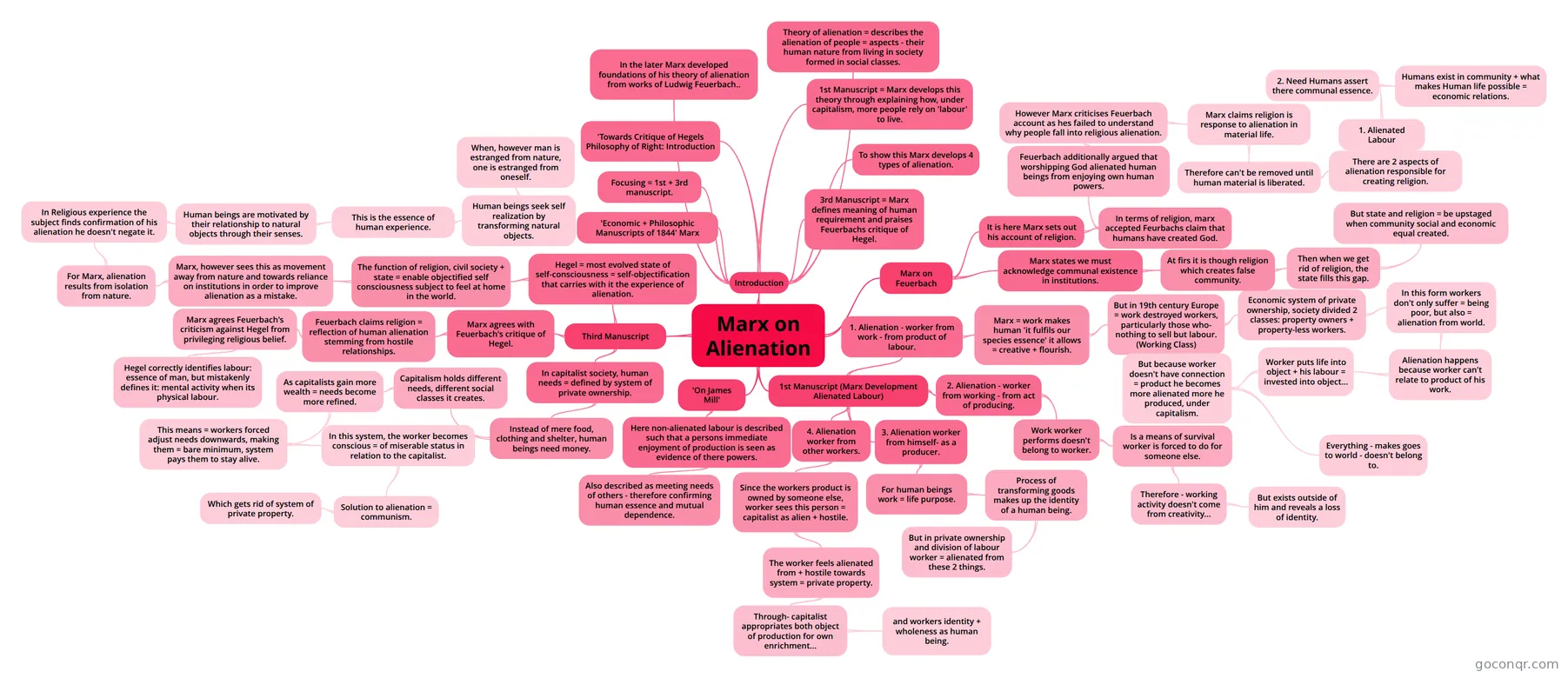
Mind map: Marx on alienation
Conteúdo do mapa
Marx on Alienation
Introduction
- 'Economic + Philosophic Manuscripts of 1844' Marx
- Focusing = 1st + 3rd manuscript.
- 1st Manuscript = Marx develops this theory through explaining how, under capitalism, more people rely on 'labour' to live.
- Theory of alienation = describes the alienation of people = aspects - their human nature from living in society formed in social classes.
- In the later Marx developed foundations of his theory of alienation from works of Ludwig Feuerbach..
- 'Towards Critique of Hegels Philosophy of Right: Introduction
- 3rd Manuscript = Marx defines meaning of human requirement and praises Feuerbachs critique of Hegel.
- To show this Marx develops 4 types of alienation.
1st Manuscript (Marx Development Alienated Labour)
- 2. Alienation - worker from working - from act of producing.
- Work worker performs doesn't belong to worker.
- Is a means of survival worker is forced to do for someone else.
- Therefore - working activity doesn't come from creativity...
- But exists outside of him and reveals a loss of identity.
- Therefore - working activity doesn't come from creativity...
- Is a means of survival worker is forced to do for someone else.
- Work worker performs doesn't belong to worker.
- 1. Alienation - worker from work - from product of labour.
- Marx = work makes human 'it fulfils our species essence' it allows = creative + flourish.
- But in 19th century Europe = work destroyed workers, particularly those who- nothing to sell but labour. (Working Class)
- Economic system of private ownership, society divided 2 classes: property owners + property-less workers.
- In this form workers don't only suffer = being poor, but also = alienation from world.
- Alienation happens because worker can't relate to product of his work.
- Worker puts life into object + his labour = invested into object...
- But because worker doesn't have connection = product he becomes more alienated more he produced, under capitalism.
- Everything - makes goes to world - doesn't belong to.
- But because worker doesn't have connection = product he becomes more alienated more he produced, under capitalism.
- Worker puts life into object + his labour = invested into object...
- Alienation happens because worker can't relate to product of his work.
- In this form workers don't only suffer = being poor, but also = alienation from world.
- Economic system of private ownership, society divided 2 classes: property owners + property-less workers.
- But in 19th century Europe = work destroyed workers, particularly those who- nothing to sell but labour. (Working Class)
- Marx = work makes human 'it fulfils our species essence' it allows = creative + flourish.
- 3. Alienation worker from himself- as a producer.
- For human beings work = life purpose.
- Process of transforming goods makes up the identity of a human being.
- But in private ownership and division of labour worker = alienated from these 2 things.
- Process of transforming goods makes up the identity of a human being.
- For human beings work = life purpose.
- 4. Alienation worker from other workers.
- Since the workers product is owned by someone else, worker sees this person = capitalist as alien + hostile.
- The worker feels alienated from + hostile towards system = private property.
- Through- capitalist appropriates both object of production for own enrichment...
- and workers identity + wholeness as human being.
- Through- capitalist appropriates both object of production for own enrichment...
- The worker feels alienated from + hostile towards system = private property.
- Since the workers product is owned by someone else, worker sees this person = capitalist as alien + hostile.
- 2. Alienation - worker from working - from act of producing.
Third Manuscript
- In capitalist society, human needs = defined by system of private ownership.
- Instead of mere food, clothing and shelter, human beings need money.
- Capitalism holds different needs, different social classes it creates.
- As capitalists gain more wealth = needs become more refined.
- This means = workers forced adjust needs downwards, making them = bare minimum, system pays them to stay alive.
- In this system, the worker becomes conscious = of miserable status in relation to the capitalist.
- Solution to alienation = communism.
- Which gets rid of system of private property.
- Solution to alienation = communism.
- In this system, the worker becomes conscious = of miserable status in relation to the capitalist.
- This means = workers forced adjust needs downwards, making them = bare minimum, system pays them to stay alive.
- As capitalists gain more wealth = needs become more refined.
- Capitalism holds different needs, different social classes it creates.
- Instead of mere food, clothing and shelter, human beings need money.
- Marx agrees with Feuerbach's critique of Hegel.
- Feuerbach claims religion = reflection of human alienation stemming from hostile relationships.
- Marx agrees Feuerbach's criticism against Hegel from privileging religious belief.
- Hegel correctly identifies labour: essence of man, but mistakenly defines it: mental activity when its physical labour.
- Marx agrees Feuerbach's criticism against Hegel from privileging religious belief.
- Feuerbach claims religion = reflection of human alienation stemming from hostile relationships.
- Hegel = most evolved state of self-consciousness = self-objectification that carries with it the experience of alienation.
- The function of religion, civil society + state = enable objectified self consciousness subject to feel at home in the world.
- Marx, however sees this as movement away from nature and towards reliance on institutions in order to improve alienation as a mistake.
- For Marx, alienation results from isolation from nature.
- In Religious experience the subject finds confirmation of his alienation he doesn't negate it.
- Human beings are motivated by their relationship to natural objects through their senses.
- This is the essence of human experience.
- Human beings seek self realization by transforming natural objects.
- When, however man is estranged from nature, one is estranged from oneself.
- Human beings seek self realization by transforming natural objects.
- This is the essence of human experience.
- Human beings are motivated by their relationship to natural objects through their senses.
- In Religious experience the subject finds confirmation of his alienation he doesn't negate it.
- For Marx, alienation results from isolation from nature.
- Marx, however sees this as movement away from nature and towards reliance on institutions in order to improve alienation as a mistake.
- The function of religion, civil society + state = enable objectified self consciousness subject to feel at home in the world.
- In capitalist society, human needs = defined by system of private ownership.
Marx on Feuerbach
- It is here Marx sets out his account of religion.
- In terms of religion, marx accepted Feurbachs claim that humans have created God.
- Feuerbach additionally argued that worshipping God alienated human beings from enjoying own human powers.
- However Marx criticises Feuerbach account as hes failed to understand why people fall into religious alienation.
- Marx claims religion is response to alienation in material life.
- Therefore can't be removed until human material is liberated.
- There are 2 aspects of alienation responsible for creating religion.
- 1. Alienated Labour
- 2. Need Humans assert there communal essence.
- Humans exist in community + what makes Human life possible = economic relations.
- 2. Need Humans assert there communal essence.
- 1. Alienated Labour
- There are 2 aspects of alienation responsible for creating religion.
- Therefore can't be removed until human material is liberated.
- Marx claims religion is response to alienation in material life.
- However Marx criticises Feuerbach account as hes failed to understand why people fall into religious alienation.
- Feuerbach additionally argued that worshipping God alienated human beings from enjoying own human powers.
- In terms of religion, marx accepted Feurbachs claim that humans have created God.
- Marx states we must acknowledge communal existence in institutions.
- At firs it is though religion which creates false community.
- Then when we get rid of religion, the state fills this gap.
- But state and religion = be upstaged when community social and economic equal created.
- Then when we get rid of religion, the state fills this gap.
- At firs it is though religion which creates false community.
- It is here Marx sets out his account of religion.
'On James Mill'
- Here non-alienated labour is described such that a persons immediate enjoyment of production is seen as evidence of there powers.
- Also described as meeting needs of others - therefore confirming human essence and mutual dependence.
- Here non-alienated labour is described such that a persons immediate enjoyment of production is seen as evidence of there powers.
Informações
- Descrição
- Degree Marxism (Marx on Alienation (Feuerbach and Freedom)) Mapa Mental sobre Marx on Alienation, criado por Anna Black em 03-04-2015.
- Criado por
- Anna Black
- Visualizações
- 127
- Avaliação