
Mapa mental
DD307 Open University Social Psychology - Discursive Psychology notes
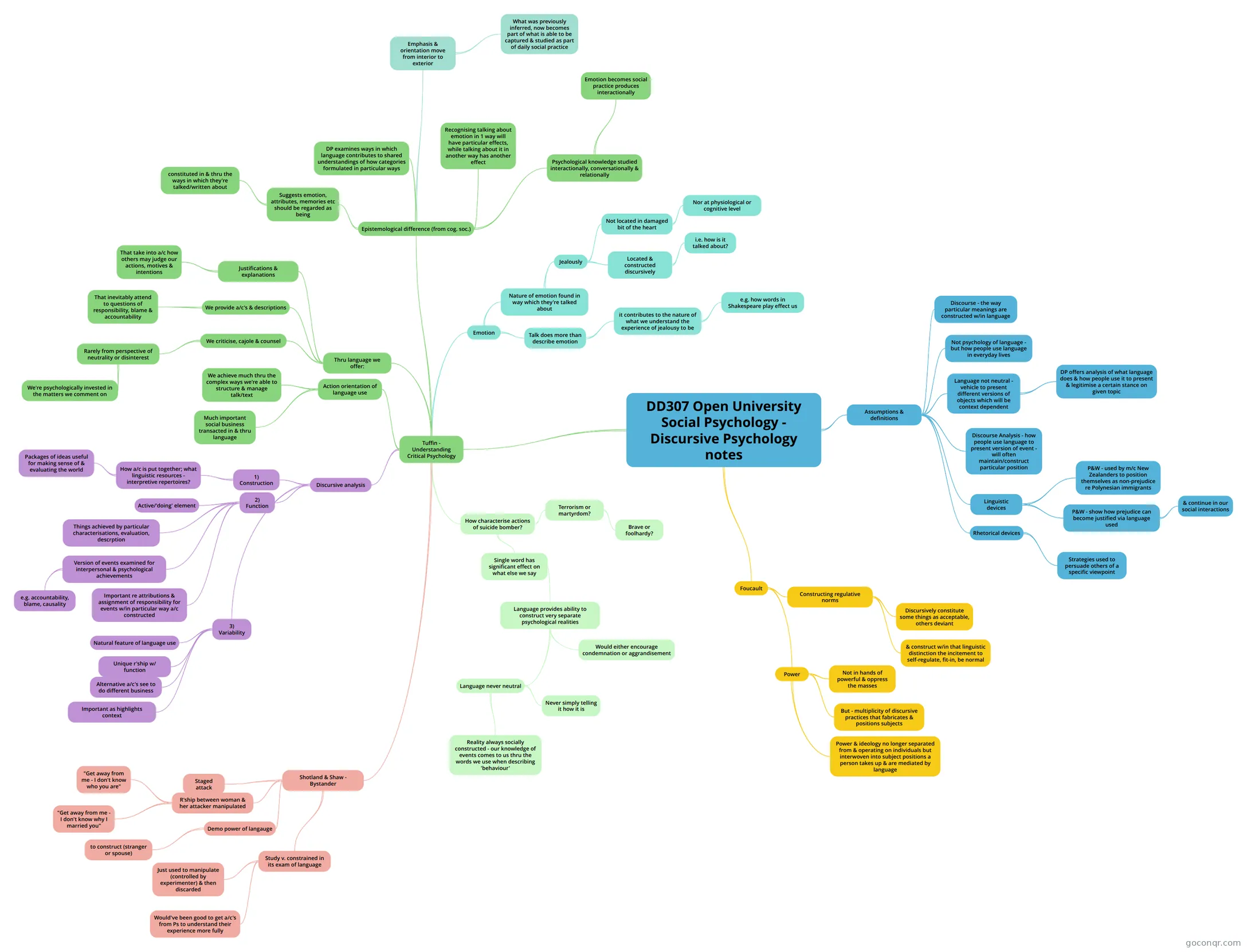
Mind map: DD307 discursive psychology notes
Conteúdo do mapa
DD307 Open University Social Psychology - Discursive Psychology notes
Assumptions & definitions
- Discourse - the way particular meanings are constructed w/in language
- Not psychology of language - but how people use language in everyday lives
- Language not neutral - vehicle to present different versions of objects which will be context dependent
- DP offers analysis of what language does & how people use it to present & legitimise a certain stance on given topic
- Discourse Analysis - how people use language to present version of event - will often maintain/construct particular position
- Linguistic devices
- P&W - used by m/c New Zealanders to position themselves as non-prejudice re Polynesian immigrants
- P&W - show how prejudice can become justified via language used
- & continue in our social interactions
- Rhetorical devices
- Strategies used to persuade others of a specific viewpoint
Foucault
- Constructing regulative norms
- Discursively constitute some things as acceptable, others deviant
- & construct w/in that linguistic distinction the incitement to self-regulate, fit-in, be normal
- Power
- Not in hands of powerful & oppress the masses
- But - multiplicity of discursive practices that fabricates & positions subjects
- Power & ideology no longer separated from & operating on individuals but interwoven into subject positions a person takes up & are mediated by language
- Constructing regulative norms
Tuffin - Understanding Critical Psychology
- Thru language we offer:
- Justifications & explanations
- That take into a/c how others may judge our actions, motives & intentions
- We provide a/c's & descriptions
- That inevitably attend to questions of responsibility, blame & accountability
- We criticise, cajole & counsel
- Rarely from perspective of neutrality or disinterest
- We're psychologically invested in the matters we comment on
- Rarely from perspective of neutrality or disinterest
- Justifications & explanations
- Action orientation of language use
- We achieve much thru the complex ways we're able to structure & manage talk/text
- Much important social business transacted in & thru language
- Discursive analysis
- 1) Construction
- How a/c is put together; what linguistic resources - interpretive repertoires?
- Packages of ideas useful for making sense of & evaluating the world
- How a/c is put together; what linguistic resources - interpretive repertoires?
- 2) Function
- Active/'doing' element
- Things achieved by particular characterisations, evaluation, descrption
- Version of events examined for interpersonal & psychological achievements
- e.g. accountability, blame, causality
- Important re attributions & assignment of responsibility for events w/in particular way a/c constructed
- 3) Variability
- Natural feature of language use
- Unique r'ship w/ function
- Alternative a/c's see to do different business
- Important as highlights context
- 1) Construction
- Epistemological difference (from cog. soc.)
- Suggests emotion, attributes, memories etc should be regarded as being
- constituted in & thru the ways in which they're talked/written about
- DP examines ways in which language contributes to shared understandings of how categories formulated in particular ways
- Recognising talking about emotion in 1 way will have particular effects, while talking about it in another way has another effect
- Psychological knowledge studied interactionally, conversationally & relationally
- Emotion becomes social practice produces interactionally
- Emphasis & orientation move from interior to exterior
- What was previously inferred, now becomes part of what is able to be captured & studied as part of daily social practice
- Suggests emotion, attributes, memories etc should be regarded as being
- Shotland & Shaw - Bystander
- Staged attack
- R'ship between woman & her attacker manipulated
- "Get away from me - I don't know who you are"
- "Get away from me - I don't know why I married you"
- Demo power of langauge
- to construct (stranger or spouse)
- Study v. constrained in its exam of language
- Just used to manipulate (controlled by experimenter) & then discarded
- Would've been good to get a/c's from Ps to understand their experience more fully
- How characterise actions of suicide bomber?
- Terrorism or martyrdom?
- Brave or foolhardy?
- Single word has significant effect on what else we say
- Language provides ability to construct very separate psychological realities
- Would either encourage condemnation or aggrandisement
- Language never neutral
- Never simply telling it how it is
- Reality always socially constructed - our knowledge of events comes to us thru the words we use when describing 'behaviour'
- Language provides ability to construct very separate psychological realities
- Terrorism or martyrdom?
- Emotion
- Nature of emotion found in way which they're talked about
- Jealously
- Not located in damaged bit of the heart
- Nor at physiological or cognitive level
- Located & constructed discursively
- i.e. how is it talked about?
- Not located in damaged bit of the heart
- Jealously
- Talk does more than describe emotion
- it contributes to the nature of what we understand the experience of jealousy to be
- e.g. how words in Shakespeare play effect us
- it contributes to the nature of what we understand the experience of jealousy to be
- Nature of emotion found in way which they're talked about
- Thru language we offer:
Informações
- Descrição
- DD307 Open University Social Psychology - Discursive Psychology notes
- Criado por
- Ken Adams
- Visualizações
- 81
- Tags
- Avaliação