
Mapa mental
Hamlet
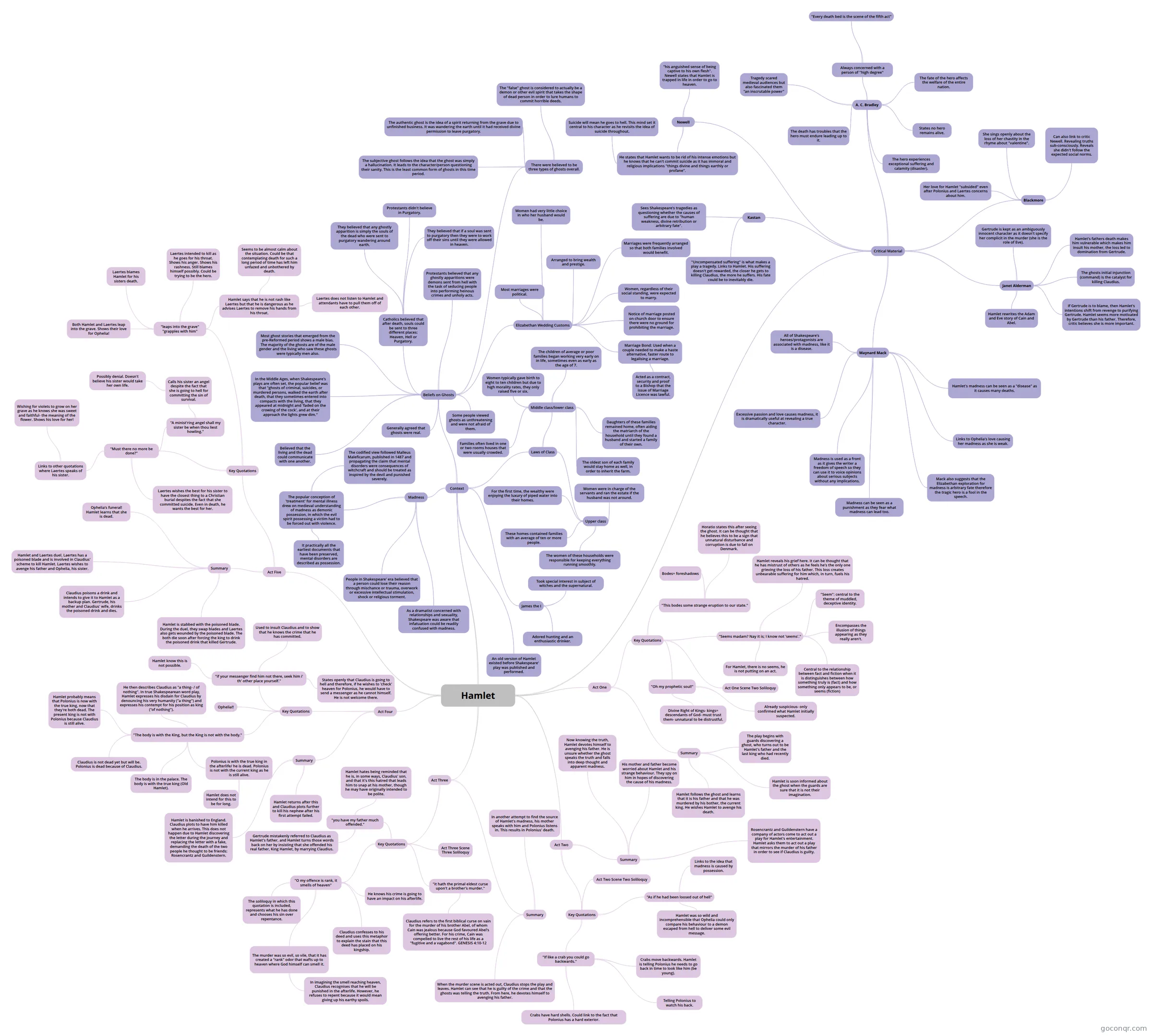
Mind map: Hamlet
Conteúdo do mapa
Hamlet
Act One
- Summary
- The play begins with guards discovering a ghost, who turns out to be Hamlet's father and the last king who had recently died.
- Hamlet follows the ghost and learns that it is his father and that he was murdered by his bother, the current king. He wishes Hamlet to avenge his death.
- Hamlet is soon informed about the ghost when the guards are sure that it is not their imagination.
- Key Quotations
- "This bodes some strange eruption to our state."
- Bodes= foreshadows
- Horatio states this after seeing the ghost. It can be thought that he believes this to be a sign that unnatural disturbance and corruption is due to fall on Denmark.
- "Seems madam? Nay it is; I know not 'seems'."
- Hamlet reveals his grief here. It can be thought that he has mistrust of others as he feels he's the only one grieving the loss of his father. This loss creates unbearable suffering for him which, in turn, fuels his hatred.
- "Seem": central to the theme of muddled, deceptive identity.
- Encompasses the illusion of things appearing as they really aren't.
- Central to the relationship between fact and fiction when it is distinguishes between how something truly is (fact) and how something only appears to be, or seems (fiction)
- For Hamlet, there is no seems, he is not putting on an act.
- Act One Scene Two Soliloquy
- "Oh my prophetic soul!"
- Already suspicious- only confirmed what Hamlet initially suspected.
- Divine Right of Kings- kings= descendants of God- must trust them- unnatural to be distrustful.
- "This bodes some strange eruption to our state."
- Summary
Act Two
- Summary
- Now knowing the truth, Hamlet devotes himself to avenging his father. He is unsure whether the ghost speaks the truth and falls into deep thought and apparent madness.
- His mother and father become worried about Hamlet and his strange behaviour. They spy on him in hopes of discovering the cause of his madness.
- Rosencrantz and Guildenstern have a company of actors come to act out a play for Hamlet's entertainment. Hamlet asks them to act out a play that mirrors the murder of his father in order to see if Claudius is guilty.
- Key Quotations
- Act Two Scene Two Soliloquy
- "As if he had been loosed out of hell"
- Hamlet was so wild and incomprehensible that Ophelia could only compare his behaviour to a demon escaped from hell to deliver some evil message.
- Links to the idea that madness is caused by possession.
- "If like a crab you could go backwards."
- Crabs move backwards. Hamlet is telling Polonius he needs to go back in time to look like him (be young).
- Telling Polonius to watch his back.
- Crabs have hard shells. Could link to the fact that Polonius has a hard exterior.
- Summary
Act Three
- Summary
- When the murder scene is acted out, Claudius stops the play and leaves. Hamlet can see that he is guilty of the crime and that the ghosts was telling the truth. From here, he devotes himself to avenging his father.
- In another attempt to find the source of Hamlet's madness, his mother speaks with him and Polonius listens in. This results in Polonius' death.
- Key Quotations
- "it hath the primal eldest curse upon't a brother's murder."
- Claudius refers to the first biblical curse on vain for the murder of his brother Abel, of whom Cain was jealous because God favoured Abel's offering better. For his crime, Cain was compelled to live the rest of his life as a "fugitive and a vagabond". GENESIS 4:10-12
- Act Three Scene Three Soliloquy
- "O my offence is rank, it smells of heaven"
- Claudius confesses to his deed and uses this metaphor to explain the stain that this deed has placed on his kingship.
- The murder was so evil, so vile, that it has created a "rank" odor that wafts up to heaven where God himself can smell it.
- In imagining the smell reaching heaven, Claudius recognises that he will be punished in the afterlife. However, he refuses to repent because it would mean giving up his earthy spoils.
- The soliloquy in which this quotation is included, represents what he has done and chooses his sin over repentance.
- He knows his crime is going to have an impact on his afterlife.
- "you have my father much offended."
- Gertrude mistakenly referred to Claudius as Hamlet's father, and Hamlet turns those words back on her by insisting that she offended his real father, King Hamlet, by marrying Claudius.
- Hamlet hates being reminded that he is, in some ways, Claudius' son, and that it's this hatred that leads him to snap at his mother, though he may have originally intended to be polite.
- "it hath the primal eldest curse upon't a brother's murder."
- Summary
Act Four
- Summary
- Hamlet is banished to England. Claudius plots to have him killed when he arrives. This does not happen due to Hamlet discovering the letter during the journey and replacing the letter with a fake, demanding the death of the two people he thought to be friends: Rosencrantz and Guildenstern.
- Hamlet returns after this and Claudius plots further to kill his nephew after his first attempt failed.
- Key Quotations
- "The body is with the King, but the King is not with the body."
- Polonius is with the true king in the afterlife/ he is dead. Polonius is not with the current king as he is still alive.
- Hamlet does not intend for this to be for long.
- The body is in the palace. The body is with the true king (Old Hamlet).
- Claudius is not dead yet but will be. Polonius is dead because of Claudius.
- Hamlet probably means that Polonius is now with the true king, now that they're both dead. The present king is not with Polonius because Claudius is still alive.
- He then describes Claudius as "a thing- / of nothing". In true Shakespearean word play, Hamlet expresses his disdain for Claudius by denouncing his very humanity ("a thing") and expresses his contempt for his position as king ("of nothing").
- Polonius is with the true king in the afterlife/ he is dead. Polonius is not with the current king as he is still alive.
- "if your messenger find him not there, seek him i' th' other place yourself."
- States openly that Claudius is going to hell and therefore, if he wishes to 'check' heaven for Polonius, he would have to send a messenger as he cannot himself. He is not welcome there.
- Hamlet know this is not possible.
- Used to insult Claudius and to show that he knows the crime that he has committed.
- Ophelia!!
- "The body is with the King, but the King is not with the body."
- Summary
Act Five
- Summary
- Ophelia's funeral! Hamlet learns that she is dead.
- Hamlet and Laertes duel. Laertes has a poisoned blade and is involved in Claudius' scheme to kill Hamlet. Laertes wishes to avenge his father and Ophelia, his sister.
- Claudius poisons a drink and intends to give it to Hamlet as a backup plan. Gertrude, his mother and Claudius' wife, drinks the poisoned drink and dies.
- Hamlet is stabbed with the poisoned blade. During the duel, they swap blades and Laertes also gets wounded by the poisoned blade. The both die soon after forcing the king to drink the poisoned drink that killed Gertrude.
- Key Quotations
- "Must there no more be done?"
- Laertes wishes the best for his sister to have the closest thing to a Christian burial despites the fact that she committed suicide. Even in death, he wants the best for her.
- Links to other quotations where Laertes speaks of his sister.
- Wishing for violets to grow on her grave as he knows she was sweet and faithful- the meaning of the flower. Shows his love for her!
- "A minist'ring angel shall my sister be when thou liest howling."
- Calls his sister an angel despite the fact that she is going to hell for committing the sin of survival.
- Possibly denial. Doesn't believe his sister would take her own life.
- Calls his sister an angel despite the fact that she is going to hell for committing the sin of survival.
- "leaps into the grave" "grapples with him"
- Both Hamlet and Laertes leap into the grave. Shows their love for Ophelia!
- Laertes blames Hamlet for his sisters death.
- Laertes intended to kill as he goes for his throat. Shows his anger. Shows his rashness. Still blames himself possibly. Could be trying to be the hero.
- Hamlet says that he is not rash like Laertes but that he is dangerous as he advises Laertes to remove his hands from his throat.
- Seems to be almost calm about the situation. Could be that contemplating death for such a long period of time has left him unfazed and unbothered by death.
- Laertes does not listen to Hamlet and attendants have to pull them off of each other.
- "Must there no more be done?"
- Summary
Context
- An old version of Hamlet existed before Shakespeare' play was published and performed.
- Madness
- As a dramatist concerned with relationships and sexuality, Shakespeare was aware that infatuation could be readily confused with madness.
- People in Shakespeare' era believed that a person could lose their reason through mischance or trauma, overwork or excessive intellectual stimulation, shock or religious torment.
- The popular conception of 'treatment' for mental illness drew on medieval understanding of madness as demonic possession, in which the evil spirit possessing a victim had to be forced out with violence.
- It practically all the earliest documents that have been preserved, mental disorders are described as possession.
- The codified view followed Malleus Maleficarum, published in 1487 and propagating the claim that mental disorders were consequences of witchcraft and should be treated as inspired by the devil and punished severely.
- Beliefs on Ghosts
- Generally agreed that ghosts were real.
- In the Middle Ages, when Shakespeare's plays are often set, the popular belief was that "ghosts of criminal, suicides, or murdered persons, walked the earth after death, that they sometimes entered into compacts with the living, that they appeared at midnight and 'faded on the crowing of the cock', and at their approach the lights grew dim."
- Believed that the living and the dead could communicate with one another.
- Most ghost stories that emerged from the pre-Reformed period shows a male bias. The majority of the ghosts are of the male gender and the living who saw these ghosts were typically men also.
- Catholics believed that after death, souls could be sent to three different places: Heaven, Hell or Purgatory.
- They believed that if a soul was sent to purgatory then they were to work off their sins until they were allowed in heaven.
- They believed that any ghostly apparition is simply the souls of the dead who were sent to purgatory wandering around earth.
- Protestants didn't believe in Purgatory.
- Protestants believed that any ghostly apparitions were demons sent from hell with the task of seducing people into performing heinous crimes and unholy acts.
- Some people viewed ghosts as unthreatening and were not afraid of them.
- There were believed to be three types of ghosts overall.
- The subjective ghost follows the idea that the ghost was simply a hallucination. It leads to the character/person questioning their sanity. This is the least common form of ghosts in this time period.
- The authentic ghost is the idea of a spirit returning from the grave due to unfinished business. It was wandering the earth until it had received divine permission to leave purgatory.
- The "false" ghost is considered to actually be a demon or other evil spirit that takes the shape of dead person in order to lure humans to commit horrible deeds.
- Elizabethan Wedding Customs
- Women had very little choice in who her husband would be.
- Marriages were frequently arranged so that both families involved would benefit.
- Arranged to bring wealth and prestige.
- Women, regardless of their social standing, were expected to marry.
- Most marriages were political.
- Notice of marriage posted on church door to ensure there were no ground for prohibiting the marriage.
- Marriage Bond: Used when a couple needed to make a haste alternative, faster route to legalising a marriage.
- Acted as a contract, security and proof to a Bishop that the issue of Marriage Licence was lawful.
- Laws of Class
- Middle class/lower class
- Families often lived in one or two rooms houses that were usually crowded.
- Women typically gave birth to eight to ten children but due to high morality rates, they only raised five or six.
- The children of average or poor families began working very early on in life, sometimes even as early as the age of 7.
- Daughters of these families remained home, often aiding the matriarch of the household until they found a husband and started a family of their own.
- The oldest son of each family would stay home as well, in order to inherit the farm.
- Upper class
- For the first time, the wealthy were enjoying the luxury of piped water into their homes.
- These homes contained families with an average of ten or more people.
- The women of these households were responsible for keeping everything running smoothly.
- Women were in charge of the servants and ran the estate if the husband was not around.
- Middle class/lower class
- James the I
- Adored hunting and an enthusiastic drinker.
- Took special interest in subject of witches and the supernatural.
Critical Material
- Kastan
- Sees Shakespeare's tragedies as questioning whether the causes of suffering are due to "human weakness, divine retribution or arbitrary fate".
- "Uncompensated suffering" is what makes a play a tragedy. Links to Hamlet. His suffering doesn't get rewarded, the closer he gets to killing Claudius, the more he suffers. His fate could be to inevitably die.
- Newell
- He states that Hamlet wants to be rid of his intense emotions but he knows that he can't commit suicide as it has immoral and religious implications "things divine and things earthly or profane".
- Suicide will mean he goes to hell. This mind set it central to his character as he revisits the idea of suicide throughout.
- "his anguished sense of being captive to his own flesh". Newell states that Hamlet is trapped in life in order to go to heaven.
- He states that Hamlet wants to be rid of his intense emotions but he knows that he can't commit suicide as it has immoral and religious implications "things divine and things earthly or profane".
- A. C. Bradley
- States no hero remains alive.
- The hero experiences exceptional suffering and calamity (disaster).
- The death has troubles that the hero must endure leading up to it.
- Tragedy scared medieval audiences but also fascinated them "an inscrutable power"
- Always concerned with a person of "high degree"
- "Every death bed is the scene of the fifth act"
- The fate of the hero affects the welfare of the entire nation.
- Blackmore
- Her love for Hamlet "subsided" even after Polonius and Laertes concerns about him.
- She sings openly about the loss of her chastity in the rhyme about "valentine".
- Can also link to critic Newell. Revealing truths sub-consciously. Reveals she didn't follow the expected social norms.
- Maynard Mack
- All of Shakespeare's heroes/protagonists are associated with madness, like it is a disease.
- Excessive passion and love causes madness, it is dramatically useful at revealing a true character.
- Madness is used as a front as it gives the writer a freedom of speech so they can use it to voice opinions about serious subjects without any implications.
- Madness can be seen as a punishment as they fear what madness can lead too.
- Mack also suggests that the Elizabethan exploration for madness is arbitrary fate therefore the tragic hero is a fool in the speech.
- Links to Ophelia's love causing her madness as she is weak.
- Hamlet's madness can be seen as a "disease" as it causes many deaths.
- Janet Alderman
- Gertrude is kept as an ambiguously innocent character as it doesn't specify her complicit in the murder (she is the role of Eve).
- Hamlet's fathers death makes him vulnerable which makes him insult his mother, the loss led to domination from Gertrude.
- The ghosts initial injunction (command) is the catalyst for killing Claudius.
- If Gertrude is to blame, then Hamlet's intentions shift from revenge to purifying Gertrude. Hamlet seems more motivated by Gertrude than his father. Therefore, critic believes she is more important.
- Hamlet rewrites the Adam and Eve story of Cain and Abel.
- Kastan
Informações
- Descrição
- A level English Literature (Hamlet) Mapa Mental sobre Hamlet, criado por Amy Johnson em 28-01-2021.
- Criado por
- Amy Johnson
- Visualizações
- 0
- Avaliação