
Mapa mental
Deviance
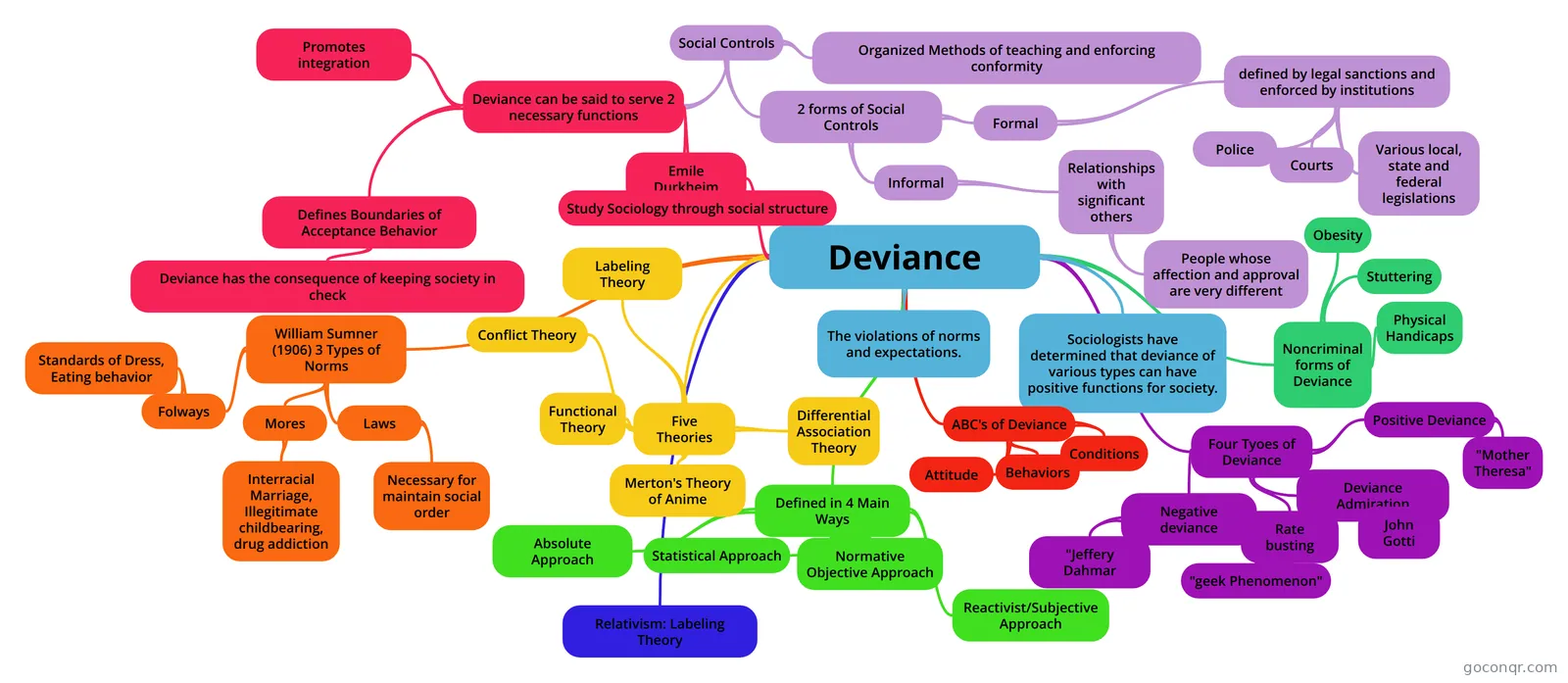
Mind map: Deviance in sociology
Conteúdo do mapa
Deviance
The violations of norms and expectations.
Sociologists have determined that deviance of various types can have positive functions for society.
Emile Durkheim
- Study Sociology through social structure
- Deviance can be said to serve 2 necessary functions
- Defines Boundaries of Acceptance Behavior
- Deviance has the consequence of keeping society in check
- Promotes integration
- Social Controls
- Organized Methods of teaching and enforcing conformity
- 2 forms of Social Controls
- Informal
- Relationships with significant others
- People whose affection and approval are very different
- Relationships with significant others
- Formal
- defined by legal sanctions and enforced by institutions
- Police
- Courts
- Various local, state and federal legislations
- defined by legal sanctions and enforced by institutions
- Informal
- Defines Boundaries of Acceptance Behavior
Five Theories
- Conflict Theory
- Functional Theory
- Labeling Theory
- Differential Association Theory
- Merton's Theory of Anime
ABC's of Deviance
- Attitude
- Behaviors
- Conditions
Noncriminal forms of Deviance
- Obesity
- Stuttering
- Physical Handicaps
William Sumner (1906) 3 Types of Norms
- Folways
- Standards of Dress, Eating behavior
- Mores
- Interracial Marriage, Illegitimate childbearing, drug addiction
- Laws
- Necessary for maintain social order
- Folways
Four Tyoes of Deviance
- Negative deviance
- "Jeffery Dahmar
- Rate busting
- "geek Phenomenon"
- Deviance Admiration
- John Gotti
- Positive Deviance
- "Mother Theresa"
- Negative deviance
Defined in 4 Main Ways
- Absolute Approach
- Statistical Approach
- Normative Objective Approach
- Reactivist/Subjective Approach
Relativism: Labeling Theory