
Mapa mental
The Periodic Table
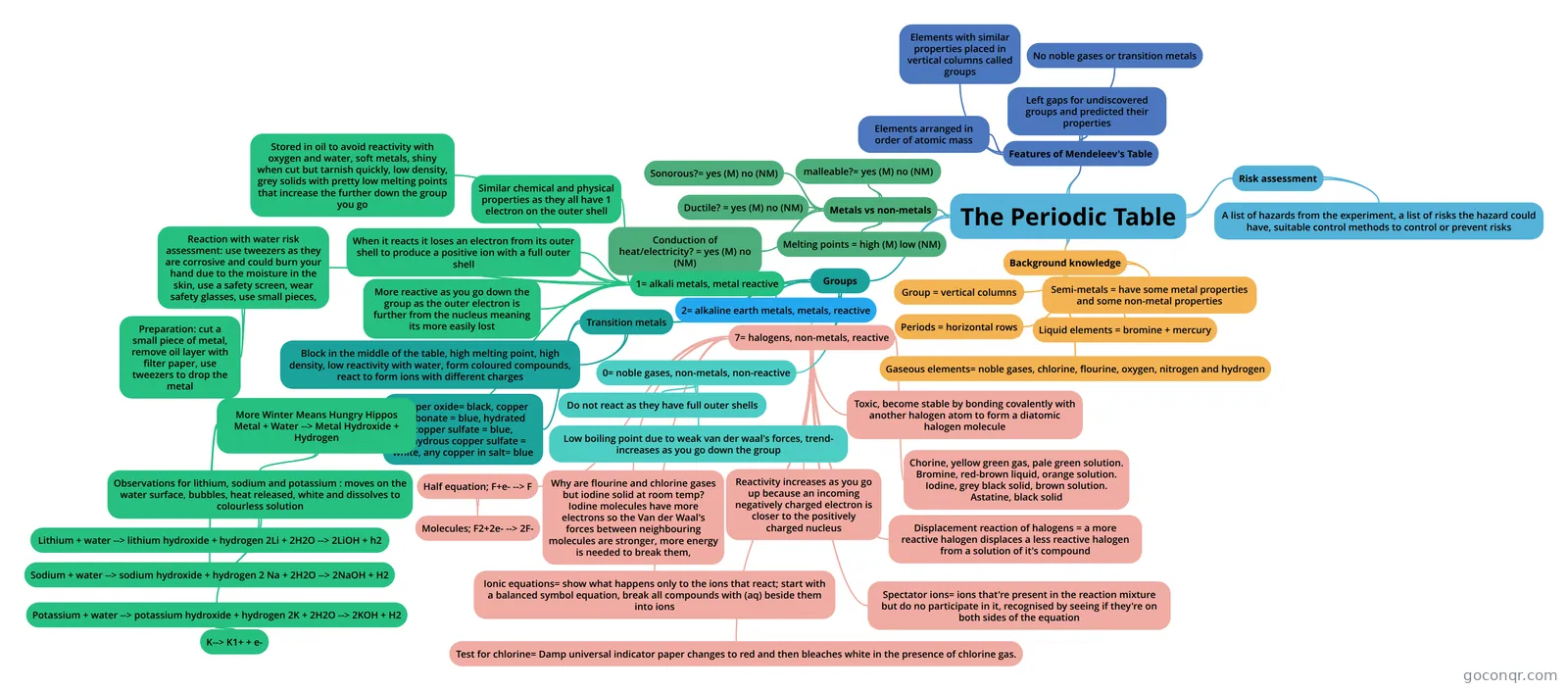
Mind map: The periodic table
Conteúdo do mapa
The Periodic Table
Features of Mendeleev's Table
- Elements arranged in order of atomic mass
- Elements with similar properties placed in vertical columns called groups
- Left gaps for undiscovered groups and predicted their properties
- No noble gases or transition metals
Background knowledge
- Group = vertical columns
- Periods = horizontal rows
- Liquid elements = bromine + mercury
- Semi-metals = have some metal properties and some non-metal properties
- Gaseous elements= noble gases, chlorine, flourine, oxygen, nitrogen and hydrogen
Metals vs non-metals
- Melting points = high (M) low (NM)
- malleable?= yes (M) no (NM)
- Ductile? = yes (M) no (NM)
- Sonorous?= yes (M) no (NM)
- Conduction of heat/electricity? = yes (M) no (NM)
Groups
- 1= alkali metals, metal reactive
- Similar chemical and physical properties as they all have 1 electron on the outer shell
- When it reacts it loses an electron from its outer shell to produce a positive ion with a full outer shell
- More reactive as you go down the group as the outer electron is further from the nucleus meaning its more easily lost
- Stored in oil to avoid reactivity with oxygen and water, soft metals, shiny when cut but tarnish quickly, low density, grey solids with pretty low melting points that increase the further down the group you go
- Reaction with water risk assessment: use tweezers as they are corrosive and could burn your hand due to the moisture in the skin, use a safety screen, wear safety glasses, use small pieces,
- Preparation: cut a small piece of metal, remove oil layer with filter paper, use tweezers to drop the metal
- More Winter Means Hungry Hippos Metal + Water --> Metal Hydroxide + Hydrogen
- Observations for lithium, sodium and potassium : moves on the water surface, bubbles, heat released, white and dissolves to colourless solution
- Potassium + water --> potassium hydroxide + hydrogen 2K + 2H2O --> 2KOH + H2
- K--> K1+ + e-
- Potassium + water --> potassium hydroxide + hydrogen 2K + 2H2O --> 2KOH + H2
- Lithium + water --> lithium hydroxide + hydrogen 2Li + 2H2O --> 2LiOH + h2
- Sodium + water --> sodium hydroxide + hydrogen 2 Na + 2H2O --> 2NaOH + H2
- Observations for lithium, sodium and potassium : moves on the water surface, bubbles, heat released, white and dissolves to colourless solution
- 2= alkaline earth metals, metals, reactive
- 7= halogens, non-metals, reactive
- Toxic, become stable by bonding covalently with another halogen atom to form a diatomic halogen molecule
- Chorine, yellow green gas, pale green solution. Bromine, red-brown liquid, orange solution. Iodine, grey black solid, brown solution. Astatine, black solid
- Reactivity increases as you go up because an incoming negatively charged electron is closer to the positively charged nucleus
- Why are flourine and chlorine gases but iodine solid at room temp? Iodine molecules have more electrons so the Van der Waal's forces between neighbouring molecules are stronger, more energy is needed to break them,
- Half equation; F+e- --> F
- Molecules; F2+2e- --> 2F-
- Displacement reaction of halogens = a more reactive halogen displaces a less reactive halogen from a solution of it's compound
- Ionic equations= show what happens only to the ions that react; start with a balanced symbol equation, break all compounds with (aq) beside them into ions
- Spectator ions= ions that're present in the reaction mixture but do no participate in it, recognised by seeing if they're on both sides of the equation
- Test for chlorine= Damp universal indicator paper changes to red and then bleaches white in the presence of chlorine gas.
- 0= noble gases, non-metals, non-reactive
- Do not react as they have full outer shells
- Low boiling point due to weak van der waal's forces, trend- increases as you go down the group
- Transition metals
- Block in the middle of the table, high melting point, high density, low reactivity with water, form coloured compounds, react to form ions with different charges
- Copper oxide= black, copper carbonate = blue, hydrated copper sulfate = blue, anhydrous copper sulfate = white, any copper in salt= blue
- 1= alkali metals, metal reactive
Risk assessment
- A list of hazards from the experiment, a list of risks the hazard could have, suitable control methods to control or prevent risks
Informações
- Descrição
- Displacement reactions of halogens experiment not included
- Criado por
- Elana McGrogan
- Visualizações
- 7
- Avaliação