
Mapa mental
Electron Transport Chain and Oxidative Phosphorylation
Conteúdo do mapa
Electron Transport Chain and Oxidative Phosphorylation
Happens at inner mitochondrial membrane
Chemiosmotic Theory
- Utilizing proton gradient to synthesize ATP
Carbohydrates, lipids, and amino acids are reduced fuels for the cell, electrons from these are transferred to NAD+ or FAD to make NADH and FADH2, these can then be used in oxidative phosphorylation to make ATP
DG = -nFE
- High E indicates a strong tendency to be reduced
- Electrons are donated by the half reaction with the more negative E and accepted by the reaction with the more positive E
- High E indicates a strong tendency to be reduced
Electron Transport Chain
- Four protein complexes in the inner mitochondrial membrane
- Lipid soluble coenzyme (CoQ) and water soluble protein (cyt c) shuttle between protein complexes
- Electrons fall in energy from Complexes I and II to Complex IV
- Complexes
- Each contains multiple redox centers consisting of Flavin mononucleotide (FMN) or Flavin Adenine Dinucleotide (FAD)
- Initial electron acceptors for Complex I and II
- Can carry two electrons by transferring at a time
- Cytochromes a, b, or c
- Iron-sulfur cluster
- Complex I
- NADH-CoQ Oxidoreductase
- Electron transfer from NADH to Q
- Electron Path: NADH --> FMN --> FeS --> Q --> FeS --> Q
- 4 H+ transported out per 2 e-
- Coenzyme Q (Ubiquinone)
- Lipid soluble conjugated dicarbonyl
- Accepts two electrons, picks up two protons to give an alcohol ubiquinol
- Ubiquinol can freely diffuse in the membrane, carrying electrons with protons from one side to the other
- Iron Sulfur Clusters
- One electron carriers
- Coordinated by cysteines in protein
- Contain equal number of Fe and S atoms
- Complex II
- Aka: Succinate-CoQ Oxidoreductase, succinate dehydrogenase, flavoprotein 2
- Three types of FeS clusters (4Fe-4S, 3Fe-4S, 2Fe-2S)
- Electron Path: succinate --> FAD --> Fe3+ --> Q
- Complex III
- CoQ-Cytochrome c Oxidoreductase
- CoQ passes electrons to cyt c and pumps H+ in a redox cycle known as the Q cycle
- The main transmembrane protein in Complex III is the by cytochrome
- Cytochromes are one-electron transfer units
- Complex IV
- Electrons crom cyt c are used in a four electron reduction of O2 to form H2O
- Oxygen is the terminal electron acceptor in the electron transport chain
- Each contains multiple redox centers consisting of Flavin mononucleotide (FMN) or Flavin Adenine Dinucleotide (FAD)
Oxidative Phosphorylation
- Proton gradient is established across the cristae membrane in mitochondria
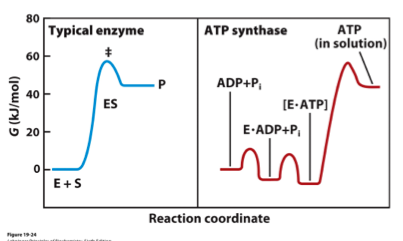
- ATP Synthase
- Made of two complexes, F1(matrix) and F0 (inner membrane), both of which have subunits
- Alternating alpha and beta subunits in F1
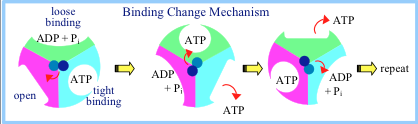
- Conformation of beta subunit changes between three different conformations, open, loose (ADP + Pi) and tight (ATP)
- Takes a lot of energy to release ATP from tight binding
- Conformation of beta subunit changes between three different conformations, open, loose (ADP + Pi) and tight (ATP)
- Gamma structure rotates
- Inhibition
- Rotenone inhibits Complex I, cyanide, azide, and CO inhibit complex IV, and oligomycin and DCCD inhibit ATP synthase
- Uncouplers
- Disrupt tight coupling between ETC and OP by dissipating proton gradient
- Hydrophoobic molecules with a dissociable proton that shuttle across the membrane carrying protons
- ATP-ADP Translocase
- Moves ATP out of the of the mitochondria at the cost of 1 H+ each
- Regulation
- Lack of work means lack of demand for ATP
- Oxidative phosphorylation is driven not by supply of fuel but by demand for energy
- P/O Ratio
- 2.5 for NADH electrons
- 1.5 for FADH2 electrons
Imagens e arquivos do mapa
Informações
- Descrição
- Description of process of the electron transport chain, oxidative phosphorylation and the function of ATP synthase
- Criado por
- Sarah Emslie
- Visualizações
- 431
- Tags
- Avaliação