
Mapa mental
Cloning
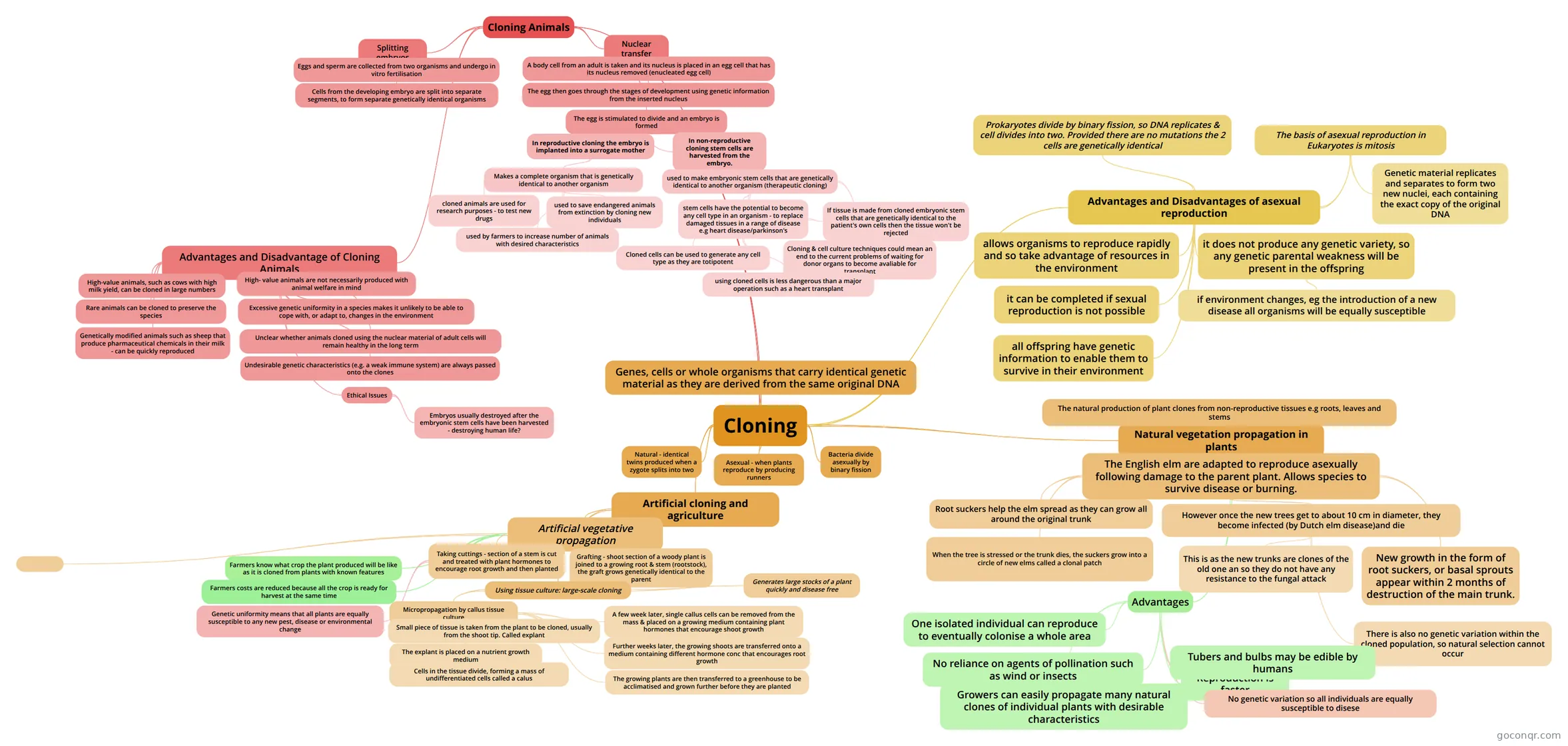
Mind map: Cloning in biology
Conteúdo do mapa
Cloning
Genes, cells or whole organisms that carry identical genetic material as they are derived from the same original DNA
Natural - identical twins produced when a zygote splits into two
Asexual - when plants reproduce by producing runners
Bacteria divide asexually by binary fission
Advantages and Disadvantages of asexual reproduction
- allows organisms to reproduce rapidly and so take advantage of resources in the environment
- Prokaryotes divide by binary fission, so DNA replicates & cell divides into two. Provided there are no mutations the 2 cells are genetically identical
- The basis of asexual reproduction in Eukaryotes is mitosis
- Genetic material replicates and separates to form two new nuclei, each containing the exact copy of the original DNA
- it can be completed if sexual reproduction is not possible
- all offspring have genetic information to enable them to survive in their environment
- it does not produce any genetic variety, so any genetic parental weakness will be present in the offspring
- if environment changes, eg the introduction of a new disease all organisms will be equally susceptible
Natural vegetation propagation in plants
- The natural production of plant clones from non-reproductive tissues e.g roots, leaves and stems
- The English elm are adapted to reproduce asexually following damage to the parent plant. Allows species to survive disease or burning.
- New growth in the form of root suckers, or basal sprouts appear within 2 months of destruction of the main trunk.
- Root suckers help the elm spread as they can grow all around the original trunk
- When the tree is stressed or the trunk dies, the suckers grow into a circle of new elms called a clonal patch
- However once the new trees get to about 10 cm in diameter, they become infected (by Dutch elm disease)and die
- This is as the new trunks are clones of the old one an so they do not have any resistance to the fungal attack
- There is also no genetic variation within the cloned population, so natural selection cannot occur
- Advantages
- One isolated individual can reproduce to eventually colonise a whole area
- No reliance on agents of pollination such as wind or insects
- Reproduction is faster
- No genetic variation so all individuals are equally susceptible to disese
- Tubers and bulbs may be edible by humans
- Growers can easily propagate many natural clones of individual plants with desirable characteristics
Artificial cloning and agriculture
- Artificial vegetative propagation
- Taking cuttings - section of a stem is cut and treated with plant hormones to encourage root growth and then planted
- Genetic uniformity means that all plants are equally susceptible to any new pest, disease or environmental change
- Grafting - shoot section of a woody plant is joined to a growing root & stem (rootstock), the graft grows genetically identical to the parent
- Farmers know what crop the plant produced will be like as it is cloned from plants with known features
- Farmers costs are reduced because all the crop is ready for harvest at the same time
- Taking cuttings - section of a stem is cut and treated with plant hormones to encourage root growth and then planted
- Using tissue culture: large-scale cloning
- Generates large stocks of a plant quickly and disease free
- Micropropagation by callus tissue culture
- Small piece of tissue is taken from the plant to be cloned, usually from the shoot tip. Called explant
- The explant is placed on a nutrient growth medium
- Cells in the tissue divide, forming a mass of undifferentiated cells called a calus
- A few week later, single callus cells can be removed from the mass & placed on a growing medium containing plant hormones that encourage shoot growth
- Further weeks later, the growing shoots are transferred onto a medium containing different hormone conc that encourages root growth
- The growing plants are then transferred to a greenhouse to be acclimatised and grown further before they are planted
- Artificial vegetative propagation
Cloning Animals
- Splitting embryos
- Eggs and sperm are collected from two organisms and undergo in vitro fertilisation
- Cells from the developing embryo are split into separate segments, to form separate genetically identical organisms
- Nuclear transfer
- A body cell from an adult is taken and its nucleus is placed in an egg cell that has its nucleus removed (enucleated egg cell)
- The egg then goes through the stages of development using genetic information from the inserted nucleus
- The egg is stimulated to divide and an embryo is formed
- In non-reproductive cloning stem cells are harvested from the embryo.
- used to make embryonic stem cells that are genetically identical to another organism (therapeutic cloning)
- stem cells have the potential to become any cell type in an organism - to replace damaged tissues in a range of disease e.g heart disease/parkinson's
- If tissue is made from cloned embryonic stem cells that are genetically identical to the patient's own cells then the tissue won't be rejected
- using cloned cells is less dangerous than a major operation such as a heart transplant
- Cloning & cell culture techniques could mean an end to the current problems of waiting for donor organs to become avaliable for transplant
- Cloned cells can be used to generate any cell type as they are totipotent
- stem cells have the potential to become any cell type in an organism - to replace damaged tissues in a range of disease e.g heart disease/parkinson's
- used to make embryonic stem cells that are genetically identical to another organism (therapeutic cloning)
- In reproductive cloning the embryo is implanted into a surrogate mother
- Makes a complete organism that is genetically identical to another organism
- cloned animals are used for research purposes - to test new drugs
- used to save endangered animals from extinction by cloning new individuals
- used by farmers to increase number of animals with desired characteristics
- Makes a complete organism that is genetically identical to another organism
- In non-reproductive cloning stem cells are harvested from the embryo.
- Advantages and Disadvantage of Cloning Animals
- High-value animals, such as cows with high milk yield, can be cloned in large numbers
- Rare animals can be cloned to preserve the species
- Genetically modified animals such as sheep that produce pharmaceutical chemicals in their milk - can be quickly reproduced
- High- value animals are not necessarily produced with animal welfare in mind
- Excessive genetic uniformity in a species makes it unlikely to be able to cope with, or adapt to, changes in the environment
- Unclear whether animals cloned using the nuclear material of adult cells will remain healthy in the long term
- Undesirable genetic characteristics (e.g. a weak immune system) are always passed onto the clones
- Ethical Issues
- Embryos usually destroyed after the embryonic stem cells have been harvested - destroying human life?
- Splitting embryos
Informações
- Descrição
- Biology Mapa Mental sobre Cloning, criado por sophie.mesquita em 12-04-2013.
- Criado por
- sophie.mesquita
- Visualizações
- 453
- Tags
- Avaliação