
Mapa mental
ِA5 Nuts & Bolts
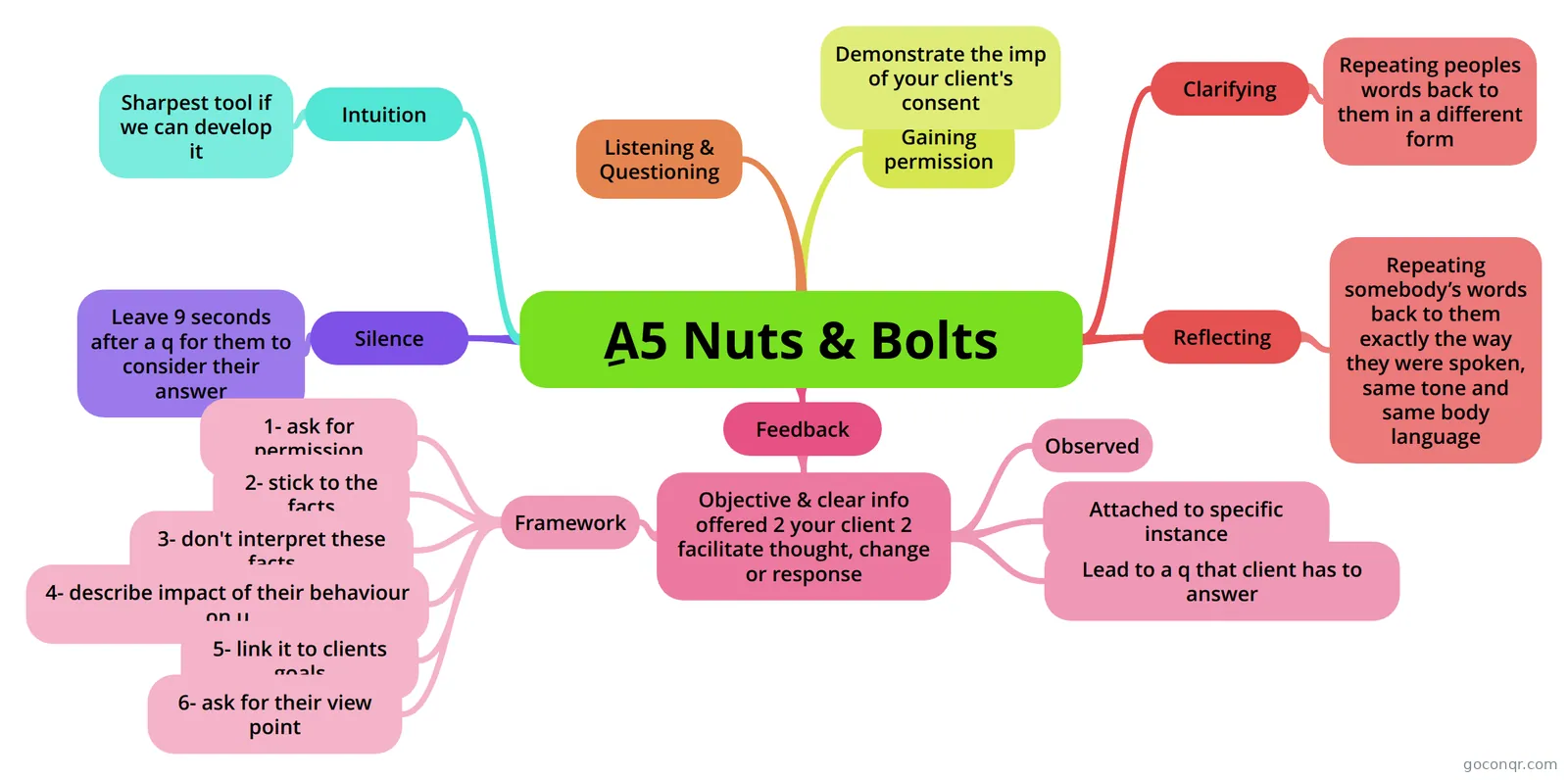
Mind map: A5 nuts and bolts coaching skills
Conteúdo do mapa
ِA5 Nuts & Bolts
Listening & Questioning
- https://my.examtime.com/en-US/p/41621-UNIT 3 CRUCIAL COACHING SKILLS
Clarifying
- The other side of the same coin that has reflecting on it to confirm we heard correctly and that we understood. it creates rapport with people shows that we r making ever effort to listen, understand and speak thoughts aloud, politely moving people along if saying too much details or got stuck. to stop making excuses, to stop rambling and go on/move fwd..
- Repeating peoples words back to them in a different form
Reflecting
- but be cautious it cant appear to b mechanical don’t parrot it back it will be so irritating so be cautious. -it validates and reassures that listener is interested -useful to move foreword -when in doubt what q to ask, reflect back the words. -the client knows that they have been heard so dont need to give more details -it’s a great rapport builder.
- Repeating somebody’s words back to them exactly the way they were spoken, same tone and same body language
Intuition
- however we have to turn to the maxim of committing to the clients agenda and not to be judgmental. make sure that it doesn't turn to unwelcome advice always act carefully on ur intuition. if client doesnt seen to relate to your hunch, its ok, let it go, move fwd, stay in the moment, don't be afraid to challenge ur client in order to uncover new insights.
- Sharpest tool if we can develop it
Silence
- not natural these days but incredibly useful tool a- allows fr thinking time...client to answer in their own thoughts, any interruption will be diverting -don't feel the need to break your clients silence leave 9 seconds after a q for them to consider their answer, silence is intrinsic tool for coaching, don’t break silence by suggesting an answer or asking a diff q before 9 secs be patient b- allows for reflection reflection: can bring out some emotional memories. allow silence initially but if it increases, ask the client what’s the sticking point but allow it initially.
- Leave 9 seconds after a q for them to consider their answer
Gaining permission
- to say or to ask something can help build a rapport by demonstrating the imp of your clients consent, helps them feel safe, in control, be prepared to proceed, creates a powerful anchor for the client to stop and listen carefully ex: ‘listen , can i challenge u on that statement?’ ‘can i ask u to clarify what u mean by that'?’ would it be ok 4 me to give u some feedback on some points/ makes the client feel they have a choice/ the right to say no
- Demonstrate the imp of your client's consent
Feedback
- Objective & clear info offered 2 your client 2 facilitate thought, change or response
- ‘can i stop u for a min, when u talked about you boss there and a couple of times previously, u shook ur head slightly, what do u think the meaning of this?’ ‘well, yeah i guess so and i didn't realize. maybe i find it pretty frustrating and its getting to me.’ - it brings the client to a reason.. raw material 2 help them move in to change and bring in a positive response - poor feedback wont hurt but if its very frequent.. affects rapport and makes client fed up
- Observed
- Attached to specific instance
- Lead to a q that client has to answer
- Framework
- 1- ask for permission
- 2- stick to the facts
- not opinions only state what u see, observable facts
- 3- don't interpret these facts
- most of ur interpretations at best not quiet right at worst completely wrong
- 4- describe impact of their behaviour on u
- ur not giving anything as a definitive explanation ‘when u shook your head slightly i felt its kind of difficult for u’ this is diff from interpretation, ur not offering any judgment from your side its only a feeling u had. don't say ‘ i felt u have problem with ur boss’ this is interpretation.
- 5- link it to clients goals
- to make feedback focused on goals to make client interested in listening to your feedback
- 6- ask for their view point
- very imp,, to make client respond to how ur observation to their coaching goal. ‘what r ur thoughts on that?’
- Objective & clear info offered 2 your client 2 facilitate thought, change or response
Informações
- Descrição
- Coaching (Audio Sessions) Mapa Mental sobre ِA5 Nuts & Bolts, criado por Yomna em 12-04-2013.
- Criado por
- Yomna
- Visualizações
- 101
- Tags
- Avaliação