
Mapa mental
Gothic
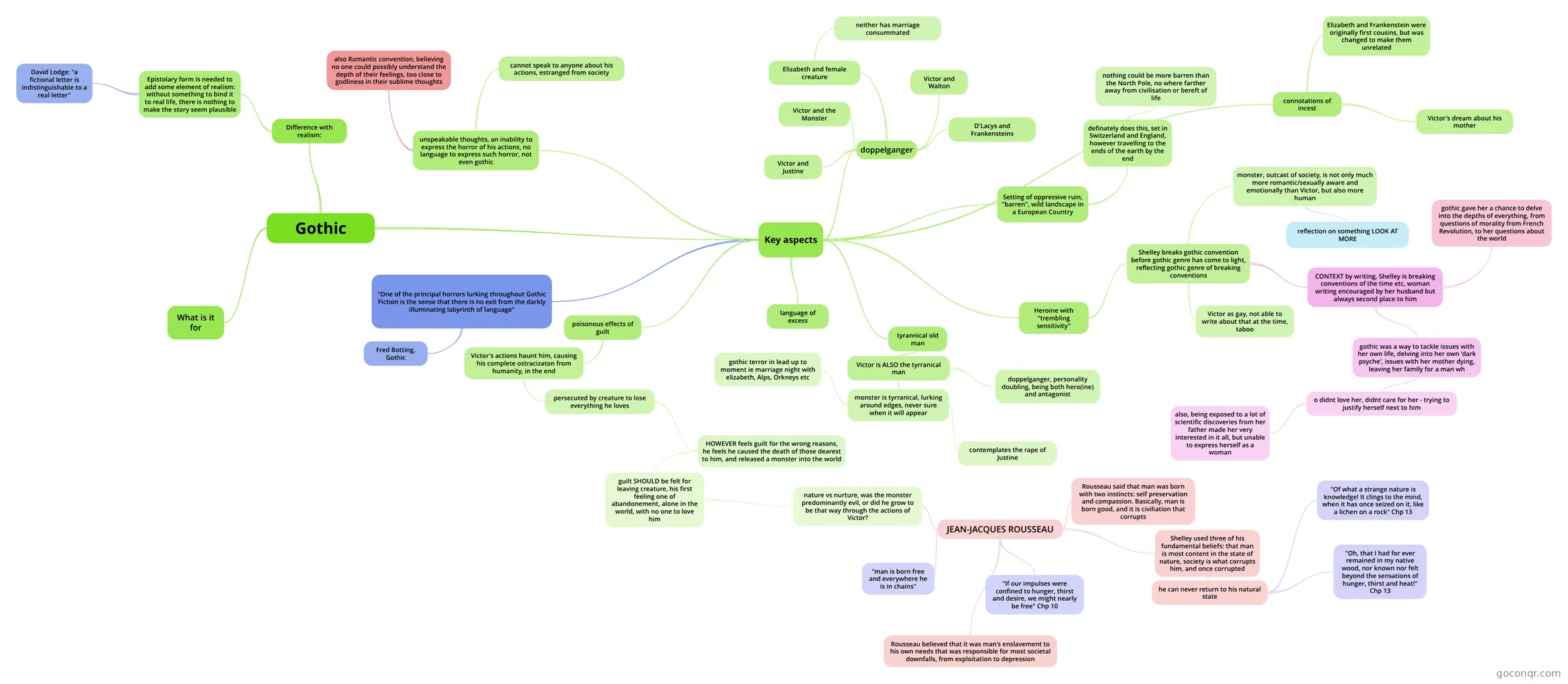
Mind map: Gothic fiction
Conteúdo do mapa
Gothic
Difference with realism:
- Epistolary form is needed to add some element of realism: without something to bind it to real life, there is nothing to make the story seem plausible
- David Lodge: "a fictional letter is indistinguishable to a real letter"
- Epistolary form is needed to add some element of realism: without something to bind it to real life, there is nothing to make the story seem plausible
What is it for
Key aspects
- Setting of oppressive ruin, "barren", wild landscape in a European Country
- definately does this, set in Switzerland and England, however travelling to the ends of the earth by the end
- nothing could be more barren than the North Pole, no where farther away from civilisation or bereft of life
- definately does this, set in Switzerland and England, however travelling to the ends of the earth by the end
- Heroine with "trembling sensitivity"
- Shelley breaks gothic convention before gothic genre has come to light, reflecting gothic genre of breaking conventions
- Victor as gay, not able to write about that at the time, taboo
- monster, outcast of society, is not only much more romantic/sexually aware and emotionally than Victor, but also more human
- reflection on something LOOK AT MORE
- CONTEXT by writing, Shelley is breaking conventions of the time etc, woman writing encouraged by her husband but always second place to him
- gothic was a way to tackle issues with her own life, delving into her own 'dark psyche', issues with her mother dying, leaving her family for a man wh
- o didnt love her, didnt care for her - trying to justify herself next to him
- also, being exposed to a lot of scientific discoveries from her father made her very interested in it all, but unable to express herself as a woman
- o didnt love her, didnt care for her - trying to justify herself next to him
- gothic gave her a chance to delve into the depths of everything, from questions of morality from French Revolution, to her questions about the world
- gothic was a way to tackle issues with her own life, delving into her own 'dark psyche', issues with her mother dying, leaving her family for a man wh
- Shelley breaks gothic convention before gothic genre has come to light, reflecting gothic genre of breaking conventions
- tyrannical old man
- Victor is ALSO the tyrranical man
- doppelganger, personality doubling, being both hero(ine) and antagonist
- monster is tyrranical, lurking around edges, never sure when it will appear
- gothic terror in lead up to moment ie marriage night with elizabeth, Alps, Orkneys etc
- contemplates the rape of Justine
- Victor is ALSO the tyrranical man
- doppelganger
- Victor and the Monster
- Victor and Walton
- Victor and Justine
- D'Lacys and Frankensteins
- Elizabeth and female creature
- neither has marriage consummated
- connotations of incest
- Elizabeth and Frankenstein were originally first cousins, but was changed to make them unrelated
- Victor's dream about his mother
- poisonous effects of guilt
- Victor's actions haunt him, causing his complete ostracizaton from humanity, in the end
- persecuted by creature to lose everything he loves
- HOWEVER feels guilt for the wrong reasons, he feels he caused the death of those dearest to him, and released a monster into the world
- guilt SHOULD be felt for leaving creature, his first feeling one of abandonement, alone in the world, with no one to love him
- nature vs nurture, was the monster predominantly evil, or did he grow to be that way through the actions of Victor?
- JEAN-JACQUES ROUSSEAU
- "man is born free and everywhere he is in chains"
- Rousseau said that man was born with two instincts: self preservation and compassion. Basically, man is born good, and it is civiliation that corrupts
- "If our impulses were confined to hunger, thirst and desire, we might nearly be free" Chp 10
- Shelley used three of his fundamental beliefs: that man is most content in the state of nature, society is what corrupts him, and once corrupted
- he can never return to his natural state
- "Oh, that I had for ever remained in my native wood, nor known nor felt beyond the sensations of hunger, thirst and heat!" Chp 13
- "Of what a strange nature is knowledge! It clings to the mind, when it has once seized on it, like a lichen on a rock" Chp 13
- he can never return to his natural state
- Rousseau believed that it was man's enslavement to his own needs that was responsible for most societal downfalls, from exploitation to depression
- JEAN-JACQUES ROUSSEAU
- nature vs nurture, was the monster predominantly evil, or did he grow to be that way through the actions of Victor?
- guilt SHOULD be felt for leaving creature, his first feeling one of abandonement, alone in the world, with no one to love him
- HOWEVER feels guilt for the wrong reasons, he feels he caused the death of those dearest to him, and released a monster into the world
- persecuted by creature to lose everything he loves
- Victor's actions haunt him, causing his complete ostracizaton from humanity, in the end
- unspeakable thoughts, an inability to express the horror of his actions, no language to express such horror, not even gothic
- cannot speak to anyone about his actions, estranged from society
- also Romantic convention, believing no one could possibly understand the depth of their feelings, too close to godliness in their sublime thoughts
- language of excess
- "One of the principal horrors lurking throughout Gothic Fiction is the sense that there is no exit from the darkly illuminating labyrinth of language"
- Fred Botting, Gothic
- Setting of oppressive ruin, "barren", wild landscape in a European Country
Informações
- Descrição
- Frankenstein Mapa Mental sobre Gothic, criado por bookluvr em 22-04-2013.
- Criado por
- bookluvr
- Visualizações
- 358
- Tags
- Avaliação