
Mapa mental
Population Change
Conteúdo do mapa
Population Change
World Population
- Population is the number of people in a given area, location or space.
- World population has exponentially increased. In 1804, the world's population hit 1 billion. Just 100 years later, in 1927, it hit 2 billion. Then in 1959, it was 3 billion, in 1974 it was 4 billion, and so on until 2016, where it hit 7.4 billion.
- The world population will soon level off, due to less population growth...
Population Growth
- Natural Increase is when the birthrate is higher than the deathrate.
- Natural Decrease is when the birthrate is lower than the deathrate.
- Immigrants enter the country and increase the national population.
- Emigrants leave the country and decrease the national population
- Urbanisation decreases population growth as less children are needed in the city as one adult can work and provide enough money to allow his family to survive.
- For example, the movement of people from the countryside of Kenya to Nairobi means that less children will be needed to work, and so the population growth will slow down.
- Advanced agricultural and industrial technology decreases population growth as less children are needed to work in the fields and factories.
- The people of the Baka tribe have only just developed farming, and so will need more children to work the farms. As their technology grows, less and less children will be needed.
- Education decreases the population growth as parents will have less children to give them all the opportunity to go to school, as school fees can be expensive.
- Emancipation of women decreases the population growth, as when women are given jobs, they have less time for raising a family and so will refrain from having many children.
- In Japan, everyone, including the women, is career minded. There is less time to raise children, and some may have no children at all, decreasing the birth rate.
- Natural Change is the difference between the deathrate and the birthrate.
- Zero Growth is when the population stagnates.
The Demographic Transition Model
- Holy hell, you CAN get images on this.
- I'm not gonna re-do the others, though.
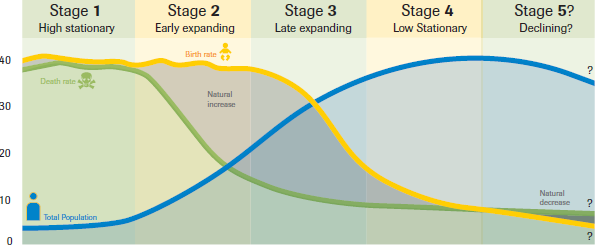
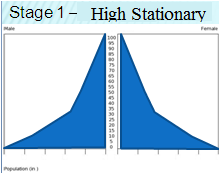
- Stage 1 is High Stationary- lots of people are born- due to lack of contraceptives, need for children for farming, etc- and lots of people die- due to lack of medicine and hospitals, and warring, etc. Many remote tribes are in this zone. As such, the total population stays low.
- Stage 2 is Early Expanding- there are still plenty of people being born, as they need farmers, but less are dying, due to drinking water improvements and basic hospitals. Some LEDCs are in this zone, such as Egypt, Kenya and India.. The population begins rising due to natural increase.
- Stage 3 is Late Expanding- the birth rate drops suddenly, due to less children being needed in industry, and the emancipation of women, and the death rate slowly declines, due to increasingly good conditions which are available to more and more people as people gain equality. Brazil is in this stage. The population is still rising.
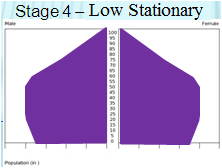
- Stage 4 is Low Stationary- the birth rate declines as women are equal and empowered, and everyone is educated enough to make their own decisions, paired with a more work-based society. The death rate levels off as technological advances in medicine become a lot more difficult (still waiting on the cure for cancer...) and it can't go much further down. The USA, France and UK are in this stage. The total population begins to stay constant.
- Stage 5 is Decline, which is more hypothetical than the other stages but is happening in some countries like Germany. The birth rate dips below the death rate, as few people want to have children. The population becomes a lot more elderly. Natural decrease means that the total population starts decreasing.
- Stage 4 is Low Stationary- the birth rate declines as women are equal and empowered, and everyone is educated enough to make their own decisions, paired with a more work-based society. The death rate levels off as technological advances in medicine become a lot more difficult (still waiting on the cure for cancer...) and it can't go much further down. The USA, France and UK are in this stage. The total population begins to stay constant.
- Stage 3 is Late Expanding- the birth rate drops suddenly, due to less children being needed in industry, and the emancipation of women, and the death rate slowly declines, due to increasingly good conditions which are available to more and more people as people gain equality. Brazil is in this stage. The population is still rising.
- Stage 2 is Early Expanding- there are still plenty of people being born, as they need farmers, but less are dying, due to drinking water improvements and basic hospitals. Some LEDCs are in this zone, such as Egypt, Kenya and India.. The population begins rising due to natural increase.
- Germany has a birthrate of 8.42 per 1000 people, and a deathrate of 11.29 per 1000 people.
- America has a birthrate of 13.2 per 1000 people and a deathrate of 8.4 per 1000 people.
- Kenya has a birthrate of 34.9 per 1000 people and a deathrate of 8.3 per 1000 people.
- The Baka Tribe has a birthrate of 43 per 1000 people and a deathrate of 41 per 1000 people.
- Vietnam has a birthrate of 15.5 per 1000 people and a deathrate of 5.8 per 1000 people.
- Holy hell, you CAN get images on this.
Population Pyramid
- The population structure means how the population is spread out across genders and ages to form one overall structure, showing how the population is made up.
- There are different types of population pyramids depending on the country's stage in the DTM, right and down a bit.
- The birth rate and death rate are high, so the base is wide, and the pyramid is steep.
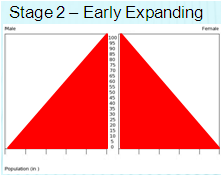
- The birth rate is still high while the death rate is decreasing, so the base is still wide and the pyramid is less steep.
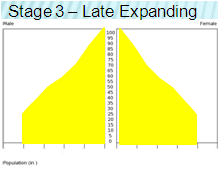
- The birth rate is decreasing and the deathrate is decreasing, so the base is thinner and the pyramid is less steep.
- The birth rate and death rate have levelled off, so the pyramid is more like a rectangle near the middle.
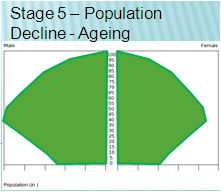
- There are more people dying than being born, so the upper part of the pyramid is wider than the lower part. The top is also less steep, meaning people are living longer.
Kerala, India
- Kerala was one of the first areas in a developing country to launch a national family planning program, which changed how they managed contraception and made social changes.
- Kerala has-
- Improved education for both sexes, so women are not forced into becoming housewives.
- Provided adult literacy classes, aiding them in getting jobs and therefore earning money.
- Educated people to understand how a smaller family is better than a bigger one.
- Reduced infant mortality through new and improved hospitals and hospital staff, so that adults do not need to have more children as 'backup' for the ones they may lose through illness.
- Socially, this has-
- Meant that there are more jobs to go around and better living conditions due to having less people to provide to.
- Increased education is literacy, maths, languages etc for children as they can now be lavished more, so they can support their families when they grow up.
- Meant that there are more jobs to go around and better living conditions due to having less people to provide to.
- Economically, this has-
- Resulted in a higher GDP than other Indian states, so Kerala can now afford more construction projects, technology, and public services.
- Politically, this has-
- Been the result of socialist/communist parties who focus on smaller families by creating social changes, showing how their system does work and so advocating them being elected in other areas of India.
- Kerala has-
- Kerala was one of the first areas in a developing country to launch a national family planning program, which changed how they managed contraception and made social changes.
China's One Child Policy
- The one child policy was introduced in 1978-1980, and was generally strictly enforced. Some people were allowed to have two children if the first child was a girl. The purpose of the policy was to halve the population growth- 1 child per 2 people.
- Some people sought to have twins through medicine as twins were allowed in the policy.
- This policy creates the 4:2:1 problem, where 1 person has to support 4 grandparents and their own parents. The policy was changed so that only-childs could then have two children to prevent this problem.
- If you broke the policy, you could be forced to have an abortion and be fined. The second child would be near-ostracized from society, if you didn't have an abortion.
- China has previously suffered from famines as there isn't enough food or farmers for the people living in the cities. This policy hoped to reduce that problem, making China more sustainable.
- Chinese pollution has been criticized due to how many people live in the cities and drive cars and produce pollution- Beijing's smog is infamous. This policy hoped to reduce the population growth and therefore reduce the growing amount of pollution produced by cities.
- China says that 400 million babies were never born due to this policy, but demographers are skeptical of this number.
- The birthrate went down to 1.8 from 2.1 in this time. This has dramatically affected the world's population- it could have potentially been much higher, if China's statistics are genuine.
- There is a gender imbalance in China, as girls are more aborted than boys- on Hainan Island, for example, there are 133 males for every 100 females.
- This policy also led to Little Emperor Syndrome, where the children were spoilt and selfish due to not having to share with siblings.
- There are fewer workers in China, meaning less economic development.
- The government is increasingly having to pay for the elderly as the single children cannot support them, which means China is only getting poorer.
- The one child policy was introduced in 1978-1980, and was generally strictly enforced. Some people were allowed to have two children if the first child was a girl. The purpose of the policy was to halve the population growth- 1 child per 2 people.
UK's Ageing Population
- More and more people are living to retirement age. Couple this with a declining birth rate, and the UK is beginning to have a problem.
- The dependency ratio is the number of dependents divided by the number of economically active people- the lower, the better. The ratio is increasing as more people become elderly and less people are born.
- In 1908, when pensions started, the life expectancy was 67. Now, it's 80.
- There's an increased demand on healthcare as illnesses associated with age become more frequent. GPs and surgeries are stretched further as elderly needs become more complex.
- Younger retired people now tend to have more disposable income (the "grey pound" is worth over £100 billion annually) to spend on holidays or their children and grandchildren, helping them.
- Hsopitals have to provide more beds to deal with illnesses like winter flu that mostly happen in older age groups. They need nursing homes and hospitals to support them, costing money.
- There are more people who have retired than under 16s.
- Older people tend to continue working much later in life, meaning they pay national insurance and tax.
- Older people tend to be more experienced workers, so some companies seek them out, making them economically active once more.
- Older people spend more money on leisure activities and create jobs for people in these sectors. Nursing homes employ hundreds of thousands of people, meaning that taking care of old people is profitable
- The oldest people often have little disposable income left from retirement, meaning they need pensions and so are a drain on the economy.
- There are four strategies that Britain can use to manage its ageing population.
- Raising the retirement age- from 65 to 68- would mean that old people would have to work longer, so there will be more people paying tax and fewer people claiming pensions.
- Encouraging the immigration of young people to the UK means that they can work and pay taxes which helps to pay for the pensions and services.
- Encouraging women to have more children using 'working family tax credits' would make it more affordable to have children and mean that more people go back to work after they have children, paying off taxes.
- Encouraging people to take out private pensions mean that they won't be as dependent on the state pension.
- More and more people are living to retirement age. Couple this with a declining birth rate, and the UK is beginning to have a problem.
Migration Within the EU
- Forced Migration is where a migrant moves because they have no choice. It's either there or death (wars, draughts, threats)
- Voluntary Migration is when a migrant could stay there but choose not to. They are weighing the pros and cons and making a decision.
- Economic Migration is when a Voluntary Migrant moves because they can earn more money for their family by moving.
- A push factor is a negative reason to leave your country.
- Work in Slovakia is poorly paid, and hard to find.
- Education is poor in Eastern Europe.
- The quality of life is much lower- people have less leisure time and have less healthcare.
- Education is poor in Eastern Europe.
- Work in Slovakia is poorly paid, and hard to find.
- A pull factor is a positive reason to enter another country.
- There are many low-skill jobs available in the UK which are unfilled by us citizens.
- Money earnt here is worth a lot in the Czech Republic, so people can provide for their families.
- There are better facilities here, such as the NHS, and there is better housing and more leisure time.
- Money earnt here is worth a lot in the Czech Republic, so people can provide for their families.
- There are many low-skill jobs available in the UK which are unfilled by us citizens.
- In 2004, the EU grew to 27 member states. Between 2004-6, the Uk received over 600,000 legal immigrants from Eastern Europe.
- UK Benefits
- Migrants pay taxes and national insurance, helping our economy.
- They take up jobs that us citizens wouldn't want to take.
- They bring their culture, goods and celebrations along with them.
- They take up jobs that us citizens wouldn't want to take.
- Migrants pay taxes and national insurance, helping our economy.
- UK Drawbacks
- Some migrants work in worse conditions than us citizens.
- There is a strain on education, as there are more children and the number of teachers isn't increasing as quickly.
- Fear, resentment and racism spring from the attitudes of the locals, making the country more filled with hatred.
- There is a strain on education, as there are more children and the number of teachers isn't increasing as quickly.
- Some migrants work in worse conditions than us citizens.
- Country of Origin Benefits
- Money is sent back by the immigrants, making the country wealthier.
- There is less strain on the services in that country, and more opportunities for employment, as people are leaving.
- Money is sent back by the immigrants, making the country wealthier.
- Country of Origin Drawbacks
- There is a lack of workers who can train the younger people and have the skills needed, especially in high-skill jobs like being a doctor or engineer.
- There is an ageing population as the young people are all leaving, meaning more pensions need to be provided by the government.
- There is a lack of workers who can train the younger people and have the skills needed, especially in high-skill jobs like being a doctor or engineer.
Migration Into the EU
- A refugee is somebody who is forced to migrate and seeks refuge in another country.
- An asylum seeker is a refugee who wishes to migrate permanently. They don't return to their home country.
- Sweden is suffering the impacts of having refugees in the country.
- Social impacts
- More than 125,000 Iraqis now live in Sweden. There are less resources than ever for each newcomer.
- The Iraqis aren't hired as the business owners discriminate against them. Some residents don't want to put their children in schools with Iraqi children. As they don't speak the language, there is tension and fear from both groups.
- Political impacts
- An EU meeting wanted other EU countries to help with the situation, as Sweden was the only country making any sizable dent in the number of refugees.
- The citizens are becoming less and less in favour of the government as they don't like the sheer number of refugees coming in.
- Sweden now looks generous and caring on the world stage, but equally it has come under criticism and may make other countries more hesitant to take in migrants as the impacts are so large.
- Economic impacts
- There is financial strain as benefits are needed for the Iraqis who cannot find work.
- The unemployment issue is wasting the talent of young, capable workers.
- Social impacts
Imagens e arquivos do mapa
Informações
- Descrição
- Mapa Mental sobre Population Change, criado por Liam W em 04-06-2016.
- Criado por
- Liam W
- Visualizações
- 7
- Avaliação