
Mapa mental
Unit 1.4 Paper Chromatography by visva
Conteúdo do mapa
Unit 1.4 Paper Chromatography by visva
Chromatography is used to identify substances in a mixture/sample
Chromatography Using Filter Paper
- What Does it Do?
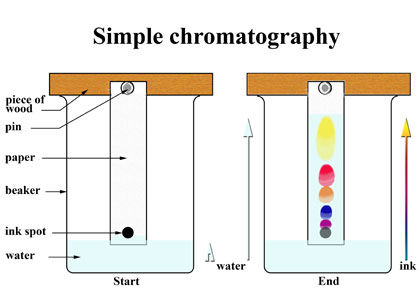
- Chromatography using filter paper is used of commonly separating out substances in a sample, commonly artificial colourings. Eg. a food colouring might contain one dye or a mixture of dyes. Chromatography will help separate out these dyes
- How Does it Work?
- 1) A pencil baseline is drawn onto a strip of filter paper with a drop of food colouring (or choice of sample) placed upon this baseline
- 2) The filter paper is then rolled up and placed in a beaker with the water of solvent of choice only just touching the filter paper. The baseline is to be kept above the water level
- 3) The solvent will then seep up the filter paper, bypassing the baseline and taking the dyes from the baseline with it
- 4) The mixture of dyes will then begin to separate due to the different dyes absorbing into the filter paper at different rates (heights on the filter paper)
- 5) The filter paper is then known as a "chromatogram" and displays the different dyes on it due to the different colours at varying heights up the filter paper
- 6) A chromatogram with 4 spots means AT LEAST 4 different dyes, not EXACTLY 4 different dyes due to there being the possibility of multiple dyes absorbing in the same place
- 5) The filter paper is then known as a "chromatogram" and displays the different dyes on it due to the different colours at varying heights up the filter paper
- 4) The mixture of dyes will then begin to separate due to the different dyes absorbing into the filter paper at different rates (heights on the filter paper)
- 3) The solvent will then seep up the filter paper, bypassing the baseline and taking the dyes from the baseline with it
- 2) The filter paper is then rolled up and placed in a beaker with the water of solvent of choice only just touching the filter paper. The baseline is to be kept above the water level
- How to Work Out the "Rf" Value for Each Chemical (Substance)
- Rf= Distance Travelled By Substance (Eg. Food Colouring) ÷ Distance Travelled by Solvent (eg. Water)
- 1) A pencil baseline is drawn onto a strip of filter paper with a drop of food colouring (or choice of sample) placed upon this baseline
- What Does it Do?
Imagens e arquivos do mapa
Informações
- Descrição
- IGCSE Chemistry (Unit 1 Particles and Purifications) Mapa Mental sobre Unit 1.4 Paper Chromatography by visva, criado por Visvamitra Ravindran em 05-09-2016.
- Criado por
- Visvamitra Ravindran
- Visualizações
- 2
- Histórico
-
- Criado por Tom Johnson · 9 fev 2015
- Copiado por Visvamitra Ravindran · 5 set 2016
- Avaliação